Bringing your dog on public transport in Portugal: Muzzles and half-tickets
Disclosure: This article contains affiliate links. If you buy through them, we may earn a commission at no extra cost to you. Read our full disclosure.
You’ve got a dog, a train to catch at Lisbon’s Cais do Sodré, and a ticket inspector looking at your dog’s bare snout. Do you need a muzzle? A ticket for the dog? Can you even board? This guide explains how dog travel works on Portuguese trains, metros, buses, trams and ferries, so you can travel calmly and avoid fines.
How Dog Travel Works on Portuguese Public Transport
My first attempt to take my terrier on a regional train out of Lisbon was a mess. I had a leash, a water bottle and no muzzle. The conductor was polite but firm. Either the dog went in a carrier, or the muzzle came out. I had neither, so we got off at the next station and walked home along the coast.
Most of the confusion goes away once you understand one principle. Portuguese operators sort dogs into two groups: dogs inside a closed carrier, and dogs outside one. Nearly every rule follows from that split.
The Carrier Rule
A small dog inside a closed, ventilated carrier is usually treated like hand luggage. On most networks this is the easiest way to travel. The carrier generally has to fit on your lap or at your feet. It must not take up a seat that a paying passenger could use, and it must not block the aisle.
Picture a Saturday morning on a crowded Linha de Sintra train. You have a soft-sided carrier holding a dachshund, and you have it tucked under your seat. Nobody gives you a second look. Now picture the same dachshund on a leash, sniffing other passengers’ shoes. That dog is in the second group, and stricter conditions apply.
Dogs Outside a Carrier
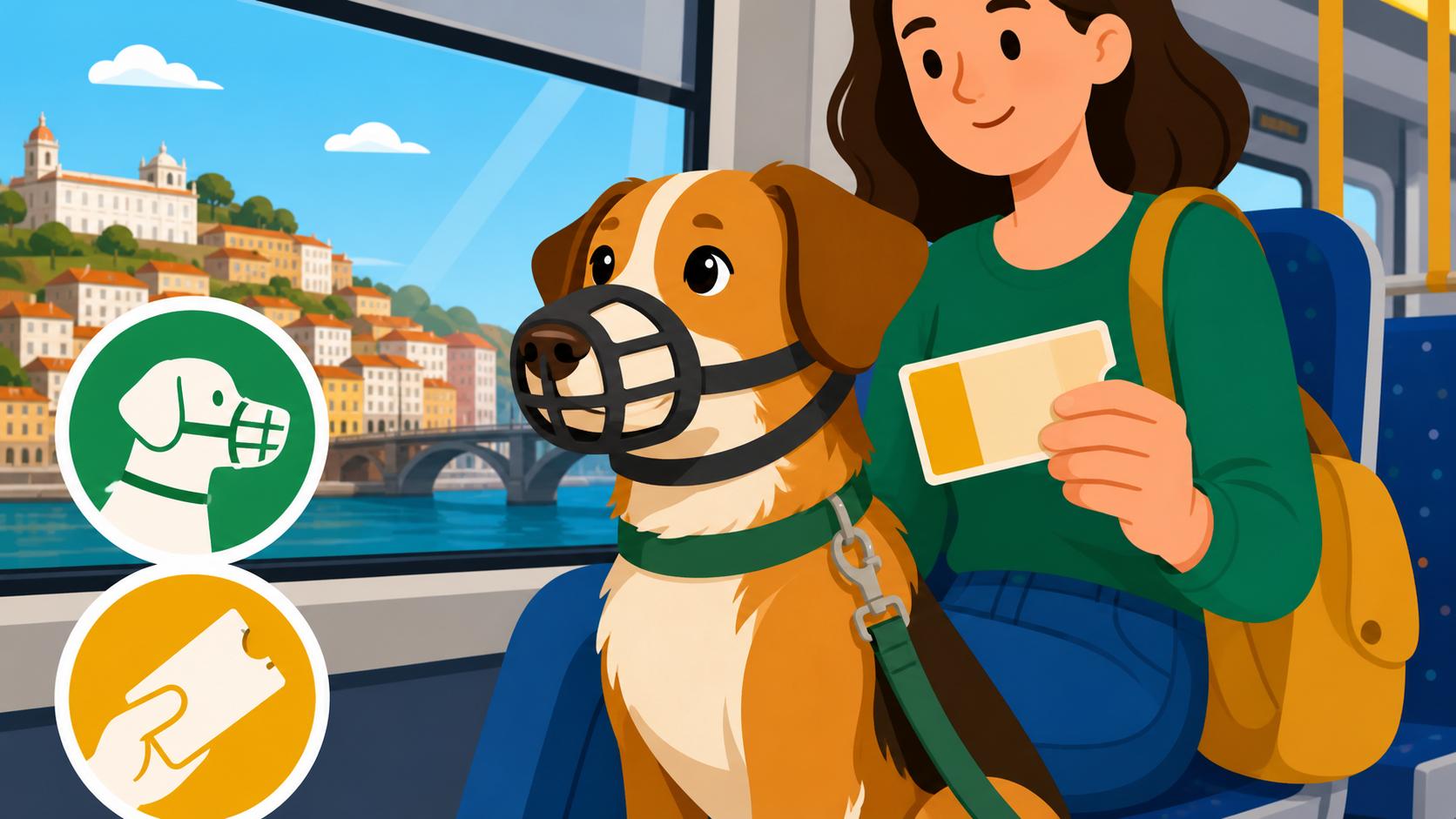
Medium and large dogs travelling outside a carrier are where muzzles and tickets come in. Where operators allow these dogs at all, they normally require:
- A muzzle fitted for the whole journey.
- A short leash held by the owner at all times.
- No more than one dog per passenger in most cases.
- A dog that does not occupy a seat.
On some services, especially longer-distance trains, a dog travelling outside a carrier also needs its own ticket. This is often called a half-ticket or reduced fare. The exact conditions, and whether a ticket is needed at all, depend on the operator and the type of service. Always read the operator’s current regulations before you travel.
Assistance Dogs Are a Separate Category
Guide dogs and other assistance dogs have a legal right to accompany their handlers on public transport in Portugal. They generally do not need a carrier or a separate ticket. Handlers should carry the dog’s identification and any accreditation documents. Staff sometimes ask for them, especially on less-travelled regional lines.
Operator-by-Operator Breakdown
Every operator writes its own rulebook, which is a big part of the frustration. What is fine on the Lisbon Metro may get you stopped on an intercity bus. For a broader picture of each network, see How to Use Public Transport in Lisbon and Porto.
Trains with Comboios de Portugal
CP runs everything from suburban Lisbon and Porto lines to the Alfa Pendular and Intercidades. In general:
- Small pets in carriers travel as hand luggage.
- Dogs outside a carrier must be muzzled and leashed, and they may need their own ticket.
On long-distance trains with reserved seating, the dog still cannot take a seat. It has to settle at your feet.
If you book online, look for a dog or pet option during checkout rather than trying to sort it out on board. Buying train tickets online with Comboios de Portugal (CP) app walks through the booking screens. If you want the bigger picture on routes and passes, Using Comboios de Portugal (CP) Trains and the Navegante Pass covers that.
I recommend avoiding rush hour on suburban lines whenever you can. A muzzled Labrador on the Cascais line at 8:30 on a weekday morning is technically within the rules. Practically, it’s misery for you, the dog and everyone squeezed around you.
Lisbon Metro, Buses and Trams
In Lisbon, the Metro and Carris, which runs the buses, trams and city elevators, have both opened up to dogs over the years. Carriers are universally accepted. Leashed, muzzled dogs are allowed under conditions that can include limits on numbers and on crowded times.
Escalators are the big practical issue in the Metro. Many dogs panic on them, and paws can get caught. Use the lifts at stations like Baixa-Chiado or Marquês de Pombal, or carry a small dog.
Trams are another story. Tram 28 is packed with tourists and has very little floor space. Even when a dog is allowed, it’s often a poor choice. Getting Around Lisbon: Metro, Trams, and the Famous 28 helps you plan routes that avoid the worst crowds.
Porto Metro, STCP Buses and Ferries
Porto’s Metro and STCP buses follow the same broad pattern: carriers for small animals, and muzzle-plus-leash conditions for larger dogs where these are permitted. Check that your Andante card or ticket is validated for yourself. If your dog needs a ticket, validate that too. Inspectors in Porto are thorough. Using the Andante card in Porto: Zones, top-ups, and ticket validation fines explains validation in detail.
Lisbon’s river ferries are often the most dog-friendly option in the region. The crossings to Cacilhas, Seixal, Montijo and Barreiro are short, and the boats have open deck space. A muzzle and leash are typically expected for dogs outside a carrier. Check the operator’s rules for the specific route. Taking the ferry in Lisbon: Cacilhas, Trafaria, and Barreiro routes covers the crossings themselves.
Comparison Table of Typical Conditions
| Transport type | Small dog in carrier | Dog outside carrier | Ticket for the dog | Practical tip |
|---|---|---|---|---|
| CP suburban trains | Usually accepted as hand luggage | Muzzle and short leash required | May be required, check CP rules | Avoid weekday peak hours |
| CP long-distance trains | Usually accepted as hand luggage | Muzzle and short leash required, dog stays off seats | Often required, sometimes a reduced or half fare | Book the dog option when buying online |
| Lisbon Metro | Accepted | Allowed with muzzle and leash, subject to limits | Check Metro rules | Use lifts, not escalators |
| Carris buses and trams | Accepted | Allowed with muzzle and leash, subject to limits | Check Carris rules | Skip Tram 28 with larger dogs |
| Porto Metro and STCP | Accepted | Conditions set by each operator | Check operator rules | Validate every ticket you hold |
| Tagus ferries | Usually accepted | Usually allowed with muzzle and leash | Check route rules | Stay on open deck if your dog gets anxious |
| Intercity coaches | Varies by company | Often restricted | Varies | Confirm before booking |
| Assistance dogs | Not needed | Legally allowed with handler | Generally not required | Carry accreditation |
Muzzles, Carriers and Gear That Actually Work
The kit matters more than most people expect. A muzzle that rubs or a carrier that collapses turns a short trip into a fight.
Choosing the Right Muzzle
Pick a basket muzzle over a tight fabric one. A basket muzzle lets your dog pant, drink small sips of water and take treats. That matters a lot in a hot carriage in July. Fabric muzzles that hold the mouth closed are meant for very short handling moments, not a long train ride to Coimbra.
Fit is everything. You should be able to slide a finger between the strap and the dog’s head. There should be room for your dog to open its mouth to pant. Measure snout length and circumference before buying.
Pet shops in Portugal sell muzzles. Many expats order a wider range of sizes from Amazon Spain, which ships to mainland Portugal and stocks basket muzzles for awkward snout shapes like those of greyhounds and bulldogs.
Training Your Dog to Accept the Muzzle
Don’t put a muzzle on for the first time at the station. Introduce it at home over a week or two:
- Let your dog sniff the muzzle, then reward with a treat.
- Put a treat inside the basket so your dog pushes its nose in voluntarily.
- Fasten the strap for a few seconds, reward, then remove it.
- Build up gradually to several minutes while you walk around the house.
- Practise outdoors on a normal walk before your first trip on transport.
- Do a short test ride, such as one or two Metro stops, before attempting a long train journey.
Carriers and Travel Essentials
For small dogs, choose a carrier with a rigid base, good ventilation on several sides and a secure zip. Soft carriers are easier to fit at your feet on crowded trains.
Pack a small travel kit:
- A collapsible water bowl
- Poo bags
- A towel for wet paws after a rainy Porto walk
- A copy of your dog’s vaccination record
When you first arrive in the country, a working data connection makes it far easier to check operator rules and live departures at the station. Some newcomers use an Airalo eSIM for those first days. Best unlimited data eSIMs for digital nomads arriving in Portugal compares the options.
Step-by-Step Plan for Your First Trip
Here is the routine I follow every time I travel with my dog. After a few weeks, it becomes second nature.
Before You Leave Home
- Check the operator’s official regulations for your route and type of service.
- Decide whether your dog travels in a carrier or on a leash with a muzzle.
- If a ticket is needed for the dog, buy it in advance or know how to buy it at the station.
- Pack the muzzle, a short leash, water and waste bags.
- Walk your dog well beforehand so it is calmer on board.
- Choose an off-peak departure whenever you can.
Paperwork and Health Basics
Your dog must be microchipped and registered in Portugal. Rabies vaccination is also part of the legal requirements. Inspectors rarely ask for documents on a routine trip, but having vaccination records on your phone saves trouble if there’s ever a dispute. If you are still moving your dog into the country, Bringing Pets to Portugal: Microchips, Rabies Vaccines, and EU Pet Passports covers the entry rules. Flying in with your dog is covered in Bringing a dog to Portugal: TAP Air Portugal pet policy and cabin weight limits.
Once you’ve settled in, register with a local vet early. They can update records and advise on travel sickness if your dog gets queasy on trains. How to Find a Veterinarian in Portugal for Your Pet shows you how to find one.
On Board and If Things Go Wrong
Once you’re on board:
- Sit near the doors or in an end-of-carriage space where your dog has room.
- Keep the leash short.
- Keep the dog off seats.
- Clean up immediately if there is any accident.
Staff have discretion. A barking or lunging dog can be asked to leave even when every rule has been followed.
If you think you were treated unfairly, ask politely for the specific rule being applied, and stay calm. Arguing on a moving train rarely helps. You can file a formal complaint afterwards in the operator’s complaints book. What is the ‘Livro de Reclamações’ and how does it solve consumer disputes? explains how that process works.
When Public Transport Is Not the Best Option
Sometimes trains and buses just don’t suit a particular dog: one that’s very large, very anxious or reactive.
Ride-Hailing and Taxis
Bolt and Uber both operate in Lisbon, Porto and the Algarve. Whether a driver will accept a dog is often up to the driver. Message the driver right after booking to confirm, and have a towel ready to protect the seats. Taxis work the same way: ask before you get in. Using Bolt vs Uber in Portugal: Which ride-hailing app is cheaper? compares the two apps.
Choosing a Home That Makes Dog Life Easier
Living within walking distance of parks, beaches and a dog-friendly ferry or train line makes everyday life much easier. When you search for housing, check whether the landlord accepts pets. Platforms such as Uniplaces let you filter listings, which helps for mid-term stays while you get your bearings. How to Find Pet-Friendly Rentals in Portugal covers the longer-term search.
Many expats find that once they have the right gear and a calm routine, getting around Portugal with a dog is easier than in their home country. Carry the muzzle, check the operator’s rules, travel off-peak, and you’ll rarely have trouble.
Disclaimer
This article is for general informational purposes only and does not constitute professional advice. Laws, prices and regulations vary by location and change over time. Consult a qualified professional for guidance on your specific situation.