How to Experience Carnival in Portugal
Disclosure: This article contains affiliate links. If you buy through them, we may earn a commission at no extra cost to you. Read our full disclosure.
Every February, newcomers to Portugal hear that “Carnaval is huge here,” then end up in a quiet Lisbon street wondering where the party went. The best Portuguese Carnival happens in specific towns, on specific days, and some of it is wild and centuries old. This guide covers where to go, when the 2027 dates fall, how to get there, and what to expect.
When Carnival Happens in Portugal and How the Calendar Works
The first time I tried to “do” Carnival here, I made the classic mistake of assuming it was a fixed date, like Christmas. It isn’t. Carnival in Portugal, also called Entrudo in the older rural traditions, is tied to the Catholic calendar. It is the last blowout before Lent, so it always ends on the Tuesday before Ash Wednesday. Because Easter moves every year, Carnival moves with it.
The 2027 Carnival Dates You Need to Know
For 2027, the Church calendar puts Ash Wednesday on 10 February and Easter Sunday on 28 March. That makes Carnival Tuesday, the big day known as Terça-feira de Carnaval or Shrove Tuesday, fall on 9 February 2027.
In practice, the festivities stretch across a long weekend and often well beyond it. Here is how the core days usually line up for 2027:
- Thursday 4 February and the Thursdays before it: the old “Quinta-feira de Compadres” and “Comadres” traditions in some northern and inland villages, where men and women playfully mock each other.
- Friday 5 February: school children’s parades in towns and villages across the country.
- Saturday 6 February: many of the big night parades and the main parade in Funchal, Madeira.
- Sunday 7 February: major daytime processions in Torres Vedras, Ovar, Loulé and elsewhere.
- Monday 8 February: night parties, satirical events and more parades in some towns.
- Tuesday 9 February: the grand finale almost everywhere, with the burning of effigies in the traditional villages.
- Wednesday 10 February: Ash Wednesday, when the party is officially over.
If you want the bigger picture of how Carnival fits around the rest of the festival year, see Portugal’s Biggest Festivals: A Year-Round Calendar.
Is Carnival Tuesday a Public Holiday?
This is where it gets very Portuguese. Carnival Tuesday is not one of the fixed national public holidays. However, the government frequently grants a “tolerância de ponto,” a discretionary day off for public sector workers. On top of that, many municipalities, especially Carnival towns like Torres Vedras and Ovar, give their own local day off. Banks, private businesses and shops make their own choices.
In my first year, I turned up at a Finanças office on Carnival Tuesday and found it closed. In my second year, a different office in a different town was open as usual. The lesson is to assume nothing. If you have an appointment, a bank visit or a pharmacy run planned for that week, check with the specific office or business beforehand. Schools often break for a few days around Carnival too, which means families travel and accommodation fills up. For more on how this kind of thing affects trips, see How to Plan Travel Around Portuguese Holidays.
What February Weather Means for Your Plans
Nobody warns you that Portuguese Carnival is a winter festival. Brazil gets sunshine; Portugal gets drizzle, wind, and the occasional glorious blue-sky afternoon that makes you forget the rest. Inland Trás-os-Montes, where the masked village traditions live, can be properly cold, with frosty mornings and icy nights by the bonfires.
Plan your costume around layers. The seasoned locals in Ovar and Torres Vedras wear thermals under sequins. Bring a compact rain jacket, waterproof shoes, and something warm for the long wait before a night parade. Parades are rarely cancelled for light rain, but heavy storms can lead to postponements, so follow the municipality’s official social media pages in the days before. For a broader sense of what to pack, see What’s the Weather Like in Portugal in Winter?.
The Best Places to Experience Carnival in Portugal
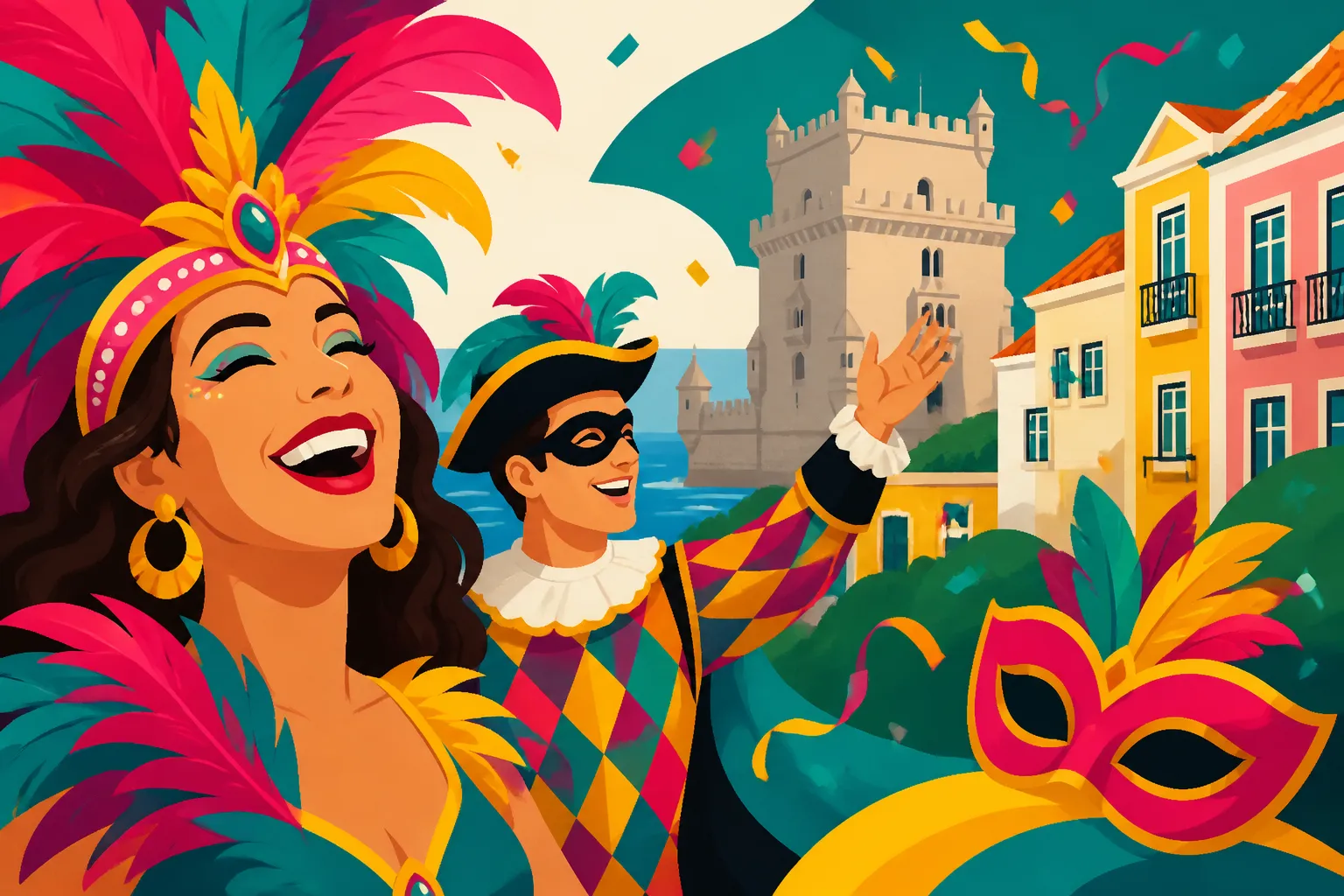
Portugal really has two Carnivals. One is the big, loud, parade-and-costume version, with floats, samba schools and satirical political puppets. The other is the ancient rural Entrudo of the northeast, with masked figures, cowbells and fire, which feels almost pagan. The richest experience usually comes from tasting both.
Torres Vedras: The Most Portuguese Carnival
Torres Vedras, in the Oeste region north of Lisbon, proudly calls its celebration “o Carnaval mais português de Portugal,” the most Portuguese Carnival in Portugal. It earns the title because it deliberately avoids the Brazilian samba model and leans into homegrown satire.
The signature sight is the “matrafonas,” men dressed as deliberately unconvincing women, with smudged lipstick, wigs, padded bras and hairy legs. Thousands of them roam the streets. Alongside them come the “cabeçudos,” figures with enormous papier-mâché heads, and floats that skewer politicians, footballers and whatever national scandal has dominated the news that year. Each year a pair of “Reis do Carnaval,” the Carnival Kings, presides over everything, and yes, the “queen” is traditionally played by a man.
The first time I went, a friend and I arrived on the Sunday in borrowed costumes and were adopted by a group of retired teachers from Lourinhã dressed as nuns. That is Torres Vedras in a sentence. It is crowded, boozy, good-natured and surprisingly family-friendly during the daytime. Nights get louder and younger. The town fills up fast, so many people stay in Lisbon or nearby coastal spots like Santa Cruz and come in for the day.
Ovar and Loulé: Big Parades North and South
Ovar, south of Porto, is the heavyweight parade Carnival of the north. It is more spectacle-driven than Torres Vedras, with large organised groups, samba schools, elaborate costumes and big themed floats. Groups rehearse for months, and the competitive spirit is real. The Sunday and Tuesday processions are the headline events, and there is a famous big night-time party during the long weekend that draws a huge young crowd from all over the region.
Ovar is very easy to reach by train from Porto, which makes it ideal if you are based in the north. Nearby Estarreja and Mealhada also host lively parades, with Mealhada known for its samba groups and its roast suckling pig, which is reason enough to go.
Down south, Loulé in the Algarve runs one of the oldest organised Carnival parades in the country. It has a slightly gentler, Mediterranean feel, with satirical floats, schools and local associations, and a carnival atmosphere that fits the Algarve’s relaxed winter pace. For expats living on the coast, Loulé is the easy win. If you are combining it with a wider trip south, see The Algarve for Travelers: Beaches, Towns, and Cliffs.
Podence and Lazarim: The Ancient Masked Traditions
If you only see one Carnival in your life here, I would quietly push you toward the villages. In Podence, a tiny village near Macedo de Cavaleiros in Trás-os-Montes, the “Entrudo Chocalheiro” is the real thing. The “Caretos” wear hand-made fringed suits in red, green and yellow, tin or leather masks, and belts heavy with cowbells. They run, leap and clatter through the lanes, chasing people, especially young women, and shaking their bells at them in a ritual of fertility and mischief. This tradition is recognised by UNESCO as Intangible Cultural Heritage, and the whole region feels the pride.
A word of honest warning: you will be chased, and you may be grabbed and “chocalhado,” bumped with the bells. It is playful, not aggressive, and the Caretos are generally respectful with children and visitors, but it is physical and noisy. Wear clothes you do not mind getting muddy.
Lazarim, near Lamego in the Douro region, is famous for its hand-carved wooden masks, made from alder wood by local artisans. On Carnival Tuesday, the village reads out the satirical “testamentos” of the “compadre” and “comadre,” mock wills that roast local residents, before effigies are burned in the square. Many of the locals around you will be sharing jokes you cannot follow, but the atmosphere of a small community laughing at itself is unforgettable. If you want to keep exploring the region afterwards, see Northern Portugal: Porto, the Douro, and the Minho.
Madeira: The Island Carnival
Funchal, Madeira’s capital, offers the most Brazilian-flavoured Carnival in Portuguese territory. The main allegorical parade takes place on the Saturday night, with feathers, sequins, floats and dance troupes filling the seafront avenues. On Tuesday afternoon, the “Cortejo Trapalhão” takes over, a chaotic comic parade where anyone can join in with homemade costumes and political jokes.
Madeirans also eat “malassadas,” fried sugared dough, on Fat Tuesday, which locals take very seriously. Combining Carnival with a few days of hiking is one of the best February trips you can make from the mainland. For planning beyond the parade, see Madeira for Travelers: Levadas, Funchal, and Peaks.
Comparing the Main Carnival Destinations
| Destination | Region | Style | Best Days to Go | Getting There | Best For |
|---|---|---|---|---|---|
| Torres Vedras | Oeste, north of Lisbon | Satirical, homegrown, cross-dressing matrafonas | Sunday and Tuesday | Express bus or train from Lisbon | Day trippers from Lisbon, groups of friends |
| Ovar | Aveiro district, south of Porto | Large organised parades, samba groups | Sunday, Tuesday and the big night party | Urban train from Porto | People based in the north, spectacle lovers |
| Loulé | Algarve | Traditional parade, relaxed atmosphere | Sunday to Tuesday | Bus or car from Faro | Algarve residents, families |
| Podence | Trás-os-Montes | Ancient masked Caretos with cowbells | Sunday to Tuesday | Car, or long-distance bus to Macedo de Cavaleiros | Culture lovers, photographers |
| Lazarim | Near Lamego, Douro | Carved wooden masks, mock wills, effigy burning | Tuesday | Car from Lamego or Porto | Rural tradition seekers |
| Funchal | Madeira | Brazilian-style night parade, comic street parade | Saturday night and Tuesday afternoon | Flight to Madeira | Combining Carnival with a short island break |
How to Plan Your Carnival Trip Step by Step
The difference between a brilliant Carnival weekend and a miserable one is almost entirely logistics. Towns that normally have a few thousand people suddenly host crowds many times their size, and the infrastructure does not always keep up.
Booking Accommodation Before It Disappears
Torres Vedras, Ovar, Podence and Lazarim have limited beds, and locals and returning emigrants snap them up early. In Podence, rooms within walking distance are scarce, so many visitors stay in Macedo de Cavaleiros or Bragança and drive in. For Lazarim, Lamego is the logical base.
I usually start looking on Booking.com in the autumn, filtering by the base towns rather than the Carnival village itself, and I always choose free-cancellation options so I can adjust once the official programme comes out. Prices around Carnival weekend rise noticeably in the hotspot towns, so check the property’s own page for current rates and compare a few nearby towns before committing. If you leave it late anyway, see How to Find Last-Minute Accommodation in Portugal.
Getting There Without a Car
Public transport is perfectly workable for the bigger Carnivals, as long as you plan your return journey with the same care as the outbound trip.
- Decide on your base city. Lisbon works for Torres Vedras, Porto works for Ovar, Faro works for Loulé.
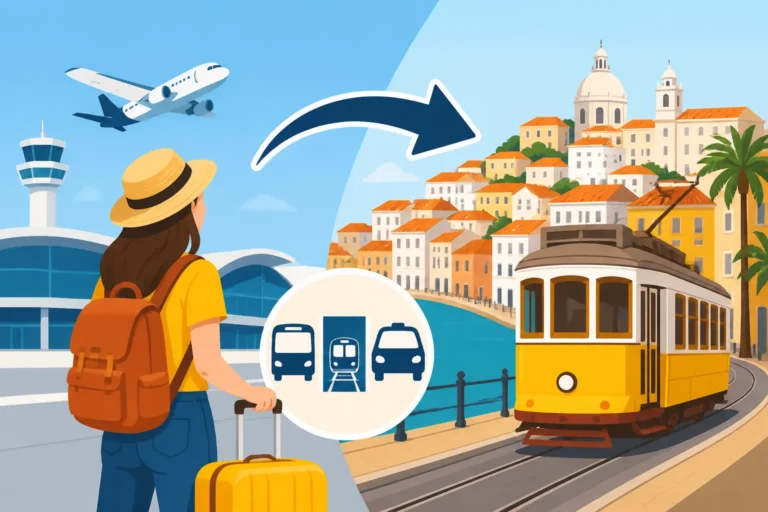
- Compare train and bus options. For Torres Vedras, the express buses from Lisbon’s Campo Grande terminal are usually quicker than the slow Oeste line train. For Ovar, the urban trains on the Porto to Aveiro line stop right in town. I often use Omio to compare train and bus times side by side for the same route, then double-check the timetable on the operator’s own website.
- Check for reinforced services. CP and some bus operators sometimes add extra services on Carnival days, but this is announced close to the date, so check the operator’s official channels in the week before.
- Book your return seat early. The last buses out of Torres Vedras on Carnival Tuesday evening can fill up completely.
- Have a backup plan. Know where the nearest taxi rank is, and keep ride-hailing apps installed, though expect surge pricing and long waits after the parades end.
For the rail side of things in more detail, see Trains in Portugal: CP Routes, Alfa Pendular, and Booking.
For Podence and Lazarim, a car is honestly the easiest option. Rede Expressos runs long-distance buses into Macedo de Cavaleiros and Lamego, but the final stretch to the villages on festival days usually means a taxi or a lift. Some years, organised day tours run from Porto to the northeastern Carnivals, and GetYourGuide is one of the places worth checking for these, which saves you the winter mountain driving.
A Sample 2027 Carnival Long Weekend
If you want to experience both sides of Portuguese Carnival in one trip, this is the route I would suggest for a mainland visitor based in Porto:
- Friday 5 February 2027: Arrive in Porto. If you are with kids, catch a local school children’s parade in the morning, which you will find in most neighbourhoods and nearby towns.
- Saturday 6 February 2027: Drive or take a bus to Macedo de Cavaleiros, check into your accommodation, and visit Podence in the afternoon as the Caretos begin to appear.
- Sunday 7 February 2027: Spend the full day in Podence for the main Entrudo Chocalheiro festivities, the music, food stalls and evening bonfires.
- Monday 8 February 2027: Drive back toward the coast, stopping in Lamego for the night.
- Tuesday 9 February 2027: Spend the afternoon and evening in Lazarim for the testamentos and effigy burning, or head back to Porto and catch the train to Ovar for the final parade.
- Wednesday 10 February 2027: Ash Wednesday. Sleep in, eat something plain, and head home.
A Lisbon-based version is simpler: Saturday night out in town, Sunday in Torres Vedras, Monday recovering on the coast, and Tuesday back in Torres Vedras for the grand finale and the “Enterro do Entrudo,” the burial of Carnival.
Costumes, Food, Safety and Local Etiquette
Once you are there, a few practical habits will make Carnival feel less like a crowded street party and more like a cultural experience you actually understand.
Finding a Costume Without Breaking the Bank
In Portugal, nobody expects you to spend a fortune. The cheerful truth is that half the country buys its wigs, masks and feather boas from the neighbourhood “loja chinesa,” the bazaar-style shops found in almost every town. Supermarkets also stock basic costume ranges in the weeks before Carnival, and party shops in Lisbon and Porto have more elaborate options.
In Torres Vedras, the homemade look is not just accepted, it is celebrated. A cheap wig, a borrowed dress, heavy makeup and a confident attitude make you a perfect matrafona. In Ovar and Madeira, costumes tend to be more polished, but spectators in casual clothes with a funny hat fit in perfectly well. In the villages of Trás-os-Montes, do not dress as a Careto yourself. Those suits and masks belong to the local tradition, and visitors simply watch and join in the fun around them.
What to Eat and Drink During Entrudo
Carnival food in Portugal is rich, heavy and designed to use up the good stuff before Lent. Look out for:
- “Sonhos” and “filhós,” fried dough pastries dusted with sugar and cinnamon, sold at stalls and bakeries.
- “Malassadas” in Madeira, eaten in enormous quantities on Fat Tuesday.
- “Cozido,” the hearty boiled meat and vegetable stew, which many families serve around Carnival, especially inland.
- Smoked sausages, “alheira” and grilled meats in Trás-os-Montes, often cooked over open fires near the festivities.
- Local wine and “jeropiga,” a sweet fortified drink, warming you up on cold northern nights.
Food stalls in the main towns are usually cash-friendly and card-friendly, but in the smaller villages, carry some cash for stalls and the local café, as card machines can struggle with the crowds or simply not exist. For an introduction to the wider food scene, see Portuguese Regional Dishes Every Visitor Should Try.
Staying Safe and Respectful in the Crowds
Carnival crowds in Portugal are generally good-humoured, but they are crowds, and the usual rules apply. Pickpockets work the densest stretches of parade routes, especially at night. Keep your phone in a zipped inner pocket, carry only the cards you need, and leave your passport at your accommodation with a photocopy on your phone. For specific techniques, see How to Avoid Pickpockets in Lisbon and Porto.
A few etiquette points that newcomers appreciate learning before they arrive:
- Expect to be sprayed with foam, hit with confetti and occasionally showered with flour or water from cheeky kids. It is part of the game, so do not wear anything precious.
- Satirical floats will mock politicians and public figures harshly. Laugh along. It is a long tradition of permitted irreverence.
- In Podence and Lazarim, you are a guest in a small community. Ask before photographing people up close outside the main festivities, do not climb on walls or property, and respect the ritual moments such as the effigy burning.
- Drinking in the street is common during Carnival in many towns, but public drunkenness that causes trouble will get you attention from the GNR or PSP police, who are very present during the big days.
- Park only in designated areas around the villages. Towing and fines are common on festival days, and blocking a farmer’s track will not make you any friends.
Carnival is also a wonderful window into how Portuguese communities celebrate together, from the Santos Populares in June to the village romarias in summer. For more on that broader picture, see Festivals, Holidays, and Traditions in Portugal. And because Carnival is the doorway into Lent, it is worth knowing what comes next on the calendar. See Easter and Holy Week (Páscoa) in Portugal for how the season unfolds after Ash Wednesday.
After several Februaries of drizzle, foam, cowbells and terrible wigs, my honest advice is this: pick one big parade and one small village, plan your transport and beds early, dress for the cold, and let yourself be silly. Portuguese Carnival rewards people who stop watching and start joining in.
Disclaimer
This article is for general informational purposes only and does not constitute professional advice. Laws, prices and regulations vary by location and change over time. Consult a qualified professional for guidance on your specific situation.