Christmas and New Year Traditions in Portugal
Disclosure: This article contains affiliate links. If you buy through them, we may earn a commission at no extra cost to you. Read our full disclosure.
When you first move to Portugal, the holiday season can feel like a beautiful but confusing maze of codfish, fried dough, and midnight bonfires. Many expats arrive expecting a carbon copy of their home traditions, only to realize that the "big day" isn't actually December 25th, and the New Year involves a very specific strategy for eating raisins. This guide helps you navigate these cultural nuances so you can celebrate like a local.
The Magic of Christmas Eve and the Consoada
In many English-speaking countries, Christmas Eve is the preamble to the main event. In Portugal, it is the main event. Known as the Consoada, this is the time when families gather for a massive late-night feast. If you are living here, you will notice that cities go quiet remarkably early on the 24th. Shops close their doors by mid-afternoon, and the streets become ghost towns as everyone retreats to their family kitchens. If you haven't stocked up on essentials by 2:00 PM, you might find yourself in a bit of a bind, as noted in our guide on Portuguese public holidays 2026: When supermarkets and banks are closed.
The atmosphere of the Consoada is deeply rooted in Catholic tradition, though it has evolved into a secular celebration for many. It is a time of immense warmth and hospitality. If you have been lucky enough to be invited to a Portuguese home for this meal, come hungry and expect to stay until the early hours of the morning. Unlike the frantic gift-opening often seen elsewhere on Christmas morning, the Portuguese typically wait until the stroke of midnight—after the meal and potentially after returning from church—to exchange presents.
The Codfish Tradition and the Simple Table
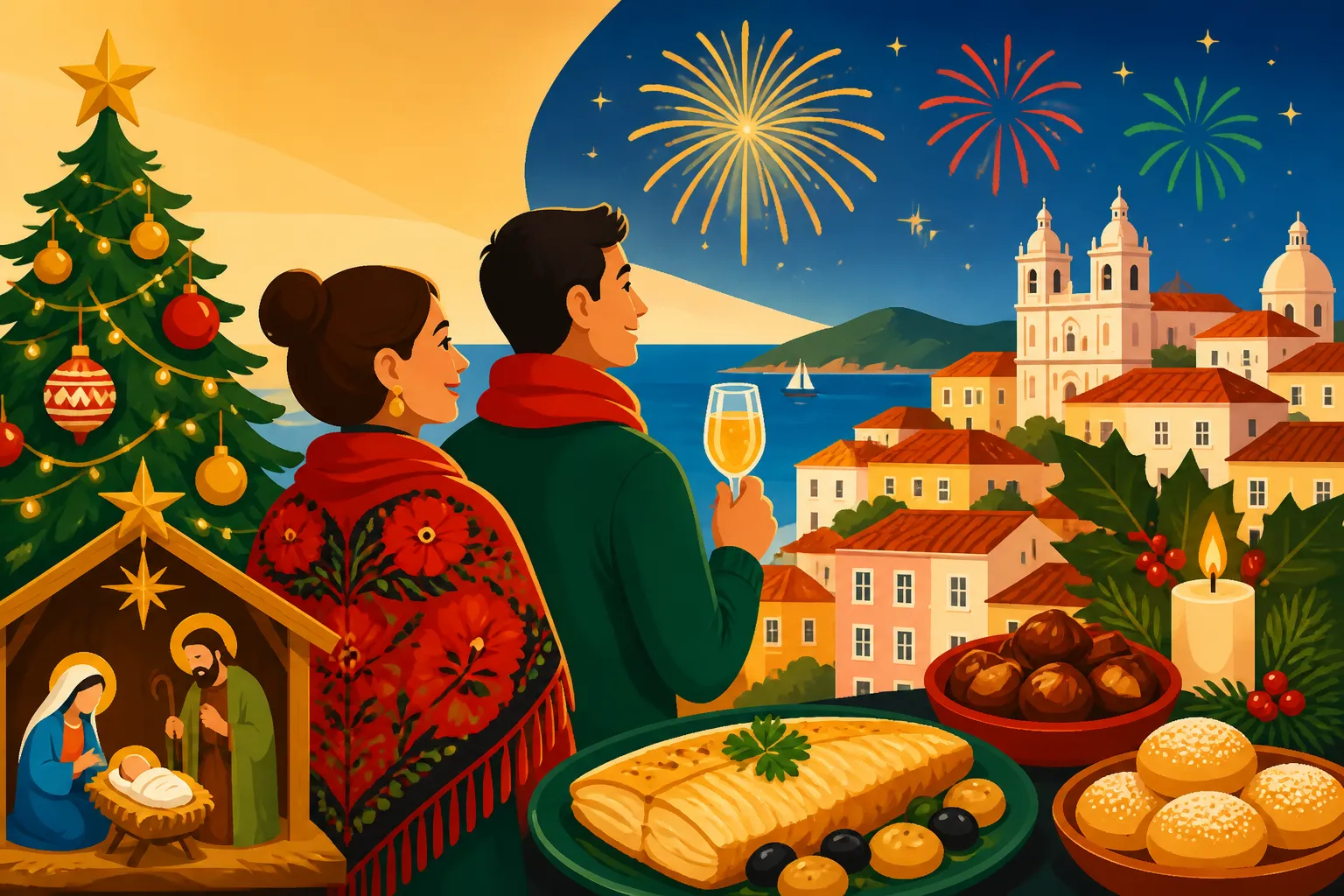
The centerpiece of the Consoada table is almost always Bacalhau Cozido (boiled salted cod). To the uninitiated, this might seem like an underwhelming choice for the most important meal of the year. Why boiled fish and cabbage instead of a roasted turkey or prime rib? The tradition stems from the Catholic fasting laws of old, which prohibited the consumption of meat on the eve of major religious feasts. While the church no longer mandates this, the habit remained, and now the smell of boiling cabbage and garlic is the definitive scent of a Portuguese Christmas.
The meal consists of high-quality salted cod, potatoes, carrots, hard-boiled eggs, and Portuguese cabbage (couve portuguesa), all drizzled liberally with the best olive oil you can find. It is deceptively simple but relies entirely on the quality of the ingredients. When you are doing your Grocery Shopping in Portugal: Continente, Pingo Doce, Auchan, and Mercados, you will see massive piles of salt-crusted cod. Don't be intimidated; learning to soak and prep this fish is a rite of passage for any expat. After the simple main course, the table is cleared to make room for an army of desserts that stay out for days.
The Midnight Mass or Missa do Galo
Even for those who aren't particularly religious, the Missa do Galo (Mass of the Rooster) is a significant cultural touchstone. It takes place at midnight, separating Christmas Eve from Christmas Day. The name allegedly comes from the legend that a rooster crowed at the moment of Christ's birth. Attending a local parish mass is one of the best ways to experience the community spirit of a Portuguese village or neighborhood.
Inside the churches, you will see elaborate nativity scenes, or Presépios. Many families also have a small altar at home where the baby Jesus is only added to the manger after the family returns from the midnight mass. After the service, it is common for neighbors to greet each other in the church square, sometimes sharing a small glass of licor or a piece of cake before heading home to open the long-awaited gifts. This late-night social hour is a fantastic way to practice your skills if you are currently Learning European Portuguese: Top Apps, Tutors, and Free Government Classes.
Traditional Portuguese Christmas Foods and Sweets
If the main meal is humble, the dessert spread is anything but. The Portuguese have a legendary "sweet tooth," and Christmas is the time when the nation's pastry skills truly shine. A typical table will feature a dozen different items, most of which are fried, covered in cinnamon and sugar, or loaded with egg yolks. This is not the time for a diet; it is the time for indulgence.
Understanding the hierarchy of these sweets is essential. You will find them in every pastelaria starting in late November, but nothing beats the homemade versions shared among neighbors. If you are still exploring the local food scene, you might want to brush up on Portuguese Coffee Culture and Restaurant Etiquette: Ordering Like a Local to ensure you know exactly how to order your caffeine fix to accompany these heavy treats.
Bolo Rei vs Bolo Rainha
The undisputed king of the table is the Bolo Rei (King Cake). This is a wreath-shaped brioche-style bread packed with nuts and topped with a vibrant array of crystallized fruits that look like jewels. Traditionally, the cake contained a dried fava bean and a small metal toy. Whoever found the bean had to pay for the cake the following year, while the toy was a lucky charm. For safety reasons, the toys are largely gone from commercial cakes, but the fava bean often remains.
For those who find crystallized fruit a bit polarizing, there is the Bolo Rainha (Queen Cake). This version omits the sugary fruit and instead doubles down on the nuts—almonds, walnuts, and pine nuts. It is often the preferred choice for expats who find the traditional Bolo Rei a bit too sweet. Both cakes are usually eaten from Christmas Eve through to the Epiphany in January.
Fried Delights: Filhós, Sonhos, and Rabanadas
The "Big Three" of Portuguese fried Christmas sweets are Filhós, Sonhos, and Rabanadas. Filhós are large disks of fried dough, often flavored with orange zest and brandy. They are meant to be rustic and are usually torn apart by hand. Sonhos (which literally translates to "dreams") are light, airy puffs made from a choux-like pastry that are deep-fried until they resemble golden clouds, then rolled in cinnamon sugar.
Rabanadas are the Portuguese answer to French toast, but far more decadent. Slices of bread are soaked in milk, wine, or sugar syrup, dipped in egg, fried, and then smothered in a cinnamon-sugar mixture or a thick syrup made with honey and dried fruits. Each region has its own twist on the recipe. In the north, you might find them served with a thick "calda d'açúcar," while in the south, they remain simpler. These sweets are so integral to the season that you will see them featured in almost every festive menu you find on Booking.com when looking for holiday dinner packages.
Unique Regional Traditions and Winter Solstice Rites
While the codfish and Bolo Rei are universal across the mainland and islands, Portugal has several fascinating regional traditions that date back centuries. Some of these are surprisingly pagan in origin, reflecting the country's ancient Celtic and Roman roots. Exploring these traditions is a great way to decide Where to Live in Portugal: Lisbon, Porto, Algarve, and Silver Coast Compared, as each region offers a completely different vibe during the winter months.
These traditions often center around the idea of community and the triumph of light over darkness. If you are staying in the interior of the country, you will experience a much colder, more rugged version of Christmas than the mild, palm-fringed holidays of the Algarve.
The Christmas Log or Madeiro in Beira Interior
In regions like Castelo Branco and Guarda, the Madeiro de Natal is a massive tradition. On Christmas Eve, a giant bonfire is lit in the town square, usually in front of the main church. The logs are often stolen (symbolically) or donated by the local youth, and the fire is kept burning for days. This "Madeiro" serves as a gathering point for the entire village after the Consoada meal.
People stand around the fire, drinking wine, singing traditional songs, and keeping warm in the biting winter air of the mountains. It is a powerful display of community solidarity. If you are traveling to see these fires, make sure you understand the basics of Public Transport and Driving in Portugal: Trains, Tolls, and Licenses, as mountain roads in December can be tricky, and public transport schedules are often reduced.
Caretos of Varge and Winter Solstice Rites
In the remote village of Varge, near Bragança, the "Festa dos Rapazes" (Feast of the Boys) takes place around Christmas and the New Year. This involves the Caretos—young men dressed in fringed suits of red, yellow, and green, wearing metal or leather masks. They run through the village, playing pranks, shouting, and creating a controlled sort of chaos.
This tradition is a UNESCO-recognized piece of intangible cultural heritage and is linked to ancient rites of passage and winter solstice celebrations. It is a world away from the "quiet family Christmas" of Lisbon. If you want to witness this, you can often find unique local stays through Booking.com, but you must book months in advance as these small villages have limited capacity.
| Tradition | Region | Key Feature |
|---|---|---|
| Madeiro | Beira Interior | Massive communal bonfire in the church square |
| Caretos | Trás-os-Montes | Masked "devils" celebrating the winter solstice |
| Bananeiro | Braga | Drinking Muscatel and eating a banana on Dec 24th |
| Presépios de Sal | Aveiro | Intricate nativity scenes made entirely of salt |
| Janeiras | National | Door-to-door caroling in early January |
New Year’s Eve Customs in Portugal
When it comes to the Passagem de Ano (New Year's Eve), the Portuguese trade the quiet family vibe for high-energy parties, fireworks, and a very specific set of superstitious rituals designed to ensure the coming year is prosperous. Whether you are in a major city or a seaside town, the transition into the New Year is taken very seriously.
If you are planning to spend the night in a major hub like Lisbon or Porto, the fireworks displays are world-class. You can check GetYourGuide for boat tours that offer a front-row seat to the fireworks over the Tejo or Douro rivers. It is an unforgettable way to ring in the year, provided you follow the local rules for luck.
The Twelve Raisins and Sparkling Wine
The most important New Year's tradition in Portugal involves the "Doze Passas" (Twelve Raisins). As the clock strikes midnight, you are expected to eat one raisin for every chime. For each raisin you consume, you get to make one wish for the coming year. It sounds simple, but trying to chew and swallow twelve dry raisins in sixty seconds while everyone is cheering and popping corks is an Olympic-level feat of coordination.
Experienced locals will have their twelve raisins pre-counted in a small bowl or a napkin. To wash them down, you must have a glass of Espumante (Portuguese sparkling wine). It is also traditional to stand on a chair for the final countdown and to ensure you have some money in your pocket (or even your shoe) to attract wealth in the coming year.
Banging Pots and Pans: Scaring Away the Old Year
In many neighborhoods, especially in the more traditional areas of Lisbon and Porto, the midnight bells are followed by a cacophony of noise. People lean out of their windows or stand on their balconies banging pots and pans with wooden spoons. The idea is to make as much noise as possible to "scare away" the evil spirits and bad luck of the old year, clearing the path for a fresh start.
This tradition is particularly lively in apartment-heavy neighborhoods. If you have chosen Cascais expat life: Is the premium rent worth the seaside lifestyle?, you might find the celebrations a bit more polished, with professional fireworks and beach parties, but the pot-banging still persists in the older parts of town. It’s a wonderful, chaotic moment of shared catharsis.
Epiphany and the Three Kings (Dia de Reis)
While many expats are used to the holiday season ending on January 2nd, the Portuguese keep the spirit alive until the Dia de Reis (Day of the Kings) on January 6th. This marks the Epiphany, when the Three Wise Men are said to have reached the baby Jesus. It is the official "bookend" of the Christmas season.
Until January 6th, you will still see Christmas lights twinkling in the streets, and the Bolo Rei remains a staple in the bakeries. For many families, this is the day when the final gifts are exchanged (a tradition more common in the past, though still kept by some) and when the holiday decorations are finally packed away.
Singing the Janeiras
Between New Year’s Day and the Epiphany, you may encounter groups of people wandering the streets or going door-to-door singing. These are the Janeiras (January songs). These groups of singers, often accompanied by accordions or tambourines, sing traditional carols that wish the neighbors a happy and prosperous new year.
In exchange for their songs, the singers are traditionally given treats—nuts, fruit, or a small glass of brandy. In modern times, it is often a way for local choirs or community groups to raise money. Hearing the Janeiras echoing through a cobblestone alleyway is a hauntingly beautiful experience that makes the Cost of Living in Portugal 2026: Detailed Budgets for Singles and Families feel like a small price to pay for such rich cultural immersion.
Closing the Season and Taking Down Decorations
January 6th is the day the party officially ends. It is considered bad luck in some regions to keep your decorations up past this date. The massive city trees are dismantled, and the Presépios are carefully boxed up. For the expat, this is usually the time to reflect on the whirlwind of the past month and perhaps plan a quiet weekend away to recover.
If you are feeling the "post-holiday blues," it’s a great time to use Omio to find cheap bus or train tickets for a winter getaway to the Alentejo or the Algarve, where the crowds have vanished, and the prices are much lower. Using Comboios de Portugal (CP) Trains and the Navegante Pass makes these trips easy and affordable, allowing you to see the country in its quietest, most peaceful state.
Practical Tips for Expats During the Holidays
Navigating the Portuguese holidays requires a bit of logistical foresight. Because the culture is so centered around the home and family, the "public" side of life—transport, restaurants, and shops—can be unpredictable. You don't want to be the person wandering the streets on Christmas Eve looking for an open pharmacy or a taxi that isn't already booked.
A little planning goes a long way. This is also a time when Making Friends and Networking in Portugal: Expat Groups and Meetups can be vital. If you don't have family here, many expat communities organize "Orphan Christmas" lunches or New Year's meetups so nobody has to eat their twelve raisins alone.
Travel and Transport: Planning Your Holiday Trip
If you are planning to travel within Portugal during late December, be aware that train and bus seats sell out weeks in advance. The Portuguese diaspora is huge, and thousands of people living abroad return home for the holidays, while locals in the cities head back to their ancestral villages. Use Omio to compare prices and book your tickets early to avoid being stranded.
On December 24th and December 31st, public transport usually stops running early. In Lisbon and Porto, the Metro might close by 10:00 PM on Christmas Eve. Taxis and Ubers are notoriously difficult to find during the Consoada and the peak of New Year's Eve. If you are going to a party, plan your "get home" strategy before the first glass of wine is poured.
Booking Accommodation and Experiences
For those who want to experience the legendary New Year's Eve fireworks in Funchal, Madeira—often cited as the best in the world—you need to book your hotel on Booking.com at least six months in advance. The island nearly doubles in population during this week. Similarly, if you want a guided tour of the "Christmas Villages" in the interior, check GetYourGuide for local experts who can handle the driving and the history.
Finally, remember that the "August Shutdown" has a winter equivalent. While things don't stop for a full month, the period between Christmas and New Year is a time of very low productivity for bureaucracy. If you are waiting on a residency permit or a tax document, don't expect much movement until the second week of January. Embracing this slower pace is the final, and perhaps most important, Portuguese tradition you need to learn.
Disclaimer
The information provided in this guide is for informational purposes only and reflects cultural traditions and typical schedules in Portugal as of 2026. Local customs may vary by region or family, and public transport or business hours are subject to change by local authorities. Always verify specific dates and times with local service providers.