Emergency Rooms (Urgências) in Portugal: Triage Colors and Wait Times
You have a feverish child or a parent with chest pain, it is late, and you are standing outside a Portuguese hospital trying to decode the word “Urgência.” Inside, a nurse gives you a coloured wristband and then you wait, possibly for a very long time. This guide covers how triage colours work in Portuguese emergency rooms, why some people wait much longer than others, and how to get seen faster.
How Emergency Rooms in Portugal Are Organized
My first trip to a Portuguese urgência was for a deep kitchen-knife cut on my thumb. I walked into a big Lisbon hospital expecting something like a British or American A&E. I found a ticket machine, a reception desk, a triage booth, and a waiting room full of people whose wristbands I couldn’t read. Knowing how the system is built would have saved me hours.
The Three Levels of Urgência
Portuguese public emergency care has three tiers. The Serviço de Urgência Básica, or SUB, is the most basic. These are often in smaller towns and handle stabilisation and minor problems. The Serviço de Urgência Médico-Cirúrgica, or SUMC, is the middle tier, found in district hospitals, with general surgery, orthopaedics and internal medicine on hand. The top tier is the Serviço de Urgência Polivalente, or SUP. These are in large central hospitals such as Hospital de Santa Maria and Hospital de São José in Lisbon, Hospital de São João and Hospital de Santo António in Porto, and the university hospitals in Coimbra.
This matters because the closest door is not always the right one. If you live in a small Alentejo town and break your wrist, the local SUB may stabilise you and then transfer you to a bigger hospital for the orthopaedic work. That transfer is normal and does not mean you went to the wrong place. A suspected stroke or major trauma, however, will usually go straight to a hospital with full capability, which is why calling 112 beats driving yourself in a real emergency.
If you live outside the cities, find out early which hospital covers your area and which tier it is. Many rural expats are surprised by the distances involved. See Living in rural Portugal: How far is the nearest hospital usually? for that side of things.
Adult, Pediatric and Obstetric Urgências Are Often Separate
In bigger hospitals, children and pregnant women often have their own emergency doors, separate from the general adult urgência. Lisbon’s Hospital Dona Estefânia is a well-known pediatric hospital, and many larger hospitals run a dedicated Urgência Pediátrica and Urgência Obstétrica e Ginecológica. If you turn up at the adult entrance with a toddler, staff will normally redirect you, sometimes to another building.
In recent years, some pediatric and obstetric emergency units have run on rotating schedules, especially on weekends and during summer staff shortages. One hospital may be open while a neighbouring one is temporarily closed. Expat families tend to find this out at the worst possible moment. Before driving anywhere at night with a sick child or a pregnancy concern, call SNS 24 or check the Portal do SNS to see which units are open.
Public Versus Private Emergency Rooms
Private hospital groups also run emergency services. CUF, Hospital da Luz, and Lusíadas Saúde all have urgências at their major sites, and in the Algarve the HPA group fills a similar role. Private ERs are usually calmer, quicker for low-priority cases, and more likely to have English-speaking staff on shift. The trade-off is cost: you pay out of pocket or through private insurance, and private ERs may transfer the most complex cases to a public hospital anyway. For an orientation, see Hospital da Luz and CUF: Navigating Portugal’s Biggest Private Hospitals.
| Factor | Public SNS Urgência | Private Hospital Urgência |
|---|---|---|
| Who runs it | National Health Service hospitals | Groups such as CUF, Hospital da Luz, Lusíadas |
| Typical wait for minor issues | Can be very long during peaks | Usually shorter |
| English availability | Varies by shift and hospital | Generally more consistent |
| Cost structure | User fee may apply depending on referral and outcome | Billed per visit and per test, or via insurance |
| Major trauma and complex cases | Full capability at SUP-level hospitals | May stabilise and transfer to public hospital |
| Best suited for | Serious emergencies, residents with Utente number | Minor urgent issues, insured patients wanting speed |
The Manchester Triage System and What Each Colour Means
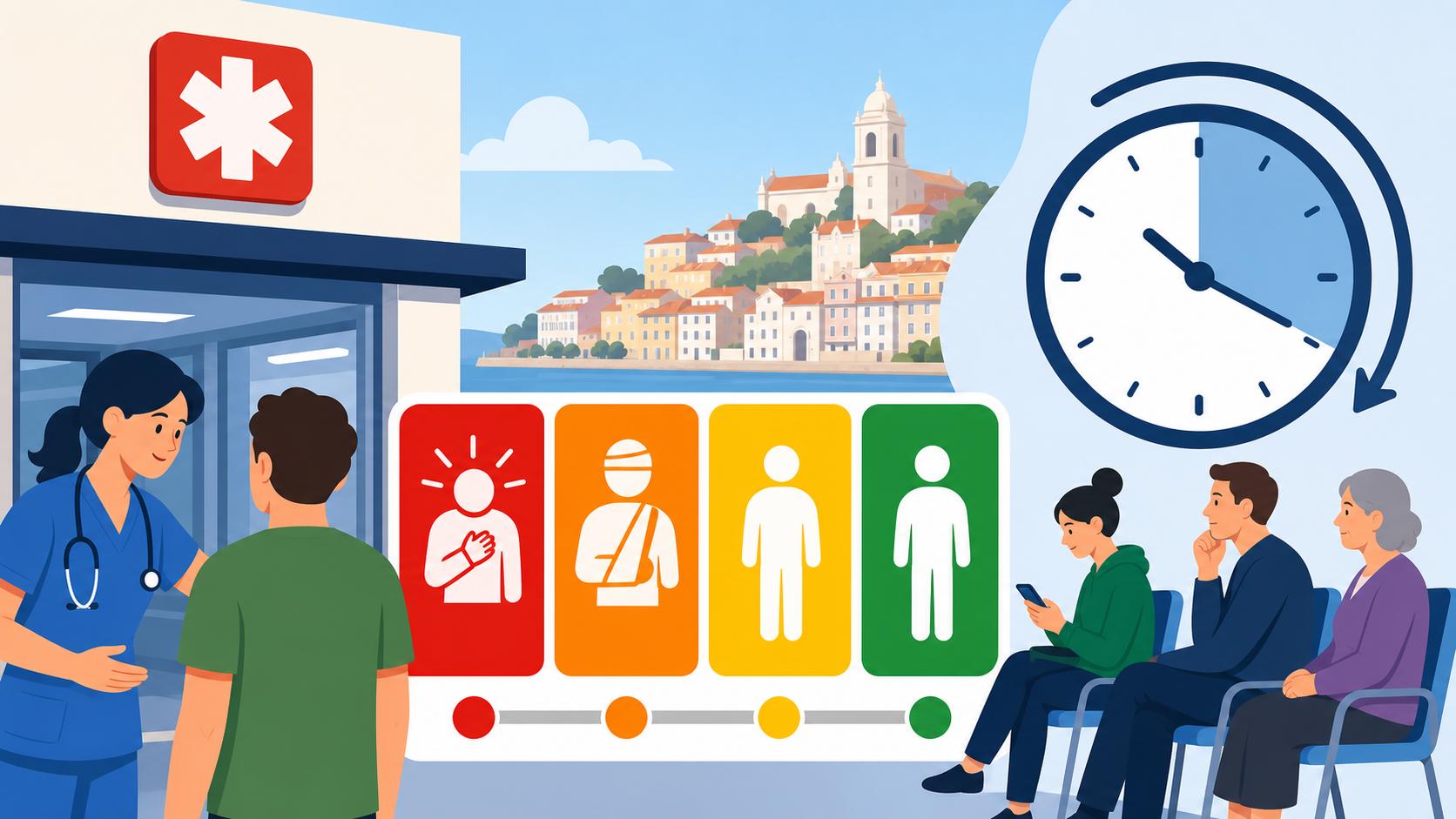
Almost every Portuguese emergency room, public or private, uses the Manchester Triage System. A triage nurse asks structured questions, checks vital signs, and assigns a priority colour, usually shown on a wristband or your file. That colour, not the order you arrived in, sets your place in the queue.
Reading the Colour Bands
The colour is a clinical judgment about how dangerous your condition could be if you wait. It says nothing about how much pain you are in or how upset you are. It took me a while to accept that.
| Colour | Portuguese Term | Priority Level | Typical Examples |
|---|---|---|---|
| Red | Emergente | Immediate | Cardiac arrest, severe breathing difficulty, major bleeding, unresponsive patient |
| Orange | Muito Urgente | Very urgent | Chest pain suggesting a heart attack, stroke symptoms, severe pain, high fever in a vulnerable patient |
| Yellow | Urgente | Urgent | Moderate pain, suspected fractures, persistent vomiting, worrying but stable symptoms |
| Green | Pouco Urgente | Standard | Minor injuries, sprains, mild infections, small cuts needing stitches |
| Blue | Não Urgente | Non-urgent | Problems that a family doctor could handle, such as mild colds or old minor complaints |
| White | Not clinical triage | Administrative or non-urgent pathway | Scheduled procedures, cases outside the standard triage flow |
Each colour has a target time for first medical contact, and the targets get longer as you move down the scale. Red is treated straight away. Blue patients may wait a very long time on a busy night, because everyone above them keeps arriving. For a closer look at the protocol, see Understanding the Manchester Triage System colors in Portuguese emergency rooms.
Why Your Colour Can Change
Triage is not a one-off verdict. If your condition gets worse while you wait, for example if your breathing tightens, a child becomes floppy, or you feel faint, tell the reception or triage staff right away. They can re-triage you to a higher colour. A patient who begins to slur their speech while waiting, for instance, can be moved from yellow to orange once a companion calmly reports the change to the nurse.
It also works the other way. A patient arriving with pain that eases with simple analgesia may be reassessed and redirected. Don’t treat the wristband as a ticket you’ve won or lost. It is a live safety tool.
Green and Blue Cases Are Not Being Ignored
The hardest part for newcomers is being green or blue and watching people who arrived after you get called first. You feel invisible, especially if you don’t speak Portuguese and can’t follow what’s being announced. You are still in the system. A sprained ankle simply ranks below a suspected heart attack, and on a weekend night in a Lisbon central hospital there may be many of those.
If you’re green or blue, the honest advice is to ask whether you need to be there at all. Many green and blue complaints are handled faster and more comfortably at a Centro de Saúde, through SNS 24, or at a private clinic’s same-day consultation.
Wait Times and Why They Vary So Much
Wait times in Portuguese urgências range from a short wait to an all-night stay, depending on your colour, the hospital, the day and the season. Knowing the pattern helps you plan, and sometimes avoid the wait altogether.
Seasonal Peaks and Staff Pressure
Winter is the hardest season. Flu, respiratory viruses and cold-related problems in older people send numbers up sharply from December through February. The large central hospitals in Lisbon and Porto take the brunt, because they receive transfers from smaller units as well as walk-ins. Monday mornings and the hours after a long weekend are also busy, as people who waited it out over the holiday arrive together.
Summer is different. In tourist areas, especially the Algarve, the population swells with visitors while some staff are on holiday. Hospital de Faro and Portimão can be very stretched in July and August. Sunburn, dehydration, jellyfish stings, scooter accidents and stomach bugs all add to green-band queues.
Checking Live Wait Times Before You Go
The SNS publishes emergency waiting times for public hospitals on the Portal do SNS, broken down by triage colour. Before going in for a non-life-threatening problem, look up your nearest hospital and its neighbours. Sometimes a hospital twenty minutes further away has a much shorter green queue.
Treat the figures as a snapshot. A major road accident can change the picture within minutes. Still, checking first is one of the easiest ways to avoid spending a whole evening in a plastic chair.
What Happens During the Wait
After triage, you’ll usually go back to a waiting area for your colour. The doctor who sees you may order bloodwork, an X-ray, or a CT scan, and each of these involves more waiting: first for the test, then for the results, then for the doctor to review them. Many people don’t expect this. Being “seen” is often the start of a multi-stage visit, not the end of it.
- Take a ticket from the machine at the entrance if there is one.
- Register at reception with your ID, Número de Utente, or EHIC or insurance details.
- Go to the triage booth when called and describe your symptoms clearly.
- Receive your colour and return to the matching waiting area.
- See the emergency doctor, who may order tests.
- Wait for tests and results, then see the doctor again for a decision.
- Leave with discharge paperwork, a prescription, a referral, or an admission to a ward.
Getting Seen Faster Without Jumping the Queue
You can’t argue your way up the triage scale, and you shouldn’t try. You can, however, use the routes that Portugal’s system wants patients to take.
Call SNS 24 Before You Go
The most useful single step is calling the SNS 24 line on 808 24 24 24. A nurse triages you over the phone. Depending on your symptoms, they may give advice for home care, send you to your Centro de Saúde, or refer you to a specific emergency room. Clinical triage runs 24 hours a day, and calls cost the same as a call to a landline (as of October 2026). See SNS 24 Helpline (808 24 24 24): Triage, Advice, and Sick Notes for a full walkthrough.
A referral from SNS 24 matters. Many public hospitals now actively prioritise patients who arrive with a referral, and walk-ins assessed as low priority without one may be redirected to primary care. Referral can also affect whether you are charged a user fee. The call often takes a few minutes and can save you an hour or more at the hospital door.
There is an SNS 24 app as well, and English support is available, though the experience varies. Have your Número de Utente ready when you call. If you don’t have one yet, sort it out soon after arriving. Registering with the Centro de Saúde: Getting Your SNS Número de Utente covers the process.
When to Call 112 Instead
For anything life-threatening, skip SNS 24 and call 112. That includes chest pain, sudden weakness on one side of the body, severe breathing difficulty, heavy bleeding, seizures, or an unconscious person. The call goes to the national emergency number, and INEM dispatches ambulances and medical teams. Patients brought in by INEM are prioritised appropriately on arrival and don’t need to queue at reception the way walk-ins do.
Many expats worry about the language barrier on an emergency call. Dispatchers commonly handle English, and stating your location clearly is the most important thing. See Calling 112: Do Portuguese emergency dispatchers speak fluent English? for practical phrases and what to expect.
Know the Alternatives for Minor Problems
Some green and blue situations don’t need a hospital at all. A pharmacist can advise on minor ailments, and every area has a rotating duty pharmacy for nights and weekends. See What is a Farmácia de Serviço and how to find one open at 2 AM. Many Centros de Saúde also run same-day or extended-hours “consulta aberta” or “atendimento complementar” slots for acute but non-serious problems.
Toothache is another common case. Public urgências generally have limited dental capability, so a severe tooth problem without facial swelling or fever is usually better handled at a private dental clinic. Emergency dentist in Porto or Lisbon: What to do for severe tooth pain covers this.
Please don’t use the ER for routine prescription renewals either. If you are running low on regular medication, see How to Refill Long-Term Medication in Portugal. The ER can help in a genuine gap, but it is the slowest and most stressful place to do it.
Costs, Insurance and Paperwork at the Urgência
Money is often the first question expats ask me, and the honest answer is that it depends on your status, how you arrived, and what happened during your visit.
User Fees in the Public System
Residents registered with the SNS may pay a user fee, called a taxa moderadora, for some emergency visits. Whether you pay depends on factors such as whether SNS 24, your Centro de Saúde, or INEM referred you, and whether you were admitted to hospital. Several groups are exempt, including children and people with certain conditions or low incomes. The rules have changed over the years, so check the current framework on the SNS portal. The full breakdown is in Taxas Moderadoras: Co-payments and Costs in the Public Health System.
Visitors and people not yet registered face a different situation. Without an Utente number or valid European cover, the hospital can bill you for the visit, tests and treatment. For realistic scenarios, see How much does an emergency room visit cost without private insurance?.
EHIC, GHIC and International Insurance
EU and EEA visitors with a valid European Health Insurance Card, and UK visitors with a GHIC, can access necessary public care on the same terms as residents. Bring the physical card or a valid certificate. Reception staff are used to seeing it. Using the European Health Insurance Card (EHIC) in Portugal explains the details, including what the card does not cover.
Expats and long-stay visitors who want private ER access often carry international health insurance. Cigna Global is a common choice for people relocating, partly because its policies are built around cross-border living rather than a single country’s system. If you have a plan like this, read your policy wording before you need it. Find out whether private emergency visits are covered, whether you have to call the insurer first, and whether the hospital can bill them directly or you pay and claim later. Check Cigna Global’s own policy documents and member portal for current terms, since cover varies by plan.
Documents to Bring Every Time
You won’t think clearly at two in the morning, so keep a ready folder or a note on your phone with the following:
- Passport or residence card
- Número de Utente, or EHIC or GHIC card
- Private or international insurance card and policy number
- A list of current medications with doses, written in Portuguese if possible
- Known allergies and major past diagnoses or surgeries
- Phone charger, water, and something to keep you occupied during the wait
Keep your discharge letter, the “nota de alta,” afterwards. It records what was found and what was done, and your family doctor or insurer may ask for it.
Language, Comfort and Practical Survival Tips
The clinical care in Portuguese emergency rooms is generally solid. What wears people down is the waiting, the noise, and not understanding what is happening.
Handling the Language Barrier
Younger doctors and nurses in Lisbon, Porto and the Algarve often speak good English. Reception staff and older team members may not. Write a short summary of your symptoms in Portuguese before you go, using a translation app if needed: when it started, where it hurts, what makes it worse, and any medications you’ve already taken. Showing that at reception and triage speeds things up a lot.
Bring a Portuguese-speaking friend if you can, and in many situations staff will let one companion stay with you. For more strategies, including when to ask for help with translation, see Navigating the public health system if you only speak English (Translation tips).
Comfort During Long Waits
Pack as though for a long journey. Waiting rooms can be cold in winter and stuffy in summer, vending machines are not always stocked, and phone batteries run down fast when you’re anxious and scrolling. A small bag with a charger, a jumper, water, and a snack (if you’ve been told you can eat) makes a long wait easier. Ask before eating or drinking, since some tests or procedures require an empty stomach.
Listen for your name, and sometimes your number. Announcements can be muffled and the names mispronounced. If you have to step outside, tell the reception desk first. Missing your call can mean waiting even longer.
Avoiding Repeat Trips for Minor Illness
A lot of green-band visits are things like mild dehydration from a stomach bug or a cold that drags on. A well-stocked home kit helps you manage these at home and keep the ER for real emergencies. Many expats in rural villages stock oral rehydration salts, electrolyte powders, a thermometer, and basic first-aid supplies. iHerb is a handy option for electrolyte and rehydration products that are not always easy to find in small local shops. Your local pharmacy remains the best place for medicines and dosing advice. Check iHerb’s own site for current shipping options to Portugal, and keep a pharmacist’s guidance in mind before using any supplement alongside prescribed medication.
The aim is not to avoid the urgência when you need it. If something feels seriously wrong, go, or call 112. The aim is to arrive prepared, through the right door, with a referral when possible, so that a stressful night becomes manageable.
Disclaimer
This article is for general informational purposes only and does not constitute professional advice. Laws, prices and regulations vary by location and change over time. Consult a qualified professional for guidance on your specific situation.