Using Translation Apps in Portugal: What Works Best
Disclosure: This article contains affiliate links. If you buy through them, we may earn a commission at no extra cost to you. Read our full disclosure.
You are standing at a busy counter in a Lisbon post office, the queue behind you is growing restless, and you realize you have no idea how to say "registered mail." It is a specific kind of panic every foreigner in Portugal knows. This guide provides a detailed roadmap to the best translation apps for navigating Portugal's unique linguistic landscape, ensuring you never feel lost for words again.
The European Portuguese vs Brazilian Portuguese Dilemma
The first thing every expat learns—usually the hard way—is that the Portuguese spoken in Portugal is distinct from the version spoken in Brazil. Most global translation apps default to Brazilian Portuguese because of the massive population difference. While the two are mutually intelligible, the vocabulary, grammar, and pronunciation are different enough to cause significant confusion when you are trying to handle official business or navigate local social norms.
Why the Distinction Matters for Expats
In Brazil, the pronoun "você" is used widely and informally. In Portugal, using "você" can be tricky; it is often skipped entirely or replaced by the person’s name or a formal title to show respect. If your translation app is giving you Brazilian syntax, you might inadvertently sound overly casual or even rude when speaking to an older shopkeeper or a government official. Furthermore, simple words like "bus" change from "ônibus" in Brazil to "autocarro" in Portugal. If you are using Omio to plan your cross-country travel, seeing "autocarro" on your ticket while your app tells you to look for an "ônibus" can lead to unnecessary stress at the station.
Contextual Vocabulary Differences
There are hundreds of everyday objects that have different names. For example, a "train" is a "trem" in Brazil but a "comboio" in Portugal. If you are trying to ask someone where the station is, using the Brazilian term might earn you a confused look or a polite correction. When you are Booking train tickets online with Comboios de Portugal (CP) app, you need to be familiar with the local terminology to ensure you are selecting the right service and class. Translation apps that allow you to specifically toggle "Portuguese (Portugal)" are worth their weight in gold for this reason alone.
The Nuance of Pronunciation
European Portuguese is often described as "shushy" and more closed-mouthed compared to the open, melodic vowels of Brazilian Portuguese. This makes voice-to-voice translation particularly difficult. If your app is trained on Brazilian phonetics, it may struggle to understand a local from a rural village in the Alentejo. Understanding these hurdles is the first step toward choosing a tool that actually bridges the gap rather than widening it.
DeepL The Gold Standard for Accuracy
Among the veteran expat community, DeepL has quickly overtaken Google as the preferred tool for written translation. Developed in Germany, this AI-powered translator is famous for capturing the "feel" of a sentence rather than just providing a word-for-word swap. For those of us living here, it has become an essential companion for everything from translating rental contracts to drafting emails to the tax office.
Superior Contextual Understanding
DeepL excels at recognizing the formal and informal distinctions that are so vital in Portuguese culture. When you are Finding English-speaking real estate lawyer for property closing in Portugal, you may still need to correspond with various government departments in written Portuguese. DeepL allows you to choose between formal and informal tones, ensuring your emails to the Conservatória or the Câmara Municipal maintain the appropriate level of "respeito." This prevents the awkwardness of sounding like a tourist when you are trying to establish yourself as a serious resident.
Handling Long-Form Documents
If you have moved to Portugal, you will inevitably be faced with a mountain of paperwork. Whether it is a utility bill from EDP or a complex health insurance policy, you need a translator that can handle more than just a single sentence. DeepL’s "Pro" and even its free web version allow you to upload entire PDF or Word documents. This is a lifesaver when you are trying to understand the fine print of a contract you found on Booking.com for a medium-term stay or a lease agreement. It maintains the formatting of the document while replacing the text, which makes it much easier to cross-reference with the original Portuguese version.
Limitations to Consider
The main drawback of DeepL is that its mobile app's "live" features—like camera translation and voice recognition—are currently less robust than Google’s. It is primarily a tool for those who want the highest quality written translation. If you are sitting at home trying to decipher a letter from the Seguranca Social, use DeepL. If you are standing in a supermarket trying to figure out if a bottle of liquid is laundry detergent or floor cleaner, you might need a different solution.
Google Translate The Versatile All-Rounder
Despite the rise of competitors, Google Translate remains a staple on the phones of almost every tourist and new arrival. Its strength lies in its versatility and its ability to function without a stable internet connection—provided you have the foresight to download the language packs ahead of time.
The Power of the Camera Tool
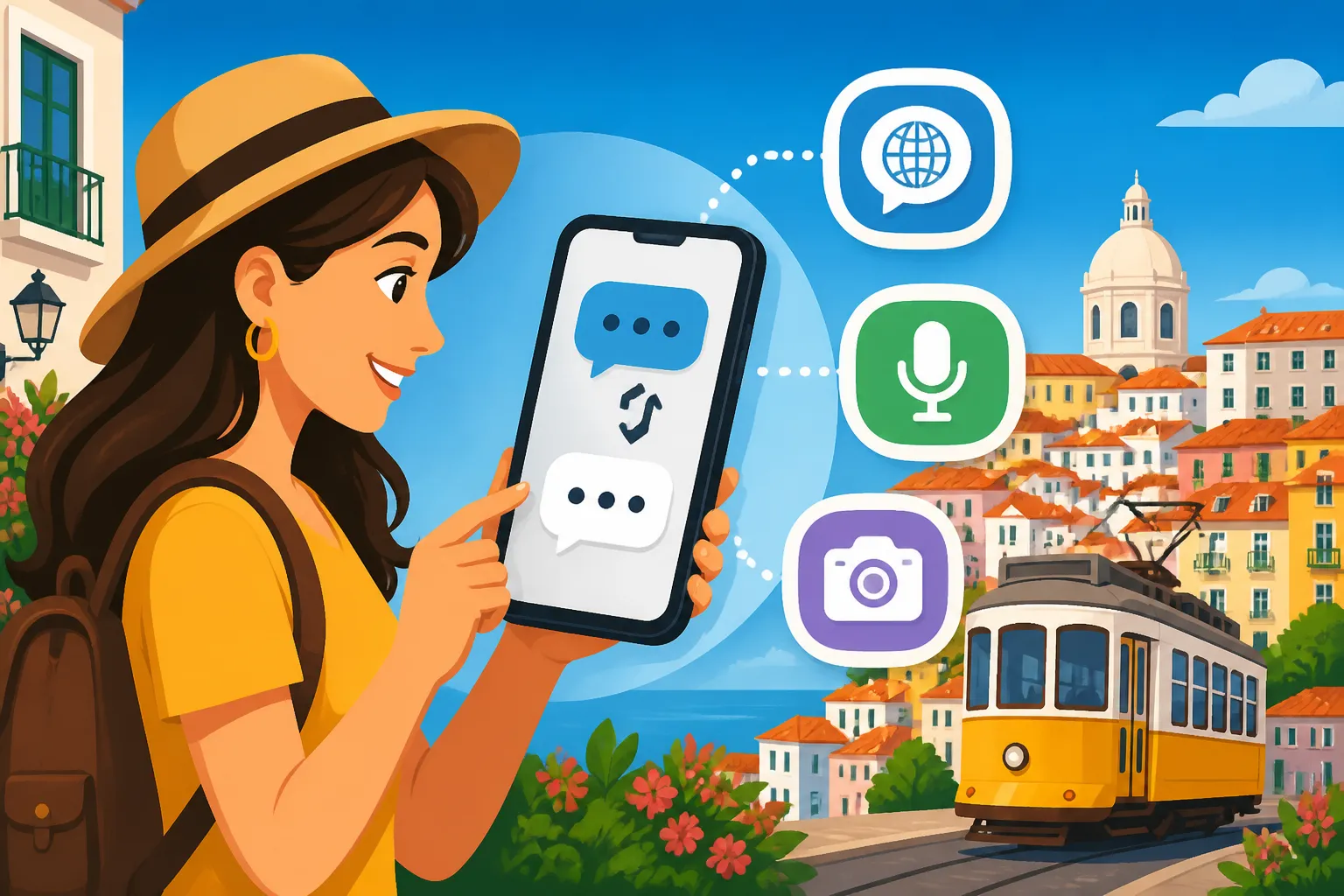
The "Instant Camera Translation" feature is arguably the most useful tool for someone who has just landed in Lisbon. You can simply point your phone at a menu, a street sign, or a notice on a shop door, and the English text will overlay the Portuguese in real-time. This is incredibly helpful when you are Learning European Portuguese: Top Apps, Tutors, and Free Government Classes and want to test your reading skills in the wild. It helps you quickly identify allergens on food labels or understand the "horários" (schedules) posted at a local medical clinic.
Conversation Mode for Real-Time Interaction
Google’s conversation mode allows two people to speak into the phone, with the app providing an audio translation for both parties. While it still leans heavily toward Brazilian Portuguese, it is usually "good enough" for basic interactions. Imagine you are at a local "tasca" trying to understand the daily specials. You can speak into the phone, and the waiter can hear the translation in Portuguese. Just be prepared for a few laughs if the app uses a particularly "Brazilian" expression for a local dish.
Offline Functionality
Data roaming can be expensive, and while you can pick up a local SIM card easily, there are often dead zones in the thick stone walls of old Portuguese buildings or in the remote hills of the Serra da Estrela. Google Translate allows you to download the Portuguese language file (approx. 50-80MB). This ensures that even if you are deep in the Douro Valley on a tour you found through GetYourGuide, you can still translate your way out of a confusing situation without needing a 4G signal.
| Feature | DeepL | Google Translate | SayHi |
|---|---|---|---|
| European PT Accuracy | High | Medium | Medium-High |
| Camera Translation | Basic | Excellent | N/A |
| Voice Recognition | Medium | High | Excellent |
| Offline Mode | No | Yes | No |
| Formal/Informal Toggle | Yes | No | No |
Specialized Apps for Voice and Learning
While the big two dominate the market, several smaller, more specialized apps can be extremely helpful for specific situations. These tools often focus on the phonetic side of the language, which is where most foreigners struggle the most.
SayHi for Seamless Dialogue
SayHi is a dedicated voice-to-voice translation app that many expats swear by for phone calls or complicated face-to-face meetings. It has a very clean interface and allows you to slow down the playback of the translated audio. This is particularly useful when you are Navigating the public health system if you only speak English (Translation tips). If you are speaking with a receptionist at a hospital, hearing the translation at 0.5x speed can help you pick up the specific pronunciation of medical terms, which is a great way to learn through immersion.
Microsoft Translator for Multi-User Chats
Microsoft’s offering has a unique "Multi-Device" feature. This allows several people to join a chat room on their own devices. As each person speaks or types in their native language, everyone else sees the translation in their own chosen language. This is a niche but powerful tool if you are attending a condominium meeting or a neighborhood planning session where multiple nationalities are present. It ensures that everyone is on the same page without the need for a professional human interpreter for every minor meeting.
Practice Portuguese and Language Learning Apps
While not strictly "translation" apps, tools like Practice Portuguese are essential for understanding the translations you are receiving. Most translation apps will give you a result, but they won't explain why a certain word was used. Practice Portuguese focuses exclusively on the European variant. When you are Portuguese greeting etiquette: When to use Beijinhos vs Handshakes, understanding the cultural context behind the words is just as important as the words themselves. Using these learning apps in conjunction with a translator helps you move away from your phone and toward genuine fluency.
Using Translation Apps in Medical and Administrative Settings
This is where the stakes are highest. A mistranslation at the pharmacy or the tax office can have real-world consequences. In these environments, you need to use translation apps as a support system rather than a complete replacement for human interaction.
At the Centro de Saúde and Hospitals
When Registering with the Centro de Saúde: Getting Your SNS Número de Utente, you will likely encounter staff who speak limited English, especially in smaller towns. It is wise to pre-translate your main points using DeepL and keep them written down in a notes app. If you have symptoms or a medical history to explain, don't rely on the "live" voice translation in the heat of the moment. Write it out clearly beforehand. This ensures that the Finding an English-speaking General Practitioner (Médico de Família) you eventually see has accurate information about your condition.
Navigating the Finanças and CTT
Government offices in Portugal are notorious for their specific jargon. Words like "morada fiscal" (tax address) or "comprovativo" (proof/receipt) appear constantly. Use your app's camera feature to read the tickets you pull from the "senha" (queue) machines. Many expats find that if they show a translated sentence on their phone to a clerk, the clerk will appreciate the effort and try to help more patiently. It shows that you are trying to bridge the linguistic gap rather than just expecting everyone to speak English.
Banking and Digital Payments
Portugal is highly digital, but the apps for major banks like Millennium bcp or Santander are often only partially translated into English. When you are setting up the Using the MB Way app: Why it’s better than carrying cash in Portugal, you might run into error messages in Portuguese. Screenshot these messages and run them through a translator. It usually turns out to be something simple like "exceeded daily limit" or "invalid phone number," but seeing it in your native language can prevent a lot of frustration and unnecessary trips to the bank branch.
Practical Tips for the Tech-Savvy Expat
To make the most of these tools, you need a few "boots on the ground" strategies. The technology is only as good as the person using it, and there are several ways to improve the accuracy of your digital translations.
Simplify Your English Input
Translation AI works best with clear, simple sentence structures. Avoid using slang, idioms, or overly complex metaphors in English. Instead of saying "I'm feeling a bit under the weather and I've got a splitting headache," try "I feel sick. My head hurts a lot." The simpler the input, the more likely the Portuguese output will be accurate and understandable to a local. This is especially true when How to order coffee in Portugal: Bica, Meia de Leite, Pingado, and Galão, where speed and clarity are essential during the morning rush.
Reverse Translate to Verify
If you are sending an important message, always "reverse translate." Take the Portuguese result your app gave you, paste it into a new window, and translate it back into English. If the resulting English is different from what you originally intended, you know the Portuguese version is likely confusing. Tweak your English until the reverse translation matches your intent perfectly. This extra step can save you from major misunderstandings when communicating with landlords or contractors.
Don't Forget the Human Element
Even the best app cannot replace a smile and a "Bom dia." Portuguese culture is deeply social and values politeness. Always start your interaction with a greeting in Portuguese before reaching for your phone. A simple "Desculpe, não falo bem português, pode ajudar-me com este tradutor?" (Sorry, I don't speak Portuguese well, can you help me with this translator?) goes a long way. Most locals are incredibly patient and helpful if they see you are making a genuine effort to communicate.
Beyond the Screen Cultural Context and Slang
The final frontier of translation is understanding what isn't being said. Portugal has a rich tradition of idiomatic expressions that even the most advanced AI struggles to decipher.
Why "Pois" and "Pois é" Confuse Apps
You will hear the word "Pois" constantly. Depending on the tone and context, it can mean "Yes," "I agree," "No kidding," or "I'm listening." Most apps will just translate it as "Then" or "Well," which makes no sense in a conversation. Learning these small filler words will make you feel much more integrated into the rhythm of Portuguese life. It’s these tiny nuances that distinguish a resident from a visitor who just uses Booking.com for a weekend getaway.
Dealing with "Desenrascar"
There is a famous Portuguese word, "desenrascar," which roughly means to find a creative, makeshift solution to a problem. It is a point of national pride. If a local says they will "desenrascar" a solution for your broken shutter or your lost paperwork, an app might translate it as "to disentangle." In reality, it means they are going to fix it using whatever they have on hand. Understanding this cultural trait will help you manage your expectations when dealing with local services.
The Importance of Regional Accents
A translation app that works perfectly in the tourist areas of the Algarve might struggle in the northern city of Porto or the islands of the Azores. The "s" sounds and the speed of speech vary significantly. If you are traveling through different regions on a trip planned with GetYourGuide, be aware that the local "sotaque" (accent) might require you to rely more on written translation rather than voice recognition. The north is known for a more "v" sound where the south uses a "b" sound (the famous trocar os vês pelos bês), a quirk that still trips up many digital translators today.
Health and Medical Disclaimer
This article is provided for informational purposes only and does not constitute professional medical, legal, or financial advice. While translation apps can be helpful tools in navigating a foreign country, they are prone to errors and should not be relied upon in life-threatening emergencies or for the interpretation of complex legal documents. Always seek the assistance of a qualified human interpreter or a professional advisor—such as a certified lawyer or a medical professional—when dealing with sensitive or high-stakes matters in Portugal. The author and publisher are not responsible for any misunderstandings or consequences resulting from the use of the technologies mentioned in this guide.