What to do if your Portuguese bank account is blocked or frozen unexpectedly
Disclosure: This article contains affiliate links. If you buy through them, we may earn a commission at no extra cost to you. Read our full disclosure.
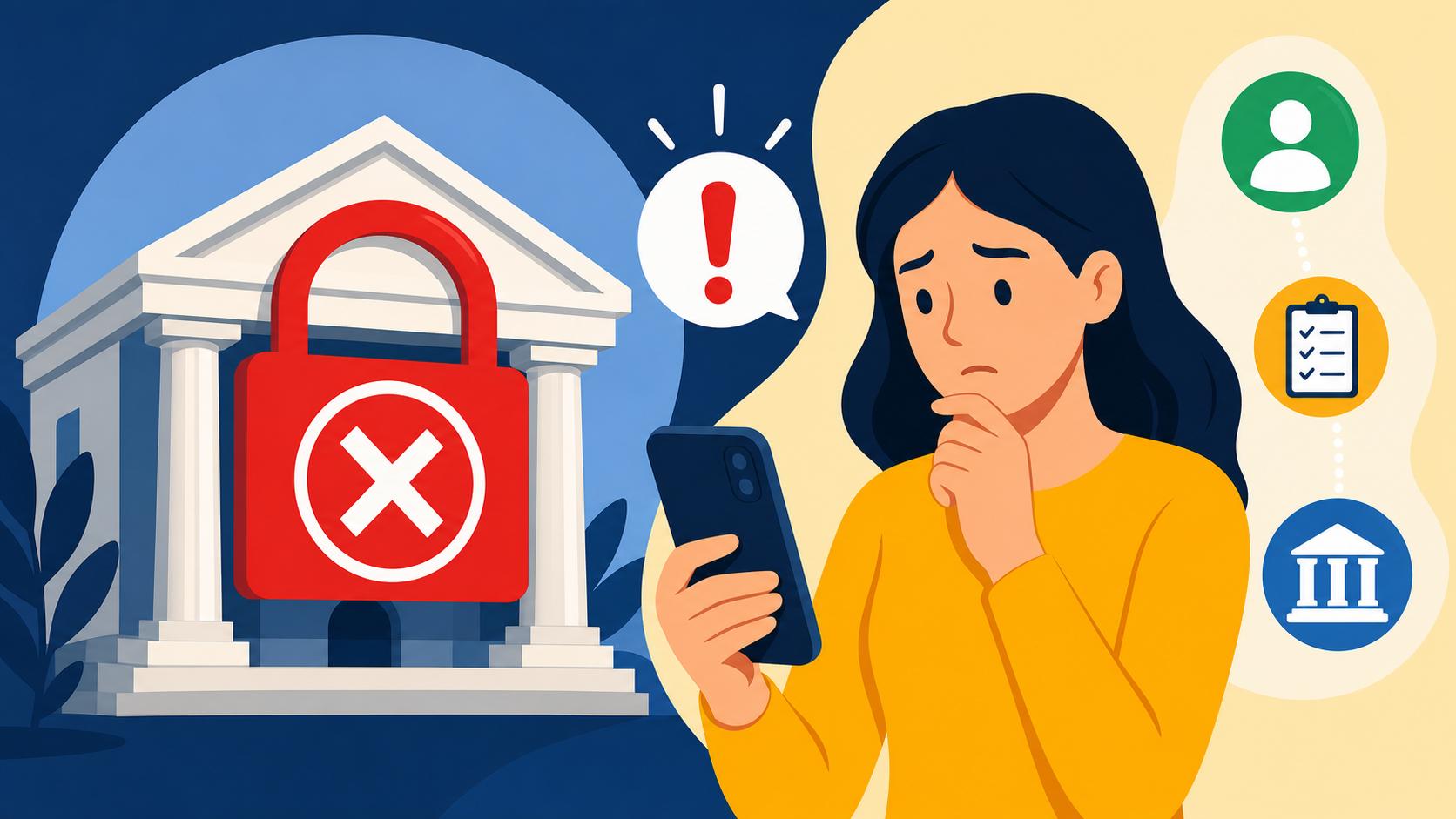
You tap your banking app to pay rent and get an error. Your card is declined at Pingo Doce, and the branch says your account is “bloqueada” with no clear reason. In Portugal this happens more often than you would expect, especially to foreigners. This guide explains why Portuguese banks freeze accounts, how to find the real cause quickly, and how to unlock your money without losing weeks.
Why Portuguese Banks Freeze Accounts Without Warning
When it happened to me, I stood in a Millennium bcp branch in Lisbon with a queue behind me, trying to understand a clerk who kept repeating “falta atualizar os dados.” I felt like I’d done something criminal. I hadn’t. Most freezes in Portugal are administrative, and once you know which category yours falls into, the fix is usually predictable.
Portuguese banks operate under strict anti-money-laundering rules supervised by the Banco de Portugal. Banks are legally required to keep your identity, address, tax number and profession current. If anything in your file goes stale, or a transaction looks unusual for your profile, many banks restrict the account first and ask questions afterwards.
Outdated Identity Documents and the KYC Update Request
The most common trigger for expats is the “atualização de dados”, the KYC (know your customer) refresh. Banks periodically ask clients to confirm their details. The request often arrives as a letter in Portuguese, an in-app banner you dismissed, or an email that went to spam. If you don’t respond within the deadline the bank sets, it may limit debits, block your card or freeze online banking.
The second document trap is your residence card. If the bank has your card’s expiry date on file and that date passes, its system can automatically flag the account, even if you have already applied to AIMA to renew it. Newcomers can be locked out of their salary for this reason alone. For that scenario, see What to do if your bank freezes your account because your residence card expired and Dealing with AIMA Backlogs: What to Do If Your Card Expires.
A mismatched address can cause the same problem. If Finanças still lists your old foreign address and the bank’s records show a Portuguese one, the compliance team may ask you to reconcile them. Changing your NIF address from a foreign country to your Portuguese address walks through updating your tax record.
Garnishment Orders From Finanças, Social Security or the Courts
This one stops people in their tracks: a “penhora”, a legal seizure order. The Autoridade Tributária (Finanças), Segurança Social or a court enforcement agent (agente de execução) can order your bank to freeze funds to cover an unpaid debt. Often you never received the original notice, because it went to an old address or to a Via CTT inbox you never activated.
Common examples include an unpaid IUC car tax, a missed IRS installment, a freelancer’s overdue Social Security contributions, or an unpaid toll fine that escalated into a tax debt. The bank is not your adversary here. It is legally obliged to follow the order and usually cannot lift it on its own.
The law protects a minimum portion of income from seizure, a threshold tied to the national minimum wage, so a garnishment should not leave you with literally nothing. Banks do not always apply that protection automatically, especially if your income arrives from abroad. You may need to request it.
Fraud Alerts and Unusual Transaction Patterns
The third category is behavioural. Large incoming international transfers, cash deposits, many small payments from strangers, or funds arriving from cryptocurrency exchanges can trigger a compliance review. Picture a newly arrived retiree moving the proceeds of a house sale, or a freelancer whose clients suddenly pay much more. To a bank’s monitoring system, both look different from the profile you described when you opened the account.
Crypto off-ramping is a frequent trigger. Withdrawing euros from Binance to a Portuguese bank account is legal, but many traditional banks treat exchange transfers as higher risk and ask for proof of where the money came from. The same applies to large inheritances. How to legally transfer an overseas inheritance into a Portuguese bank account explains how to document that type of transfer before it lands.
Sometimes the freeze protects you. If someone tried to access your account from an unfamiliar device or your card was skimmed at an ATM, the bank may lock everything until you confirm your identity.
Step-by-Step: What to Do the Moment You Discover the Freeze
Panic makes the next hour messy. When my account was locked, my instinct was to fire off angry emails in English. That got me nowhere. A calm, structured approach works far better with Portuguese banks, where a phone call or a branch visit usually achieves more than written messages.
Your First Day Action Plan
- Check your app, email, spam folder and physical mail for any notice from the bank, Finanças or Segurança Social. Also log in to the Portal das Finanças and check your messages and any Via CTT electronic mailbox linked to your NIF.
- Call the bank’s customer line and ask directly: “Qual é o motivo do bloqueio da minha conta?” (What is the reason for the block on my account?). Ask whether it is a full block or only a restriction on debits or cards.
- Ask whether the block was placed by the bank itself or by an external entity. This one answer determines everything that follows.
- If it’s external, ask for the name of the entity, the process number (número do processo) and the amount frozen.
- If it’s internal, ask exactly which documents they need and whether you can submit them through the app or must visit a branch.
- Write down the date, time, name of the person you spoke with and what they said. You will need this if you escalate.
- Book an appointment at your branch rather than walking in. Many branches handle compliance cases only by appointment.
What to Bring to the Branch
Bring more than you think you need. A branch employee can’t scan a document you left at home, and a second visit costs you days.
- Your passport and your residence card, or AIMA’s proof of your renewal application if the card has expired
- Your NIF document or a printout from the Portal das Finanças
- Recent proof of address, such as a utility bill in your name or your registered rental contract
- Proof of income: payslips, an employment contract, pension statements or recent invoices if you’re self-employed
- For large transfers, the source-of-funds paperwork: a property sale deed, inheritance documents, brokerage statements or exchange transaction history
- A Portuguese-speaking friend, or a translation app downloaded for offline use
Keeping Your Life Running While You Wait
Even a simple fix can take days, so protect your essentials. Rent, utilities and direct debits will bounce, and a bounced direct debit for electricity or a gym contract can create fees and new headaches. Tell your landlord early. In my experience, Portuguese landlords respond much better to a proactive message than to a missed payment.
This is where a second account at a different institution earns its keep. A Wise multi-currency account can receive euros through a SEPA transfer and pay your rent. A Trade Republic account, or one at a neobank, can act as a backup for card spending. Neither replaces a traditional Portuguese bank for everything, but having one already set up means a freeze is an inconvenience, not a crisis. For options, see Online and Neobanks in Portugal: ActivoBank, Moey!, Revolut, and N26.
If your salary or pension is paid into the frozen account, ask your employer or pension provider whether they can temporarily redirect the next payment. Do this only for internal compliance blocks. With a court or tax garnishment, moving income to dodge the order can create legal trouble.
Fixing the Root Cause Depending on Who Froze Your Account
Once you know the source, the path splits. The table below summarises the most common scenarios.
| Cause of the freeze | Typical signs | Who can lift it | What usually resolves it |
|---|---|---|---|
| KYC data update | App banner, letter asking to “atualizar dados” | Your bank | Submitting updated ID, address and income documents |
| Expired residence card | Freeze around the card’s expiry date | Your bank | AIMA renewal proof or new card |
| Tax debt garnishment | Specific amount frozen, notice from Finanças | Autoridade Tributária | Paying the debt, a payment plan or a formal challenge |
| Social Security garnishment | Freeze linked to contributions | Segurança Social | Settling arrears or agreeing to installments |
| Court enforcement | Contact from an agente de execução | The enforcement agent or court | Settlement, payment or legal opposition |
| Fraud or AML review | Sudden block after a large or unusual transfer | Your bank’s compliance team | Source-of-funds documentation |
| Suspected account compromise | Block after login or card alerts | Your bank | Identity verification and new credentials |
Clearing an Internal Bank Block
If the bank placed the block itself, you’re in the best position. Submit everything requested in a single, complete package, and ask the employee to confirm in writing, or at least in the app, that the documents have been received. Then ask for the expected review time. Compliance teams often sit in Lisbon or Porto headquarters, not your local branch, so the person in front of you may not be able to lift the block on the spot.
For source-of-funds reviews, write a short timeline of the money: where it came from, why you moved it and what it’s for. Attach every supporting document in order. A clear one-page explanation can turn a weeks-long back-and-forth into a quick approval. If the funds came from investments, add brokerage statements or exchange records showing your original purchases. For US citizens, compliance questions sometimes overlap with reporting obligations; see US Expats: Do Portuguese banks report my balance directly to the IRS via FATCA?.
Handling a Garnishment From Finanças or Segurança Social
With a penhora, go straight to the source. Log in to the Portal das Finanças, open the section for tax enforcement processes, and you should see the debt, the process number and the amount owed, including interest and costs. Segurança Social Direta shows contribution debts in a similar way.
You generally have three routes. You can pay the debt in full, after which the authority notifies the bank to release the funds. You can request a payment plan, which in many cases leads to the seizure being lifted or reduced. Requesting a payment plan for a large IRS tax bill in Portugal explains that route. Or, if you believe the debt is wrong, for example a tax charged to an address you’d already left or an IUC for a car you’d sold, you can file a formal challenge within the legal deadlines.
If the seizure has frozen more than the protected minimum and you need money to live on, put a written request to the enforcing entity to respect the unseizable portion, attaching proof of your income. This is a situation where professional help is often worth paying for. Finding an English-Speaking Certified Accountant (Contabilista Certificado) can point you to someone who can read the enforcement file and spot errors quickly.
When the Block Lingers With No Explanation
Sometimes you do everything right and the account stays frozen. You call, they say it’s “em análise” (under review), and nothing changes. At that point, stop chatting and escalate formally, which the next section covers.
Escalating, Complaining and Preventing the Next Freeze
Portuguese consumer protection in banking is stronger than many newcomers realise. Banks must respond to formal complaints, and the regulator takes them seriously.
Formal Complaint Channels That Actually Work
- Submit a written complaint directly to the bank through its official complaints channel. Include your account number, a timeline of every contact and the documents you have already provided. Ask for a written explanation of the block and its legal basis.
- If the response is unsatisfactory or never arrives, file a complaint through the Livro de Reclamações, either the physical book at the branch or the electronic version. A copy goes to the Banco de Portugal. For how the system works, see What is the ‘Livro de Reclamações’ and how does it solve consumer disputes?.
- Submit a complaint directly to the Banco de Portugal through its Portal do Cliente Bancário. The regulator will contact the bank and ask for an explanation.
- For disputes involving money owed to you, consider one of the banking dispute resolution centres that handle consumer cases, which are usually faster and cheaper than going to court.
- If a garnishment appears to be legally wrong, speak to a lawyer, ideally one who handles tax enforcement.
Keep every message polite and factual. Portuguese institutions respond well to formality and paper trails, and a clearly documented complaint carries far more weight than an emotional one.
If the Freeze Was Fraud-Related
If the block came after suspicious activity on your card, confirm whether any unauthorised transactions went through. You have rights to dispute them, and acting quickly matters. Consumer rights: How to dispute a fraudulent credit card charge in Portugal covers the process step by step. Ask the bank to issue a new card and reset your online banking credentials, and enable notifications for every transaction going forward.
How to Prevent Another Freeze
After my own freeze, I put a few habits in place, and I haven’t had a problem since.
- Respond to every “atualização de dados” request immediately, even if it seems routine.
- Upload your renewed residence card, or AIMA’s proof of your renewal application, the day you receive it.
- Keep your address consistent across the bank, Finanças and Segurança Social.
- Activate Via CTT and check the Portal das Finanças messages every month, so tax notices never reach you only after a seizure.
- Tell your bank in advance before any large incoming transfer, such as a property sale, an inheritance or crypto proceeds.
- Keep a second account with a different provider so a single freeze never cuts off rent and groceries.
- Use SEPA direct debits carefully. Paying utility bills automatically: Setting up SEPA Direct Debits on your bank app helps you track what leaves your account and when.
When you move large sums in the other direction, preparation matters too; see Transferring money out of Portugal: Limits and reporting rules for large sums. If you’re weighing whether your current bank suits your situation as a foreigner, Opening a Bank Account in Portugal: Best Banks for Foreigners and Expats compares the main options.
A frozen account feels like a door slamming in your face, especially in a country where you’re still learning the language and the system. But in the vast majority of cases it’s a paperwork problem with a paperwork solution. Find out who froze it, give them exactly what they need, keep records of everything and escalate formally when the process stalls.
Disclaimer
This article is for general informational purposes only and does not constitute professional advice. Laws, prices and regulations vary by location and change over time. Consult a qualified professional for guidance on your specific situation.