Understanding the Manchester Triage System colors in Portuguese emergency rooms
Walking into a packed Portuguese emergency room for the first time can feel like stepping into a confusing, high-stakes lottery where you do not speak the language and the rules are unwritten. I remember sitting in the fluorescent-lit waiting area of Hospital de Santa Maria in Lisbon with a searing abdominal pain, watching people arrive after me but get called in first, feeling utterly forgotten. This guide will demystify the Manchester Triage System used throughout Portugal so you know exactly what your wristband color means for your wait time and your care.
The Reality of the Portuguese Urgência System
In Portugal, the emergency department is known as the Urgência. Whether you are in a massive public teaching hospital like São João in Porto or a local facility in the Algarve, the first person you see—after the administrative check-in—is the triage nurse. This process is not a "first-come, first-served" system. Instead, Portugal utilizes the Manchester Triage System (MTS), a clinical risk management tool used worldwide to ensure that the most critically ill patients are seen first.
When you arrive, the administrative staff will ask for your ID and your health number. If you are a resident, you should have already completed the process of Registering with the Centro de Saúde: Getting Your SNS Número de Utente. Without this number, the process becomes significantly more expensive and administratively burdensome. Once you are checked in, you are sent to a small room where a nurse will take your vitals—blood pressure, heart rate, temperature, and oxygen levels—and ask you a series of questions about your symptoms. Based on your answers and your vitals, you will be handed a colored wristband (pulseira). This color determines your fate for the next several hours.
The stress of waiting in a crowded ER can be overwhelming, especially if you are already feeling unwell. Expats often get incredibly frustrated, assuming that the long wait is a sign of a failing system, but often, it is simply the triage system working as intended—prioritizing life-threatening cases over minor ones. To better prepare for your life in Portugal, it is worth reading through a Healthcare in Portugal for Expats: The Complete 2026 Medical Guide to understand the broader context of how these hospitals function.
Breaking Down the Five Triage Colors
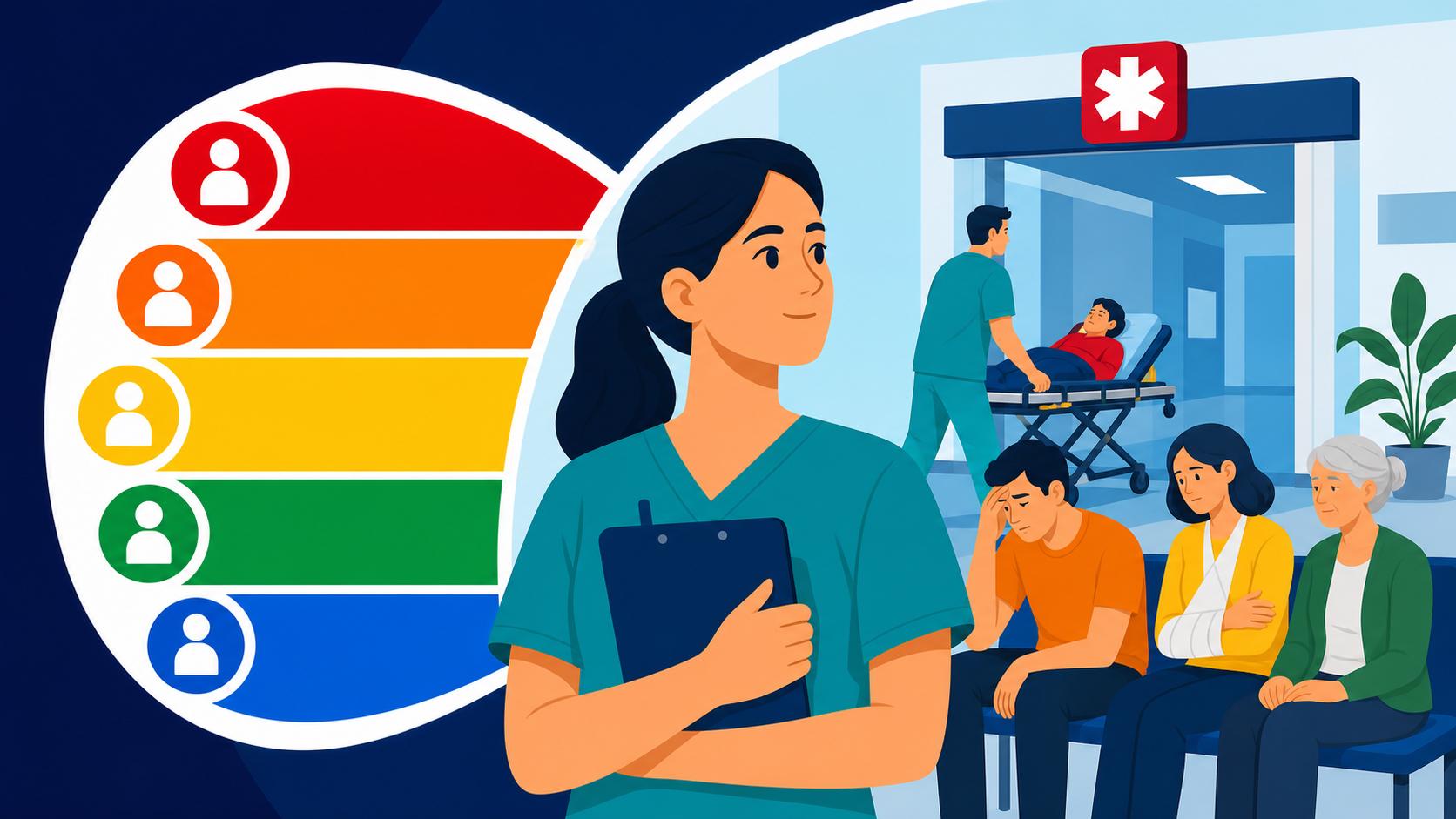
The Manchester Triage System uses five distinct colors to categorize the urgency of a patient's condition. Understanding these colors is the key to managing your expectations and knowing whether you should settle in for a long wait or expect immediate intervention.
Red: Emergência (Immediate)
A red bracelet is reserved for life-threatening situations where the patient requires immediate medical attention. There is no wait time for a red patient; they are taken straight to the "Sala de Reanimação" (Resuscitation Room). This category includes cardiac arrest, severe respiratory distress, massive trauma, or unconsciousness. If you or someone you are with is in this state, you likely arrived via ambulance after Emergency Medical Care in Portugal: Calling 112 and Going to the Hospital. In these cases, the triage happens almost instantaneously upon arrival.
Orange: Muito Urgente (Very Urgent)
The orange bracelet signifies a very serious condition that is not immediately life-threatening but could become so very quickly. The target wait time to see a doctor is 10 minutes. Common scenarios for an orange bracelet include suspected strokes, severe chest pain that isn't yet a confirmed cardiac arrest, major bone fractures, or severe burns. Even though 10 minutes is the target, in a busy public hospital, this can sometimes stretch slightly, but you will be monitored closely by the nursing staff in the meantime.
Yellow: Urgente (Urgent)
A yellow bracelet is perhaps the most common for serious but stable conditions. The target wait time is 60 minutes. This is for patients who need medical intervention to prevent their condition from worsening, such as moderate pain, high fever that doesn't respond to medication, or significant but non-life-threatening injuries. If you are an expat with Private Health Insurance in Portugal: Costs, Coverage, and Best Providers, you might find that the wait for a yellow bracelet in a private hospital is much closer to that 60-minute mark than in a public one.
Green: Pouco Urgente (Less Urgent)
The green bracelet is for minor injuries or illnesses. The target wait time is 120 minutes, but in reality, in large public hospitals like Hospital de São José, a green patient can wait anywhere from four to twelve hours. This category covers things like sprains, minor cuts needing stitches, or persistent but stable coughs. Many people who receive a green bracelet would be better served at their local health center, but because those are often overbooked, the ER becomes the default.
Blue: Não Urgente (Non-Urgent)
A blue bracelet indicates a condition that is not an emergency at all. The target wait time is 240 minutes, but these patients are the lowest priority and will always be bumped by a newer arrival with a red, orange, or yellow bracelet. This is for chronic issues, repeat prescriptions, or very minor colds. If you receive a blue bracelet, the staff may even suggest you go home and visit a primary care doctor instead.
| Color | Priority Name | Target Wait Time | Typical Scenarios |
|---|---|---|---|
| Red | Emergência | Immediate | Cardiac arrest, unconsciousness |
| Orange | Muito Urgente | 10 Minutes | Suspected stroke, severe chest pain |
| Yellow | Urgente | 60 Minutes | Severe pain, high fever, stable injuries |
| Green | Pouco Urgente | 120 Minutes | Minor wounds, sprains, mild infections |
| Blue | Não Urgente | 240 Minutes | Common cold, chronic issues, prescriptions |
Why the System Often Feels "Broken" to Foreigners
The most significant culture shock for many expats is the sheer volume of "Green" and "Blue" cases in the public ER. Because the primary care system in Portugal is often backlogged, locals use the ER for things that would normally be handled by a family doctor. This leads to the infamous "wait times" you see on the news.
Because he was assigned a green bracelet, every single ambulance arrival and every yellow-coded elderly patient was moved ahead of him. It felt personal, but it wasn't. The nurses are following a strict clinical algorithm. If your vitals are stable, you are simply not the priority.
This is where having a backup plan is essential. Many expats choose to use Using Cigna Global or Allianz for international expat healthcare in Portugal to gain access to private emergency rooms. In places like Hospital da Luz and CUF: Navigating Portugal's Biggest Private Hospitals, the triage system still exists, but because the volume of non-urgent patients is lower, the actual wait time for a green or yellow bracelet is usually a fraction of what you would experience in the public system.
Practical Alternatives Before You Head to the ER
Before you rush to the hospital and potentially face a six-hour wait with a green bracelet, there are several steps you should take. Portugal has an excellent triaging system that starts before you even leave your house.
- Call the SNS 24 Helpline: Always call 808 24 24 24 first. This is the SNS 24 Helpline (808 24 24 24): Triage, Advice, and Sick Notes. They have English-speaking nurses who will perform a "tele-triage." If they decide you need the ER, they will send a referral directly to the hospital, which can sometimes (though not always) speed up the administrative side of your arrival.
- Visit a Pharmacy: For minor ailments, Portuguese pharmacists are highly trained and can provide much more than just Pharmacies and Medication in Portugal: Prescriptions and OTC Drugs. They can often recommend over-the-counter treatments for minor infections or skin issues.
- Check the Wait Times Online: The SNS (Serviço Nacional de Saúde) website and app provide real-time wait times for every public hospital in the country, broken down by triage color. If the hospital nearest to you has a 10-hour wait for green, and one twenty minutes away has a 2-hour wait, it’s worth the drive.
If you do end up needing to stay home and recover after a minor ER visit, I’ve found that keeping a well-stocked medicine cabinet is a lifesaver. I often order my supplements and high-quality recovery aids from iHerb, as they have a better selection of specific vitamins and minerals than many local shops. Having some electrolytes and high-quality Vitamin C on hand can make the "post-ER" recovery much more bearable.
The Financial Side of the Triage
Your triage color doesn't just determine your wait; it can also affect what you pay. In the public system, you are usually required to pay a small co-payment called a taxa moderadora. However, if you are referred to the ER by the SNS 24 line or if you are admitted to the hospital after triage, these fees are often waived.
If you are a tourist or a new expat without an SNS number, the costs are different. You should be aware of How much does an emergency room visit cost without private insurance? to avoid a surprise bill. Generally, a public ER visit for a non-resident can cost around €120 to €200 just for the consultation, plus extras for exams like X-rays or blood tests. If you have international coverage through Cigna Global, you will usually pay upfront and then seek reimbursement, so keep every piece of paper the triage nurse and the doctor give you.
Tips for Surviving the Wait
If you find yourself holding a green or yellow bracelet and the waiting room is full, here is some "veteran" advice:
- Bring a Portable Charger: Public hospitals in Lisbon and Porto are notorious for having very few available outlets. Your phone is your only lifeline to the outside world during a ten-hour wait.
- Don't Eat or Drink Until Cleared: The triage nurse might tell you not to eat or drink in case you need surgery or specific blood tests. Always ask before you head to the vending machine.
- Wear Layers: Hospital waiting rooms are either freezing due to industrial AC or stiflingly hot. I always bring a large scarf or a hoodie.
- Language Matters: While many doctors speak English, the triage nurses and administrative staff might not. Have a translation app ready, or better yet, have your symptoms written down in Portuguese.
- Keep Your Paperwork: After the triage, you will get a slip of paper with a number. Watch the screens carefully. When your number flashes, you move to a secondary waiting area inside the clinical zone.
The Manchester Triage System is designed to save lives, not to provide a comfortable customer service experience. It can be cold and clinical, but knowing that a yellow bracelet means you are stable can actually be a bit of a relief, even if it means a long night in a plastic chair.
Understanding the Manchester Triage System in Portugal Disclaimer
This article is for informational purposes only and does not constitute professional medical advice, diagnosis, or treatment. Always seek the advice of your physician or another qualified health provider with any questions you may have regarding a medical condition. If you are experiencing a medical emergency, call 112 immediately. The wait times mentioned are targets set by the Portuguese Health Ministry and do not reflect guaranteed service times, which fluctuate based on hospital volume and staffing.