How to get your child’s Boletim de Vacinas (Vaccination book) translated
When you first walk into a Portuguese school or a local health center with your child, the first thing they will ask for is the "Boletim de Vacinas." I remember the sheer confusion I felt when the administrator handed back my child’s original yellow immunization card from the US, shaking her head because it wasn't in the "system." This guide solves that specific administrative headache by walking you through how to translate and validate your foreign records.
Understanding the Importance of the Portuguese Boletim de Vacinas
In Portugal, the vaccination record is more than just a medical history; it is a vital administrative key. While the country has a high rate of voluntary vaccination, the National Vaccination Plan (PNV) is the gold standard for public health. If you are planning on Moving to Portugal with Kids: Schools, Childcare, and Family Life, you quickly learn that schools, daycare centers, and even some summer camps require proof that your child’s immunizations are up to date according to Portuguese standards.
The Portuguese system is highly centralized. Every child is issued a physical "Boletim de Saúde Infantil e Juvenil," which contains the vaccination record. However, as the world moves toward digital integration, these records are also stored in the national database. If your child was born abroad, their records essentially do not exist in the eyes of the Portuguese state until they are manually "translated" and entered into the system by a qualified health professional.
School Enrollment and the National Vaccination Plan
When you enroll your child in a public or private school, the secretarial staff will check the records against the PNV. If there is a discrepancy—even if your child is fully vaccinated according to your home country's schedule—the school may flag the file. This is why getting the records sorted early is essential. I spent weeks chasing down an appointment because I didn't realize that the "mapping" of foreign vaccines to Portuguese ones takes more than just a linguistic translation; it requires medical validation.
For those still navigating the initial move, having comprehensive coverage like Cigna Global can provide a safety net while you wait for your public health registration to clear. While the public system handles the vaccinations, private insurance ensures you have access to specialists who can guide you through the transition without the long wait times often found in the public sector.
Accessing Public Healthcare and Daycare Requirements
To access the public health system's free vaccines, you first need to complete your Registering with the Centro de Saúde: Getting Your SNS Número de Utente. Without this number, your child is effectively a ghost in the system. Daycare centers (creches) are particularly strict about this. Because they cater to infants whose immune systems are still developing, they will often refuse a start date until you provide a validated Portuguese vaccination certificate.
If you find yourself waiting for public health appointments, you might consider using iHerb to order high-quality vitamins or supplements that are familiar to you from back home to keep your child's immune system supported during the transition. The stress of moving can take a toll, and having familiar products on hand is a small but significant comfort.
Step-by-Step Guide: Translating and Validating Your Foreign Records
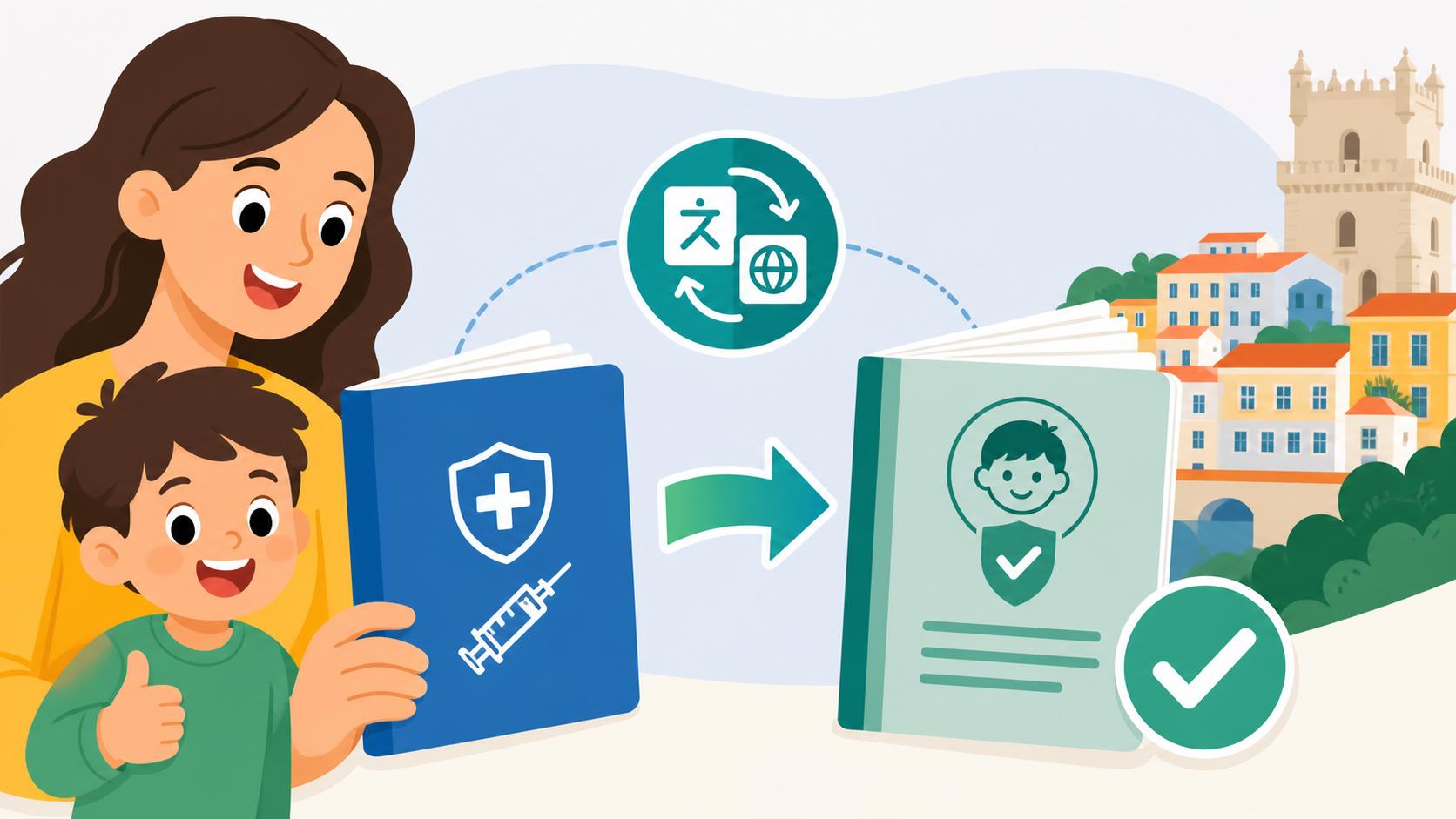
The process of "translating" a vaccination book is actually a two-part process: a linguistic translation and a medical equivalence check. Do not assume that a simple English-to-Portuguese translation from a certified translator is enough to satisfy the Centro de Saúde. You need the data to be officially recognized by a Portuguese doctor.
Obtaining an Official Translation
If your child's records are in a language other than English or Portuguese, you will almost certainly need a certified translation first. Even if they are in English, some stricter health centers in rural areas may still request a Portuguese version. You should look into the specific requirements for Translating and Certifying Documents for Portuguese Immigration to ensure the translator you hire is recognized by Portuguese authorities.
A certified translation usually involves a professional translator who signs a statement in front of a notary or lawyer. However, the most important part of the document is the list of vaccine names, dates of administration, and batch numbers. Make sure these are clearly legible. If the original handwriting from your pediatrician back home is messy, try to get a typed summary before you leave your home country.
The Role of the Médico de Família at the Centro de Saúde
Once you have your translated records (if necessary) and your original documents, you must book an appointment with a nurse or a Finding an English-Speaking General Practitioner (Médico de Família) at your local health center. This is where the actual "translation" happens. The professional will sit with the PNV chart and your child’s records, manually entering each dose into the Portuguese digital system.
In some cases, you might find that Why does my Centro de Saúde say they have no Médico de Família available? is a reality in your neighborhood. If this happens, you can still request a "consulta de recurso" or speak directly to the nursing department specifically for vaccinations. They are often more flexible with vaccine entries than they are with general medical consultations.
| Document Type | Who Provides It | Purpose in Portugal |
|---|---|---|
| Original Vaccine Card | Your home country pediatrician | Primary evidence of immunization |
| Certified Translation | Professional Translator | Overcoming language barriers for staff |
| SNS Digital Record | Portuguese Health Center | Official proof for schools and residency |
| Medical Equivalence Note | Portuguese Doctor/Nurse | Validating that foreign vaccines meet PNV standards |
Navigating the Administrative Hurdles at the Health Center
Prepare yourself for a bit of "wait and see" when you visit the Centro de Saúde. I remember sitting in a plastic chair for two hours just to be told that the nurse who handles the "foreign entries" was on lunch. To avoid this, try to go early in the morning and bring a book (and snacks for the kids).
What to Bring to Your Appointment
To make the process as smooth as possible, arrive with a folder containing:
- Your child’s original vaccination record.
- The translated version (if the original is not in English or Portuguese).
- Your child’s passport and Health Coverage for Dependents: Registering Children and Spouses in the SNS.
- Proof of address (like an Atestado de Morada from your Junta de Freguesia).
- Your own NIF and residence permit.
The nurse will look for specific vaccines like BCG (Tuberculosis), which is common in Portugal but not always in other Western countries. If your child is missing a vaccine that is mandatory on the Portuguese schedule, they will likely offer to administer it right then and there for free. Having Cigna Global can be a great backup if you prefer to have these discussions with a private pediatrician first to understand the differences in schedules.
Dealing with Missing Doses or Non-Equivalent Vaccines
Sometimes, the brand names of vaccines used in your home country don't exist in Portugal. This is where the nurse's expertise comes in. They use a mapping system to correlate, for example, the US "MMR" with the Portuguese "VASPR." If the schedules don't align perfectly—perhaps your home country gives a booster at age 4 while Portugal gives it at age 5—the nurse will guide you on when to return.
If you are feeling overwhelmed by the medical jargon, remember that you can always call the SNS 24 Helpline (808 24 24 24): Triage, Advice, and Sick Notes. They have English-speaking operators who can explain how the PNV works and what to do if you suspect your child is missing a dose. It’s a fantastic resource that many expats overlook.
Practical Tips for Expat Parents in Portugal
Once the data is entered, you won't necessarily get a new "yellow book" immediately. Instead, the nurse will print out a "Boletim de Vacinas" from the computer system. This paper is gold. Make multiple copies and scan it into your phone immediately.
Keeping Your Digital Records Updated via the Portal do Utente
The best way to manage your child’s health in the long term is to register for the "Portal do Utente." This is an online dashboard where you can see all recorded vaccinations, upcoming appointments, and even download the "Certificado de Vacinação." It saves you from having to visit the health center every time a school asks for an update.
For routine health needs, you might still prefer Finding an English-Speaking pediatrician (Pediatra) for your baby in the private sector. Private hospitals like CUF or Hospital da Luz have excellent pediatric wings. Even if you use a private doctor for check-ups, ensure they send the vaccination data to the public system, or take the private records to your Centro de Saúde periodically to keep the national database current.
Managing Your Child's Health Beyond Vaccinations
Relocating to a new climate can bring about unexpected allergies or minor illnesses. While you are waiting for the bureaucracy to settle, you can use iHerb to source child-friendly probiotics or organic remedies that might be harder to find in a standard Portuguese Farmácia. While Portuguese pharmacies are excellent, they often carry different brands than what you might be used to in London or New York.
Lastly, don't forget that Pediatric Care in Portugal: Vaccinations and Child Health Checks are a standard part of life here. The system is designed to support you, even if the initial paperwork feels like a mountain. Once you have that "Boletim" in hand, you'll feel a massive sense of relief, knowing your child is officially protected and recognized by the Portuguese healthcare system.
If you ever feel lost, remember that many of us have stood in those same lines. The "I've-been-there" reality of Portuguese administration is that it eventually works; it just requires a little patience and the right set of documents. Having international coverage from Cigna Global during these transitions ensures that no matter how slow the local health center might be, your child's health is never compromised.
Disclaimer
This guide is provided for informational purposes only and does not constitute official legal or medical advice. Procedures at Portuguese health centers (Centros de Saúde) can vary significantly by region and individual staff discretion. Always verify current requirements with your local health authority or the Serviço Nacional de Saúde (SNS). For specific medical concerns regarding vaccinations, consult a qualified healthcare professional in Portugal.