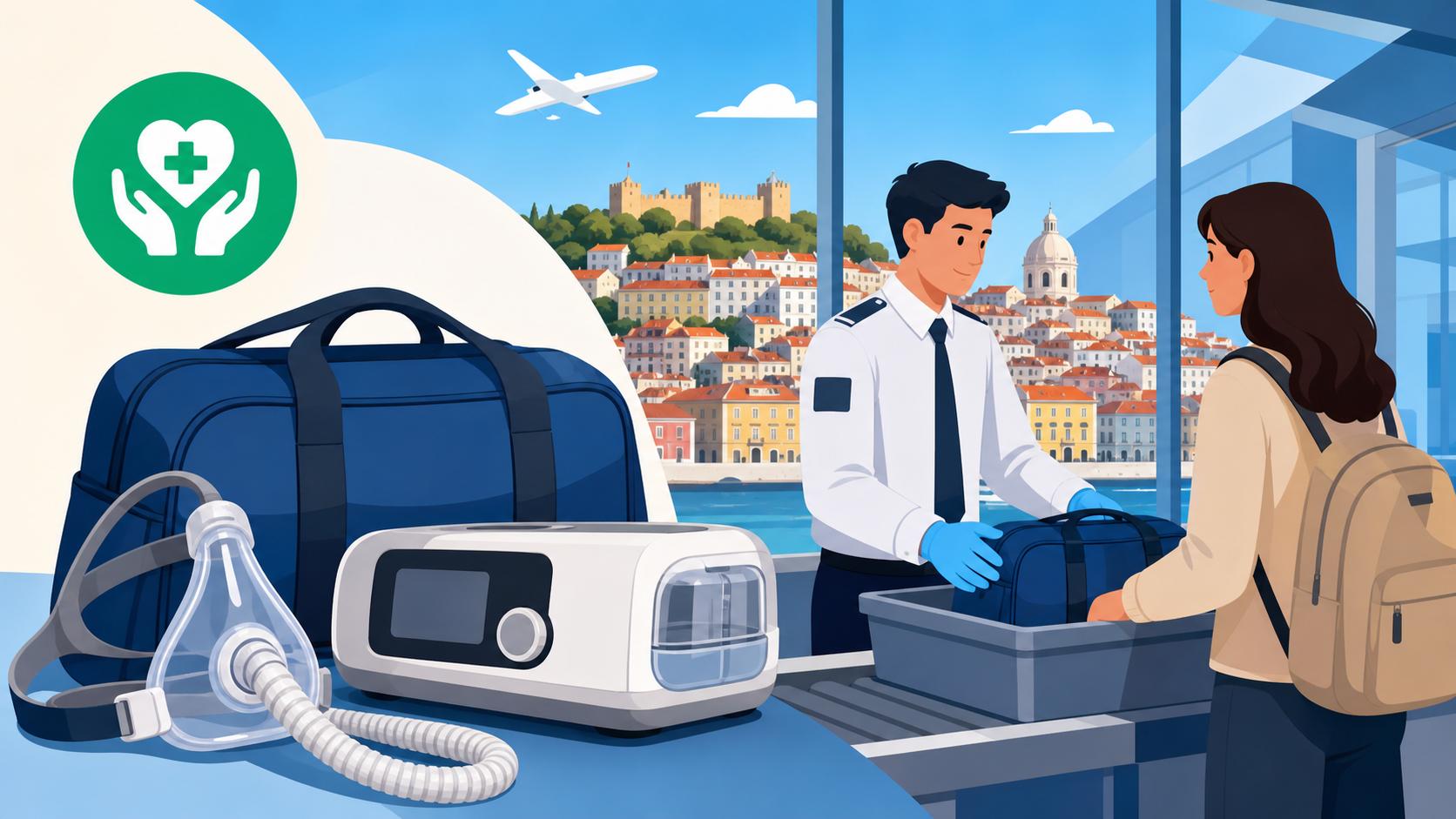
Bringing a CPAP machine or specialized medical equipment through Lisbon airport
Flying with medical equipment like a CPAP machine or specialized mobility aids can turn a dream move to Portugal into a logistical nightmare. I still remember the cold sweat I broke into at Humberto Delgado Airport when a customs official pointed at my specialized respiratory case with a look of deep suspicion. This guide solves the confusion around airline notifications, Portuguese customs declarations, and sourcing essential supplies once you land in Lisbon.
Preparing for Your Flight: Airline Regulations and Documentation
Navigating the skies with specialized medical equipment requires a proactive approach that begins long before you reach the check-in desk. Most major airlines flying into Lisbon, such as TAP Air Portugal, Lufthansa, or Emirates, have specific protocols for "Medical Portable Electronic Devices" (M-PEDs). It is not enough to simply show up; you must verify if your specific CPAP model is FAA-approved for in-flight use if you plan to use it during a long-haul crossing. Even if you do not intend to use the machine mid-flight, notifying the airline at least 48 to 72 hours in advance is standard etiquette and often a regulatory requirement to ensure the device is not counted against your carry-on luggage allowance.
The most critical piece of paper in your possession should be a "Medical Necessity Letter" from your doctor. This letter needs to be explicit, stating your diagnosis, the necessity of the device, and a full description of the equipment including its serial number. In Portugal, bureaucracy is a national pastime, and having this document translated into Portuguese can save you an hour of circular gesturing at the security gate. While many officials at Lisbon airport speak excellent English, a translated document shows respect for local procedures and leaves no room for "lost in translation" moments regarding your health.
Furthermore, ensure you have a comprehensive insurance policy that covers specialized equipment. If you are moving here permanently, looking into Private Health Insurance in Portugal: Costs, Coverage, and Best Providers is a wise move, as many local plans can be supplemented with international coverage. For those who travel frequently with high-value medical gear, a policy through Cigna Global can provide the peace of mind that your equipment is protected not just in the air, but also once you are settled in your new Portuguese home.
Battery Safety and Power Specifications
Lithium-ion batteries are the primary concern for airline security. If your CPAP or medical device relies on an external battery pack, you must check the Watt-hour (Wh) rating. Most airlines allow batteries up to 100Wh in carry-on luggage without prior approval, but anything between 100Wh and 160Wh usually requires a green light from the carrier’s dangerous goods department. Never pack these batteries in your checked luggage; the pressure and temperature changes in the hold are a fire risk that security will not tolerate.
When you arrive at the security screening in Lisbon's Terminal 1, be prepared to remove the CPAP machine from its carrying case, much like a laptop. It is helpful to place it in a clear plastic bag to keep it hygienic as it passes through the bins. Mentioning the term "equipamento médico" (medical equipment) to the staff usually triggers a more delicate handling process. If you are also carrying liquid medications or distilled water for the trip, keep them in a separate, accessible pouch. For broader context on health regulations, you might want to review Healthcare in Portugal for Expats: The Complete 2026 Medical Guide to understand how your medical needs fit into the larger system.
Documentation Checklist for Lisbon Customs
Upon landing, you will pass through the "Alfândega" (Customs). If your equipment is for personal use and is clearly used gear, you typically proceed through the Green "Nothing to Declare" channel. However, if you are bringing brand-new, high-value specialized equipment in its original packaging, you might be flagged for import duties. To avoid this, keep your original purchase receipts and your medical necessity letter handy. The goal is to prove that the item is a medical necessity for a resident or long-term visitor, not an item intended for resale in the EU.
If you are entering Portugal on a D7 or D8 visa, your status as a future resident gives you certain rights regarding the importation of personal effects. However, customs officials can be sticklers for the rules. If you find yourself in a complex situation regarding medical imports, it may be helpful to know the protocols for Bringing Prescription Drugs to Portugal: Customs and Import Rules to ensure your entire medical kit is compliant with Infarmed (the Portuguese pharmacy regulator) standards.
Navigating Lisbon Airport: Customs and Security Realities
Lisbon's Humberto Delgado Airport is notoriously busy, and the layout can be confusing for newcomers. Once you deplane, follow the signs for "Bagagem" (Baggage) and "Saída" (Exit). If you are carrying a CPAP, a portable oxygen concentrator, or a dialysis machine, the physical weight can be a burden. If you require assistance, you must book the "MyWay" service at least 48 hours before your flight. This is the airport's specialized assistance service that helps passengers with reduced mobility or heavy medical equipment navigate from the gate through customs and to the arrivals hall.
The "Nothing to Declare" channel is your likely path, but don't be surprised if you are randomly selected for a bag scan. If this happens, remain calm and immediately state that you are carrying medical equipment. Use the phrase "É para uso pessoal médico" (It is for personal medical use). In my experience, the officers at Lisbon are generally empathetic toward health needs, provided you aren't trying to hide other dutiable goods like excessive tobacco or alcohol alongside your medical gear.
| Equipment Type | Typical Airline Action | Lisbon Airport Requirement | Suggested Documentation |
|---|---|---|---|
| CPAP Machine | Carry-on only (usually free) | Security scan (like a laptop) | Doctor's Letter (Medical Necessity) |
| Oxygen Concentrator | Prior airline approval needed | Battery check at security | FAA Approval + Doctor's Note |
| Insulin Pumps | Keep on person; notify security | May need manual search | Prescription + Medical ID |
| Dialysis Equipment | Advanced cargo/cabin booking | Customs declaration likely | Full Medical History + Import Cert |
| Wheelchairs | Gate check or cabin stowage | MyWay assistance recommended | Battery Type Cert (if electric) |
Dealing with Alfândega (Customs) for High-Value Gear
If your medical equipment is exceptionally specialized—think high-end ventilators or custom-built mobility chairs—the customs officers might ask for a "Declaração de Importação." For those moving their entire life to Portugal, this is often handled as part of your "Bagagem de Mudança" (household goods move), which allows for the duty-free import of personal items used for more than six months. If you are just visiting, the "Temporary Admission" rule applies, meaning you can bring the equipment in without taxes as long as it leaves with you.
In the rare event that an officer insists on a deposit or tax, do not argue aggressively. Ask for a written explanation and, if necessary, contact your insurance provider. Many expat-friendly insurers, such as Cigna Global, have experience dealing with international logistics and can sometimes provide guidance on local medical regulations. For those already living here, knowing How to get your Número de Utente online without visiting the health center can be useful if you need to register your equipment with the local health system for future subsidies or repairs.
Connectivity and Transport from the Airport
Once you clear customs, you need to get to your accommodation. If you are carrying heavy medical gear, I strongly recommend taking a Bolt or Uber rather than the Metro. The Lisbon Metro is beautiful but involves many stairs and long walks between transfers, which is the last thing you want when lugging a CPAP and a dialysis kit. The ride-share pickup point is located at the departures level (upstairs), which is a common point of confusion for arrivals.
While in the car, you can use the airport’s free Wi-Fi to check for any local medical supply stores if you realized you forgot an adapter. If you need health supplements or niche medical accessories that aren't easily found in Portuguese "Farmácias," many expats use iHerb for reliable shipping into Portugal, though you should be mindful of potential customs delays for large orders.
Sourcing Supplies and Power in Portugal
One of the biggest shocks for North Americans moving to Portugal is the power difference. Portugal operates on a 230V supply and 50Hz frequency, using Type C and Type F plugs. Most modern CPAP machines (like those from ResMed or Philips) are dual-voltage, meaning they can handle 110V to 240V automatically. However, you must verify this by looking at the "Input" section on your device's power brick. If it says 100-240V, you only need a simple plug adapter, not a bulky voltage converter.
Using a voltage converter with a CPAP is generally discouraged as it can lead to inconsistent power delivery, which might damage the sensitive electronics of the machine. If your machine is older and only supports 110V, it is honestly safer and cheaper to purchase a new unit once you arrive in Portugal. You can find specialized medical retailers in Lisbon such as Gasoxmed or VitalAire. If you have already started your residency process, check Registering with the Centro de Saúde: Getting Your SNS Número de Utente to see if you can eventually access these services through the public system.
Distilled Water: Where to Find It
CPAP users know that distilled water is the lifeblood of their humidifier chamber. In the United Kingdom or the US, you can buy this in any grocery store. In Portugal, you are looking for "Água Destilada." You will find it in the cleaning or automotive section of large supermarkets like Continente, Pingo Doce, or Auchan. It is often sold in 5-liter jugs for around €1 to €2.
Be very careful: do not buy "Água Desmineralizada" (demineralized water) if it contains added perfumes for ironing. Look for the label that says it is suitable for medical devices or "uso laboratorial." If you are in a pinch, most local pharmacies will stock smaller, more expensive bottles of pure distilled water. For more information on navigating local shops for health needs, see Pharmacies and Medication in Portugal: Prescriptions and OTC Drugs.
Emergency Repairs and Local Specialists
What happens if your machine's motor dies or your mask seal tears while you're in Lisbon? The private healthcare network in Portugal is excellent for these scenarios. You can book an appointment with a "Pneumologista" (Pulmonologist) at major private facilities. I highly recommend Hospital da Luz and CUF: Navigating Portugal's Biggest Private Hospitals for expats because they have modern equipment and many English-speaking specialists who can write a local prescription for replacement parts.
If you are a resident, you might try the public system, but be prepared for long wait times. If your equipment failure is an emergency—for instance, if you rely on a ventilator—you should know that Emergency Medical Care in Portugal: Calling 112 and Going to the Hospital is the standard procedure. For non-life-threatening issues, the SNS 24 Helpline (808 24 24 24): Triage, Advice, and Sick Notes can provide guidance on where to find the nearest on-call specialist or 24-hour pharmacy.
Long-term Management of Specialized Medical Needs
Living in Portugal with a chronic condition requiring medical equipment means building a local support network. It isn't just about the machine; it's about the maintenance. Filters and tubing need regular replacement. While you can order some parts via iHerb or specialized EU websites, having a local doctor is essential for long-term care. You should start by Finding an English-Speaking General Practitioner (Médico de Família) who can coordinate with your specialists back home.
If you are an EU citizen, you can use your Using the European Health Insurance Card (EHIC) in Portugal for necessary treatments, but this generally doesn't cover the "rental" of equipment like CPAP machines for long-term use. This is where private insurance becomes a necessity. A robust plan can cover the costs of routine check-ups and the calibration of your devices.
Routine Maintenance and Power Stability
Lisbon’s power grid is generally stable, but in older neighborhoods like Alfama or Graça, power surges can happen during winter storms. I strongly recommend plugging your CPAP or any expensive medical device into a high-quality surge protector purchased locally. Do not use a surge protector brought from North America, even with an adapter, as the internal components are not designed for 230V and can become a fire hazard.
Lastly, keep a digital backup of all your medical records on a secure cloud service. If you ever need to visit a local clinic, being able to show your previous sleep study results or equipment settings on your phone will expedite your care significantly. Navigating the Portuguese health system is a marathon, not a sprint, and being prepared with your equipment is the first step toward a successful life in this beautiful country.
Disclaimer
The information provided in this guide is for informational purposes only and does not constitute medical or legal advice. Regulations regarding airline travel and customs can change without notice. Always consult with your healthcare provider, your airline, and the official Portuguese customs authority (AT – Autoridade Tributária e Aduaneira) before traveling with specialized medical equipment.