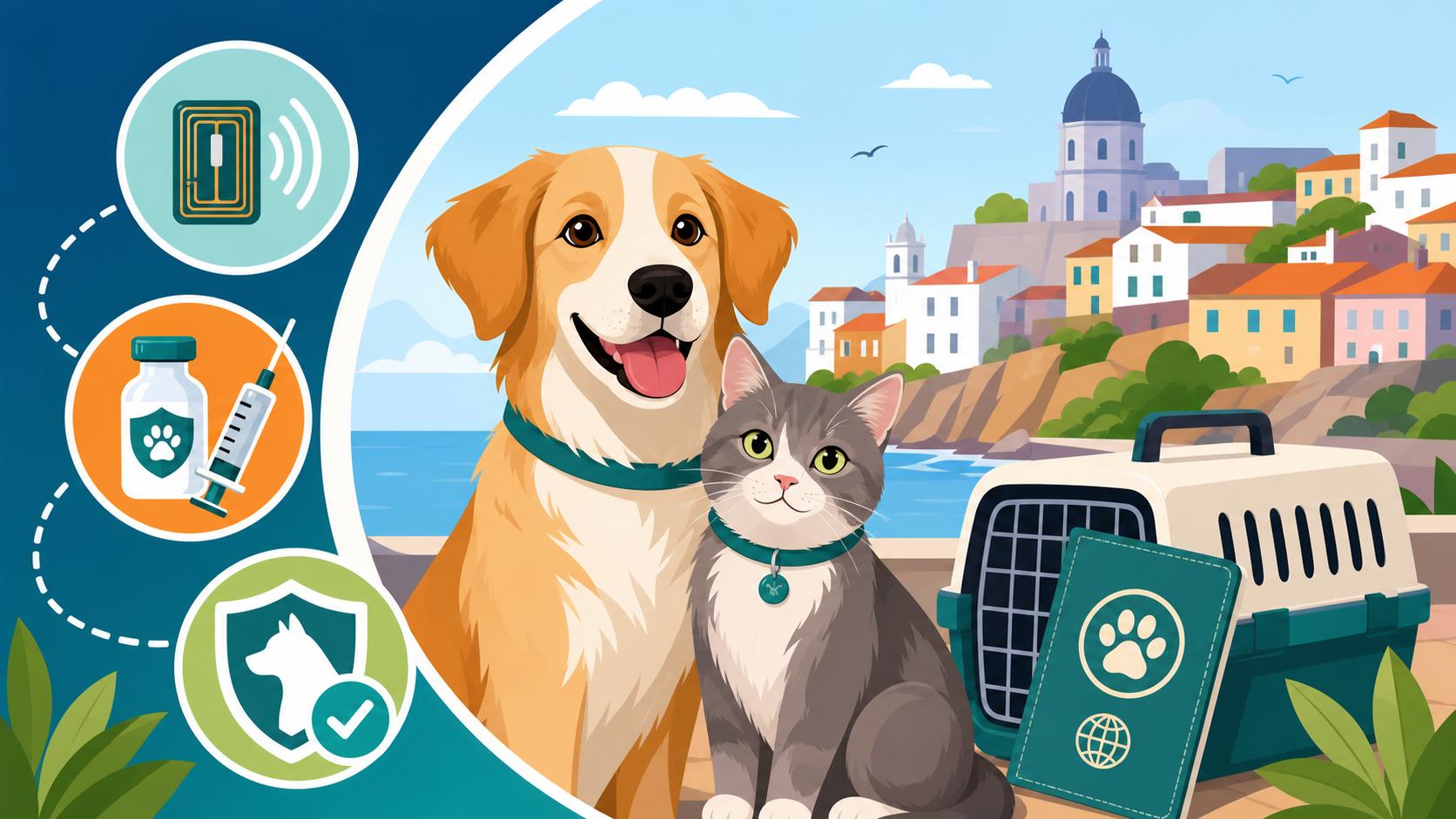
Bringing Pets to Portugal: Microchips, Rabies Vaccines, and EU Pet Passports
Picture this. Your visa appointment is booked and your lease is signed. Then you realize your dog’s rabies shot was given before his microchip was implanted, so on paper it does not count. Every year, pet owners moving to Portugal hit this kind of wall. This guide covers microchips, rabies vaccines, health certificates and EU pet passports in the right order, so your pet arrives with you.
Understanding Portugal’s Pet Entry Rules Before You Book Anything
When I moved to Lisbon, I had a cat named Biscoito who hated carriers and a folder of papers I barely understood. I thought the hard part would be the flight. It wasn’t. The hard part was understanding that EU pet import rules work in a strict sequence. Get the order wrong and the whole chain resets.
Portugal follows the European Union rules for non-commercial pet movement. The country you are coming from shapes most of what you need to do. A Spanish family driving across the border in a weekend has a very different process from an American retiree flying into Lisbon or a Brazilian family arriving at Porto.
Which Category Your Home Country Falls Into
The EU sorts countries into broad groups:
- EU member states. Pets coming from another EU country need an EU pet passport, a microchip and a valid rabies vaccination.
- Listed non-EU countries. These are countries the EU considers low risk for rabies, such as the United States, the United Kingdom, Canada and Australia. Pets need a microchip, a valid rabies vaccine and an EU animal health certificate.
- Unlisted non-EU countries. Coming from one of these adds a rabies antibody blood test, called a titer test, plus a mandatory waiting period before travel.
They had planned to fly within a month of deciding to move. Their vet then explained that the antibody test and its waiting period alone would take far longer than that. They pushed their move back, and their dog Bruno ran on the beach in Cascais a few months later than planned, with no drama at the border. Check which category your departure country sits in before you set a moving date. The EU publishes the official list, and DGAV, Portugal’s veterinary authority, confirms how it applies on arrival.
Transit matters too. If your route stops in a third country, the stopover can affect your pet’s status. Generally, a layover where your pet stays airside, inside the international transit area, is treated differently from leaving the airport. Ask your airline and your vet about any connection before you book.
Microchip First, Vaccine Second
This is the rule that catches people out. Your pet must be microchipped before the rabies vaccination that you will use for entry. The vaccine is tied to the chip number on the paperwork. If the shot came first, it legally belongs to an unidentified animal, and your pet needs to be vaccinated again after chipping.
The microchip should be ISO-compliant, because that is the standard European scanners read. If your pet has an older non-ISO chip, you have two options. You can implant a second, compliant chip, or you can travel with a compatible scanner. Most owners I know chose the second chip because it saves headaches at the airport and at every Portuguese vet visit afterward.
After the first rabies vaccination there is a waiting period before the vaccine counts as valid for travel. Booster shots given on time, before the previous one expires, usually do not restart that waiting period. A booster given after the old vaccine lapsed is treated as a brand-new primary vaccination, and the clock starts over. I keep a calendar reminder for Biscoito’s booster now because I never want to repeat that panic.
Timing Your Pet Prep Around Your Visa
If you are applying for a D7, D8 or other residence visa, your pet’s timeline runs alongside your own paperwork. Each has its own deadlines. Start the pet side at the same time as the visa side, not afterward. For a sense of how early the human process should begin, see How many months early should you start your Portugal visa application process?.
A practical way to think about it is to work backward from your flight date. The health certificate has to be issued and officially endorsed within a short window before arrival. The rabies vaccine needs to be valid and past its waiting period. The microchip must predate the vaccine. If a titer test is required, that test and its waiting period come before all of it.
The Paperwork: Health Certificates and EU Pet Passports
This is where most of the stress lives, and it is completely understandable. You are juggling official stamps, veterinary signatures and timing windows, often while also packing up your whole life. Here is what each document is and when you use it.
The EU Animal Health Certificate for Non-EU Arrivals
If you are coming from outside the EU, your pet travels on an EU animal health certificate. Your home country cannot issue an EU pet passport. The certificate is filled out by an accredited veterinarian and then endorsed by your country’s official veterinary authority. In the United States that is USDA APHIS. In the United Kingdom it is APHA, working through an Official Veterinarian.
Since Brexit, a UK-issued pet passport no longer works for entering Portugal. British owners now need the animal health certificate like any other non-EU traveler. Friends who moved from Bristol to the Silver Coast were caught off guard by this. They assumed their old blue-cover passport still carried weight, then had to rush an appointment with an Official Veterinarian.
The certificate has a limited validity window between being signed and your arrival in the EU. Once your pet has entered, it remains valid for onward travel within the EU for a further limited period. That is handy if you land in Madrid and drive to Portugal. Get the certificate signed as close to departure as the rules allow and keep the original, not a photocopy, with you on travel day.
Getting a Portuguese EU Pet Passport After You Land
Once you live in Portugal, your local vet can issue an EU pet passport. It replaces the one-time health certificate as your pet’s main travel document. With it you can take your dog to France for a holiday or drive into Spain without a fresh government endorsement every time, provided the rabies vaccination stays current.
The vet will scan the chip, check the vaccination history and record everything in the passport. Bring your original health certificate and every vaccination record you have. Whatever the vet cannot verify may need to be redone, and nobody wants to pay for a rabies shot twice.
If you leave Portugal for a country with stricter rules, such as returning to the UK, your EU pet passport still has to meet that country’s own requirements. The UK, for instance, requires tapeworm treatment within a set window before arrival. Portugal does not require it for entry.
Translations and Records From Non-English Countries
The EU animal health certificate is bilingual, written in English and the language of the EU entry country. Older vaccine booklets or lab reports may be in another language, though. If you are coming from a country where veterinary records are in Japanese, Thai or Arabic, for example, a Portuguese vet may struggle to read them. A certified translation from a service like RushTranslate removes that obstacle. For how certified translations are handled more broadly, see Translating and Certifying Documents for Portuguese Immigration.
The same applies to titer test results from a laboratory abroad. Keep the lab report, the translated version and the certificate together in one folder. RushTranslate can handle several documents in one order, which is easier than chasing a translator for each file separately.
| Document | Who Issues It | When You Use It | Main Purpose |
|---|---|---|---|
| EU animal health certificate | Accredited vet, endorsed by your country’s official authority | Arriving from outside the EU | One-time entry into the EU |
| EU pet passport | Licensed vet inside the EU, including Portugal | Living in the EU and traveling within it | Ongoing travel and identity record |
| Rabies vaccination record | Your vet | Every trip and every renewal | Proves valid rabies protection |
| Rabies titer test result | EU-approved laboratory | Arriving from an unlisted country | Proves antibody levels |
| Microchip record | Implanting vet | Always | Links the pet to all other papers |
Getting There: Flights, Airports, and Arrival Day
Arrival day is emotional for everyone, and your pet feels it too. A little planning means the only thing you worry about is whether your cat forgives you for the carrier.
Cabin, Hold, or Cargo
Airlines treat pets in three ways. Small pets can travel in the cabin under the seat. Larger pets can go in the hold as checked baggage. Some pets must travel as manifest cargo, which some airlines require on certain routes. Each airline sets its own weight limits, carrier dimensions and breed restrictions. Snub-nosed breeds like French bulldogs and Persian cats are often restricted in the hold because of breathing risks.
TAP Air Portugal is the most common carrier for direct flights into Lisbon and Porto. Its pet policy is the one I get asked about most. For the specifics, see Bringing a dog to Portugal: TAP Air Portugal pet policy and cabin weight limits. Always confirm pet space when you book, because airlines cap the number of animals per flight and those spots fill fast.
Some owners avoid direct flights to Portugal altogether. They fly into another EU hub with friendlier pet rules for their breed, then drive or take a ferry into Portugal. This works as long as your entry point is an approved travellers’ point of entry and your paperwork is in order. It adds a long day, but for a large dog that cannot fly in the cabin it can feel much safer.
What Happens at Lisbon, Porto, or Faro
When you land from outside the EU, your pet goes through a document and identity check. Officials may scan the microchip and compare it against the certificate. Pets that travel as cargo are usually processed at the airport’s cargo terminal rather than the passenger terminal. That can mean waiting while your pet is cleared and handed over.
Contact the veterinary border services at your arrival airport before you travel. They sometimes expect advance notice, especially for cargo arrivals. DGAV publishes guidance on approved entry points and procedures. Your airline’s cargo team can also tell you what the airport expects.
Have a backup plan for a delay. Pick a pet-friendly hotel near the airport for the first night, and pack a small bag with food, a leash, a collapsible water bowl and any medication. When Biscoito and I landed, our cargo clearance took longer than expected. The fact that I had food and a litter tray ready made the wait much less awful.
Settling In: SIAC Registration and Local Rules
Clearing the airport feels like the finish line, but there is local admin to handle once you are here.
Registering in SIAC and the NIF Question
Portugal keeps a national pet registry called SIAC, the Sistema de Informação de Animais de Companhia. Dogs, cats and ferrets must be registered there. Your local vet usually handles the registration. They link your pet’s microchip to you as the owner and to your Portuguese address. Do it soon after you arrive, because the rules set a deadline for registering imported animals.
The registration asks for owner details, and the vet will usually ask for your NIF, the Portuguese tax number. If you are still waiting for yours, getting it sorted early saves a second trip to the clinic. Bordr can request a NIF remotely before you even land. For the NIF process from abroad, see How to get an NIF remotely using services like Bordr, Anchorless, or e-residence.
Rabies vaccination is mandatory for dogs living in Portugal. Your vet will keep the booster schedule on record. Depending on your municipality, you may also find local rules for dogs at your Junta de Freguesia, the parish council. Ask your vet whether anything is needed beyond SIAC where you live.
Dangerous Breed Rules and Muzzles
Portugal has a list of breeds classed as potentially dangerous, called raças potencialmente perigosas. The list covers breeds such as Pit Bull Terriers, Rottweilers, American Staffordshire Terriers and Dogo Argentinos, along with their crosses. Owners of these dogs face extra requirements, which can include special licensing, liability insurance, owner training, secure fencing at home and muzzling in public.
I have a neighbor in Setúbal with a gentle Rottweiler who is terrified of pigeons. She still has to follow every rule, because the law looks at the breed, not the personality. If your dog is on the list, confirm the requirements with your vet and the local authorities before you move, so you can arrange insurance and housing in advance.
Even non-listed dogs are expected to be on a leash in most urban public spaces. Many beaches have seasonal bans on dogs during summer, though some councils designate dog-friendly beaches. In the Algarve and around Lisbon, check the local signs carefully. The same stretch of sand may welcome dogs in winter and ban them in July.
Housing and Getting Around With a Pet
Finding a landlord who accepts pets is one of the biggest hurdles in Lisbon and Porto, where demand for rentals is intense. On the legal side, see Are pets legally allowed in rented apartments in Portugal? 2027 Facts. For practical search tactics, see How to Find Pet-Friendly Rentals in Portugal. When I was apartment hunting, I offered a short pet reference from my previous landlord. That small gesture opened at least two doors.
Public transport is another adjustment. Rules differ between Lisbon’s metro, the CP trains and city buses, including when a muzzle is required and whether your dog needs a ticket. Read Bringing your dog on public transport in Portugal: Muzzles and half-tickets before your first trip across town. Small pets in a carrier are usually the easiest to bring along.
Keeping Your Pet Healthy in the Portuguese Climate
Portugal’s warm, sunny climate is part of why we moved here. It also brings health risks that pets from colder countries may never have faced.
Leishmaniasis and Sandflies
Canine leishmaniasis is a serious parasitic disease spread by sandflies. It occurs throughout much of Portugal, particularly in warmer inland areas and parts of the south. Sandflies are most active around dusk during the warmer months. Dogs coming from northern Europe, North America or the UK have usually never been exposed.
Prevention usually combines insecticide collars or spot-on treatments that repel sandflies with a vaccine that local vets can offer. It also helps to keep dogs indoors around dusk in high-risk seasons. Talk to a Portuguese vet soon after arrival about which approach suits your dog. Your vet at home may not know the local risk well.
Symptoms can include weight loss, skin lesions, hair loss around the eyes and lethargy. They can appear long after infection. If you notice anything unusual, ask your vet about a leishmaniasis test, because early detection makes a real difference.
Processionary Caterpillars and Summer Heat
Pine processionary caterpillars are one of Portugal’s hidden dangers for dogs. They march in nose-to-tail lines along the ground near pine trees, typically in late winter and spring. Their hairs cause severe reactions if a dog sniffs or licks them, including swelling of the tongue and mouth. If you live near pine forests, which describes much of the Silver Coast and the Alentejo, keep your dog on a leash during the season. Treat contact as an emergency.
Summer heat is the other big one. Pavements in Lisbon and Faro can burn paw pads in the afternoon. Walk early in the morning and late in the evening. Carry water everywhere, and never leave a pet in a parked car, even with the windows cracked. Flat-faced breeds and older animals are especially vulnerable, so shorter outings in the hottest months are kinder.
Finding a Vet You Trust
A good vet is your best partner here, both for SIAC registration and for local disease prevention. Many clinics in Lisbon, Porto and the Algarve have English-speaking staff, especially in areas with large expat communities. For tips on choosing one, see How to Find a Veterinarian in Portugal for Your Pet.
Book a first appointment within days of arriving. Use it to register in SIAC, review vaccinations, discuss leishmaniasis prevention and request a Portuguese EU pet passport. Bring every document you traveled with. That first visit is also a great time to ask about emergency clinics open after hours near your home.
Step-by-Step Checklist for Bringing Your Pet to Portugal
Here is the full sequence in order. Print it and stick it on the fridge:
- Confirm whether your departure country is in the EU, a listed non-EU country or an unlisted country.
- Check your pet’s microchip is ISO-compliant. If it is not, implant a compliant chip.
- Give the rabies vaccination after the microchip, and make sure the chip number appears on the vaccine record.
- If you are coming from an unlisted country, arrange the rabies titer test at an EU-approved laboratory and wait out the required period.
- Book flights with confirmed pet space, and check the airline’s breed, size and carrier rules.
- Arrange certified translations for any records not in English or Portuguese.
- Get the EU animal health certificate signed by an accredited vet and endorsed by your official veterinary authority within the allowed window before travel.
- Contact the veterinary border services at your arrival airport and ask what advance notice they need.
- Pack an arrival bag with food, water, a leash, medication and all original documents.
- Book a vet appointment within days of arrival to register in SIAC, review vaccinations and request an EU pet passport.
- Start leishmaniasis prevention and learn the seasonal risks for your area.
- Look up local rules on leashes, muzzles and beaches for your town.
For the wider move beyond your pet, from utilities to address registration, see Living in Portugal Guide 2027: The Complete Relocation Manual for Expats.
Bringing Biscoito to Portugal was one of the most stressful parts of my move. Watching her fall asleep in a patch of Lisbon sunshine on our first afternoon made every form worth it. Take it one step at a time, keep your documents together, and your pet will be settled in sooner than you think.
Disclaimer
This article is for general informational purposes only and does not constitute professional advice. Laws, prices and regulations vary by location and change over time. Consult a qualified professional for guidance on your specific situation.