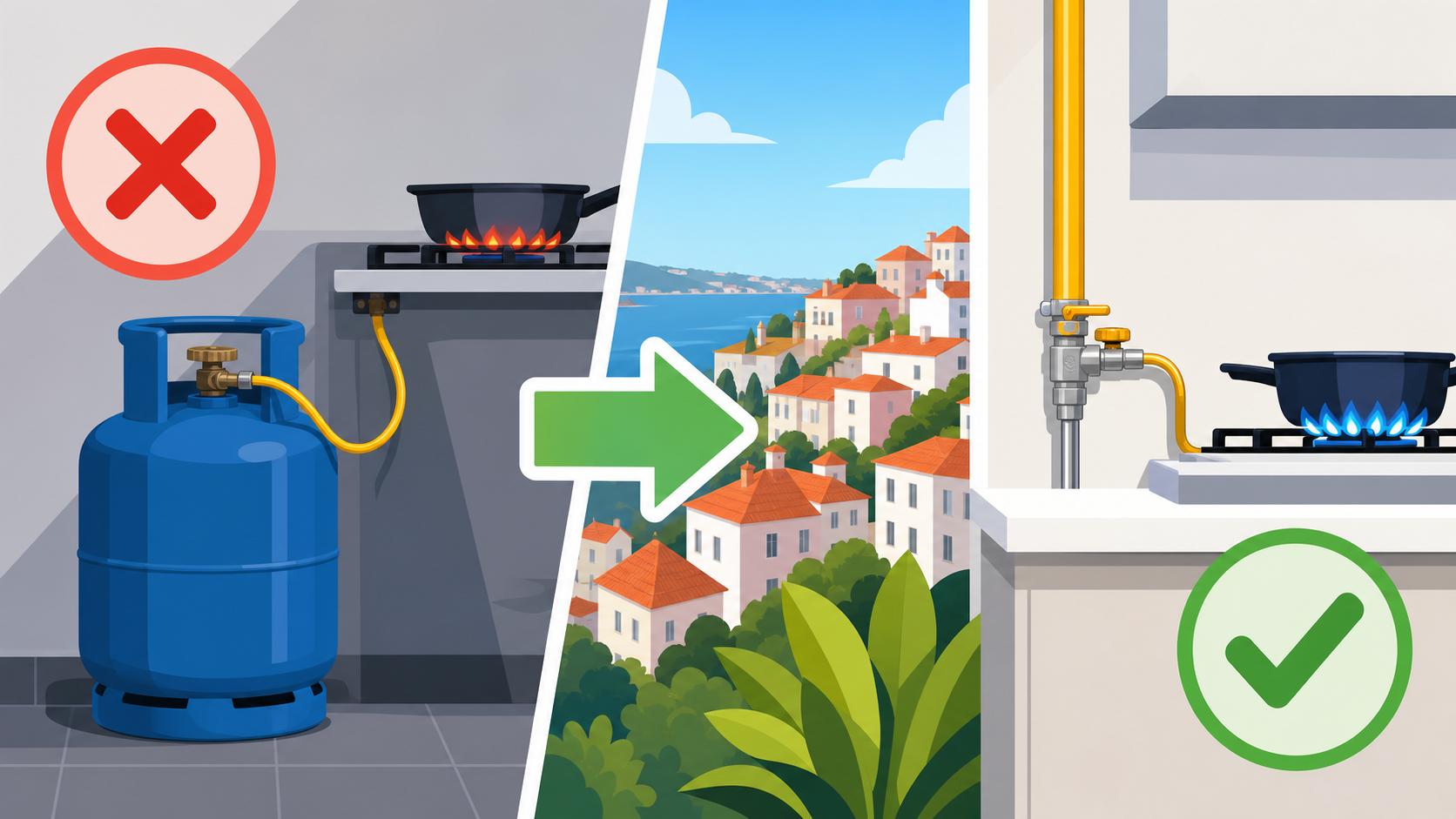
Switching from bottled gas (Garrafão) to piped city gas in Portugal
Disclosure: This article contains affiliate links. If you buy through them, we may earn a commission at no extra cost to you. Read our full disclosure.
There is a very specific type of panic that only hits you when you are covered in soap in a drafty Portuguese bathroom and the hot water suddenly turns ice-cold. I’ve been there, shivering in a tiled shower in Graça, realizing my heavy orange gas bottle finally gave up the ghost. This guide solves the logistical nightmare of transitioning from bottled gas (garrafão) to a seamless piped city gas system, ensuring you never have to lug a 13kg cylinder up four flights of stairs again.
The Reality of the Garrafão Lifestyle in Portugal
For many expats, the first encounter with a Portuguese kitchen involves a cabinet specifically designed to hide a bulky, heavy metal cylinder. This is the "garrafão," and while it is a staple of traditional living, it is also one of the most significant administrative and physical hurdles for those used to modern utilities. If you are Living in Portugal Guide 2027: The Complete Relocation Manual for Expats, you will likely start your journey with these bottles, but the novelty wears off quickly.
The system relies on either butane or propane. Butane is common for indoor use, but it has a nasty habit of not gasifying properly if the weather gets too cold—a common issue in the stone-walled houses of the Alentejo or the North. Propane is more resilient but often requires larger bottles kept outdoors. Beyond the physical strain of changing them, there is the constant mental load of tracking how much fuel is left. There is no gauge; you just shake the bottle and hope for the best.
When you are Renting an Apartment in Portugal: Contracts, Fees, and Tenant Rights, the type of gas system in place can significantly impact your quality of life. Many older buildings in Lisbon and Porto are still tied to the bottle system, even if a natural gas line runs right under the street outside. Making the switch is a path toward convenience, but it requires navigating a specific set of technical and bureaucratic hoops that can feel overwhelming if you don't speak the language fluently.
Checking Infrastructure and Feasibility
Before you get your hopes up about a life without heavy lifting, you must determine if piped gas (Gás Natural) is even an option for your specific address. In major urban centers, the infrastructure is usually there, but "near the building" and "inside the building" are two very different things. You need to look for a yellow pipe running up the side of your building or a small metal door at street level marked with a gas company logo like Galp or Lisboagas.
If you are using platforms like Uniplaces to find your initial mid-term housing, you can often filter for "natural gas" to avoid this headache entirely. However, if you have fallen in love with a traditional "Pombaline" apartment that still uses bottles, your first step is to contact the local Distribution System Operator (DSO). In Lisbon, this is typically Lisboagas; in the north, it might be Portgás. They will tell you if a "ramal" (a connection point) already exists for your unit.
Even if the pipe is in the building, your individual apartment might not be connected. This is common in subdivided older homes. You will need to check your Cost of Living in Portugal 2026: Detailed Budgets for Singles and Families to account for the initial connection fees. Sometimes the infrastructure is present, but the internal pipes of the apartment have been capped or haven't been used in decades, which leads us to the most critical—and often most frustrating—part of the process: the safety inspection.
The Dreaded Gas Inspection (Inspeção Técnica)
In Portugal, you cannot simply call a company and "turn on" piped gas. Because natural gas operates at a different pressure than bottled butane, and because safety standards are strictly enforced, a certified inspector must visit your home. This is the stage where many expats hit a wall. The inspector is not there to "help" you; they are there to find reasons why your home might be a safety hazard.
The inspection covers three main areas: the integrity of the pipes (pressure test), the ventilation of the rooms where gas is used, and the exhaustion of fumes from your water heater (esquentador). If you have a windowless kitchen or an older water heater that doesn't have a proper "chimney" to the outside, you will fail. I remember my first inspection failing because my kitchen door didn't have a 1-centimeter gap at the bottom for airflow. It felt pedantic at the time, but these rules are non-negotiable.
While waiting for these appointments, staying connected is vital, especially if you are working remotely. Using an eSIM from Airalo can ensure you have data to translate technical terms or look up Finding English-speaking plumbers and electricians using the Fixando app if the inspector finds a leak that needs immediate repair. If you fail the inspection, you will receive a report (Relatório de Inspeção) detailing the "Non-Conformities." You must fix these and pay for a second inspection before any gas will flow.
Comparison: Bottled Gas vs. Piped Natural Gas
| Feature | Bottled Gas (Garrafão) | Piped City Gas (Gás Natural) |
|---|---|---|
| Convenience | Low (must buy/replace manually) | High (always available) |
| Cost Structure | Pay-as-you-go per bottle | Monthly bill with fixed fee |
| Safety | High risk of leaks during bottle change | Regulated safety inspections |
| Appliance Performance | High heat, but pressure can drop | Constant, stable pressure |
| Space | Requires a dedicated cabinet | No storage space needed |
| Administrative Burden | None | High (Contract + Inspection) |
Converting Your Appliances
One of the biggest surprises for foreigners is that your stove and water heater are likely "tuned" for bottled gas and will not work correctly—or safely—with piped natural gas without modification. Bottled gas (butane/propane) has a higher energy density and requires smaller "injectors" or nozzles. Natural gas needs larger openings to achieve the same flame.
If you try to run natural gas through a butane stove, the flame will be tiny and orange. Conversely, putting butane through a natural gas stove creates a dangerous, massive flame. You will need to hire a certified technician to swap out the nozzles. This is a relatively simple job, but it is mandatory. When you are Setting Up Utilities in Portugal: Electricity, Gas, Water, and Internet, make sure to ask the technician for a declaration of conversion, as the gas inspector might ask for it.
For your water heater, the situation can be more complex. Some modern "esquentadores" are dual-fuel and just need a switch flipped, but many older ones are dedicated to one type. If your water heater is more than 10 years old, it is often cheaper and safer to buy a new natural gas-ready unit from Amazon Spain or a local store like Worten. A new, sealed-chamber (estanque) heater is much more likely to pass the rigorous safety inspection than an old atmospheric one.
Signing the Piped Gas Contract
Once you have a "Pass" on your inspection certificate, you can finally choose a provider. The market is liberalized, meaning you can choose from several companies like EDP, Galp, Goldenergy, or Endesa. Most expats find it easier to bundle their gas and electricity together to simplify their How to read an EDP electricity bill: Taxes, bi-hourly tariffs, and peak hours and potentially get a small discount on the fixed daily fee.
To sign the contract, you will need:
- Your NIF (Tax Identification Number).
- Your Portuguese bank account details (IBAN) for SEPA direct debit.
- Your rental contract or property deed.
- The "Código Universal de Instalação" (CUI), which is a unique number identifying your gas connection point.
The CUI is usually found on a sticker near the gas meter or provided by the DSO after the initial connection is approved. Once the contract is signed, a technician from the distributor (not the provider) will come to install the actual meter and break the seal on the pipe. From this moment on, your days of "shaking the bottle" are officially over. This transition is a major milestone in feeling settled, as it removes one of the most "temporary" aspects of Portuguese life.
Navigating Landlord Disputes and Building Rules
If you are a tenant, switching from bottles to piped gas requires the permission of your landlord. Some landlords are resistant because the mandatory safety inspection might reveal that the apartment’s ventilation isn't up to 2026 codes, forcing them to pay for renovations like installing new vents or replacing old piping. If you encounter a landlord who refuses a reasonable request for utility upgrades, you may need to consult What is the 'Livro de Reclamações' and how does it solve consumer disputes? to understand your rights regarding "habitability."
In some cases, the "Condomínio" (the building’s owners' association) might have rules about how pipes are run through common areas. If the yellow gas pipe has to cross a neighbor's terrace or a shared hallway, you need formal approval. This can add weeks to your timeline. It is always best to approach these conversations with patience and a "cafezinho" in hand; in Portugal, personal relationships often move the needle faster than legal threats.
For those living in more southern regions, the Cost of living in the Algarve: Winter vs Summer price differences for expats can be affected by your choice of gas. While natural gas is generally cheaper per unit of energy, the fixed monthly "potência" (capacity) fee means that if you only use the apartment for two months a year, keeping a bottle system might actually be more cost-effective. For full-time residents, however, the piped system is almost always the winner in both budget and sanity.
Troubleshooting the Transition Period
During the 2 to 4 weeks it typically takes to complete the switch, you will be in a state of limbo. I highly recommend keeping one full "spare" gas bottle under the sink until the very moment the piped gas technician turns the valve. There is nothing worse than returning your last bottle to the petrol station only to have your piped gas appointment canceled at the last minute due to a "greve" (strike) or a technical delay.
Also, be aware of the "inspection cycle." Once you are on piped gas, you are required by law to have a re-inspection every 5 years (or every 2 years if the building is over 20 years old or if you have a commercial license). The gas company will notify you, but if you ignore it, they have the right to cut off your supply for safety reasons. Keep your initial inspection certificate in a safe place—preferably digitized—as it is a vital document for any future property transactions or lease renewals.
Finally, keep an eye on your consumption during the first three months. Sometimes, the transition from "pre-paid" bottles to "post-paid" billing leads people to use more hot water or leave the heat on longer than they realize. Checking your meter readings manually and submitting them via your provider's app will ensure your bills are based on real usage rather than "estimativas" (estimates), which can lead to nasty surprises in your winter budget.
Disclaimer
This guide is for informational purposes only. Gas installations in Portugal are strictly regulated by the Direção-Geral de Energia e Geologia (DGEG). Always hire certified professionals (Técnicos de Gás) for any modifications to your appliances or piping. Improper gas connections can lead to carbon monoxide poisoning or explosions. Ensure your smoke and carbon monoxide detectors are functioning before and after any utility transition.