Home Internet and Mobile Plans: Vodafone, MEO, and NOS Compared
Disclosure: This article contains affiliate links. If you buy through them, we may earn a commission at no extra cost to you. Read our full disclosure.
Your new apartment in Lisbon has a fiber socket in the wall, but every operator wants a NIF, a Portuguese bank account and a long contract, and the store staff talk fast in Portuguese about “pacotes” and “fidelização.” This guide explains how Vodafone, MEO and NOS actually compare for home internet and mobile plans. It also covers how to sign up and how to get out of a contract.
How the Portuguese Telecom Market Really Works
Three Big Players and a Few Challengers
When I first arrived, I assumed I would compare a dozen internet providers the way I did back home. In Portugal, the market is dominated by three names: MEO, NOS and Vodafone. MEO is the descendant of the old national telecom company, so it tends to have the widest physical network, especially in smaller towns and the interior. NOS is strongest in cable and fiber in the urban areas, and its TV offering is very popular with Portuguese families. Vodafone often appeals to people who like a slightly simpler, more international-feeling brand and app.
There are smaller challengers too. Digi has entered the market as a low-cost operator. Each big operator also runs budget or digital-only sub-brands, such as MEO’s Uzo for mobile. These can be excellent for a single person who only needs a SIM card. For home fiber, though, most expats end up choosing among the big three.
The practical result is that all three companies offer broadly similar products at broadly similar price levels. The real differences lie in coverage at your specific address, the quality of the TV package, how easy customer service is in English, and how flexible the contract is.
Why Everything Comes in a Bundle
The word you will hear constantly is “pacote,” meaning a package or bundle. Portuguese operators build their business around bundling home internet, TV, a landline and one or more mobile lines into a single monthly bill. Store staff will often lead with the bundle that includes everything, and asking for “just internet” can feel like ordering a coffee without the pastry.
Bundles are not a scam. If a couple both need mobile data and you want fiber at home, combining them usually works out cheaper than paying separately. The catch is that bundles often come with a loyalty period, the “período de fidelização.” Breaking it early triggers a penalty tied to the discounts or installation costs you received.
Picture Sarah, a remote designer who moved to Porto on her own. She signed the biggest NOS bundle because the store made it sound like the only option. It came with a TV box she never switched on and a landline she never plugged in. A few months later she realised a fiber-only plan plus a cheap sub-brand SIM would have suited her far better. The lesson: decide what you actually use before you walk into the shop.
Fiber Coverage Versus Real-World Speed
Portugal has one of the better fiber networks in Europe, and in most of Lisbon, Porto, Braga, Coimbra and the coastal Algarve towns you can get symmetrical fiber that comfortably handles video calls and streaming. However, coverage is checked address by address, not neighborhood by neighborhood. One building on a street might have MEO fiber and NOS fiber, while the older building next door only has one operator wired in.
Always ask the operator to check your exact address, including the floor and door, before you sign anything. If you are working from home, the speed in the advert matters less than Wi-Fi coverage inside thick stone walls. More on that later.
Comparing Vodafone, MEO and NOS Side by Side
Quick Comparison Table
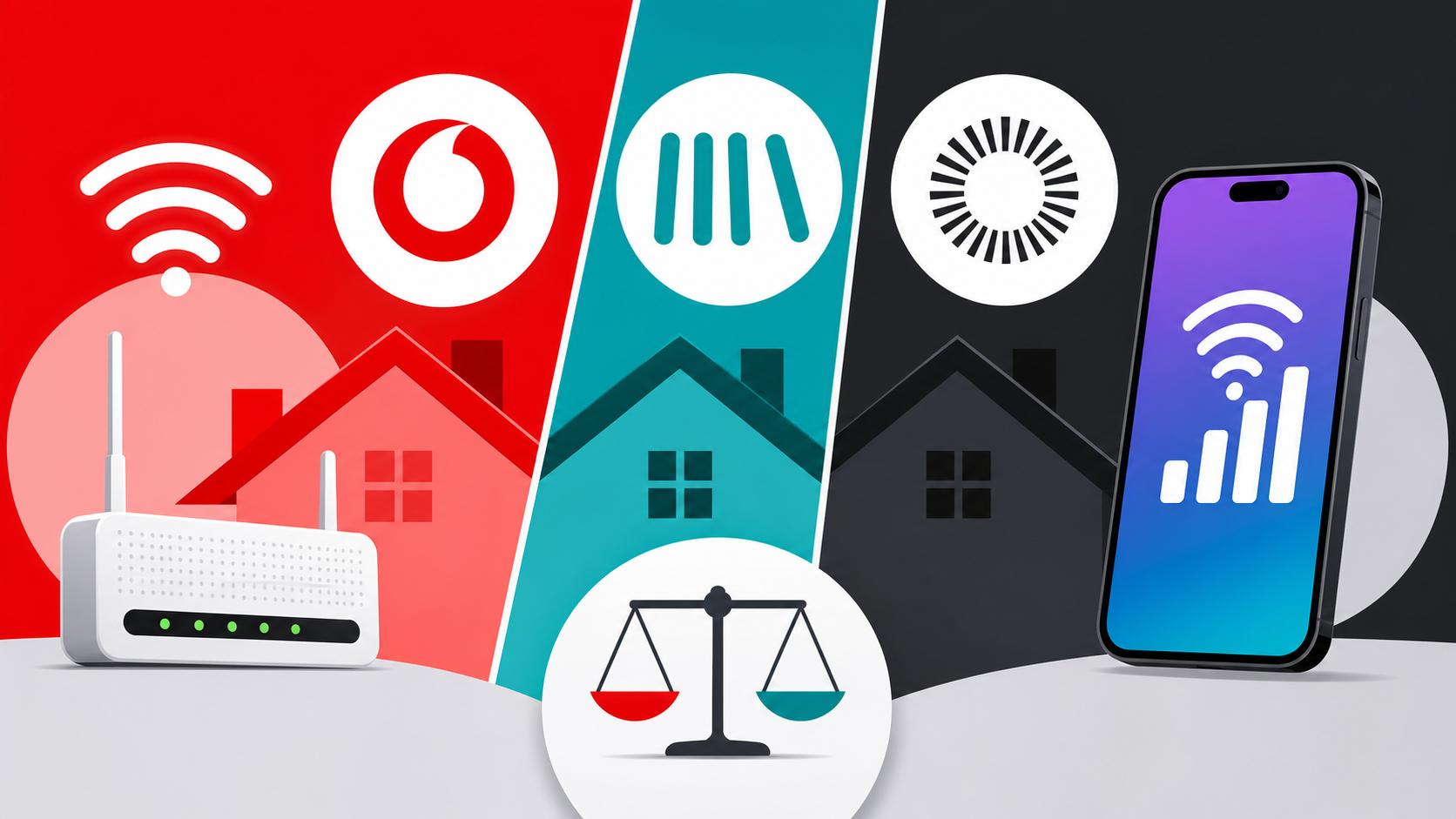
| Feature | MEO | NOS | Vodafone |
|---|---|---|---|
| Network reach | Widest overall, strong in rural and interior areas | Very strong in cities and suburbs | Good in cities, more variable in remote areas |
| TV offering | Large channel lineup, popular boxes | Very popular TV platform and app | Solid, slightly simpler TV packages |
| Budget mobile option | Uzo and other sub-brands | Digital sub-brand offers | Own lower-cost plans |
| English support | Varies by store and channel | Varies by store and channel | Often considered easier for English speakers |
| Best suited to | Rural homes, families wanting wide coverage | City households who love TV and sports | Expats wanting a straightforward app experience |
Treat this table as a general picture rather than a ranking. Your building and your habits matter more than any national reputation, and promotions change all the time. Before deciding, look at each operator’s own website for current plans and loyalty conditions.
MEO: The Coverage Champion
If you are moving to the Alentejo, the Silver Coast countryside, or a hillside village in the north, MEO is often the first operator to check. Its legacy network reaches places the others sometimes do not, and that includes copper and fiber lines plus mobile masts. Many expats in rural areas end up with MEO simply because it is the only fixed option available.
The downside some people mention is that the MEO bundle structure can feel complex, with many tiers and add-ons. Ask the store to print or email the full proposal, the “proposta,” so you can translate it calmly at home. For truly remote properties where no fixed line reaches you, see Installing fiber internet in a rural Portuguese village: Starlink vs MEO.
NOS: The City and Entertainment Favorite
NOS has a strong reputation in Lisbon, Porto and their suburbs, and its TV platform is a big reason why. If watching Portuguese football, films or kids’ channels matters to your household, NOS bundles are worth a close look. Its fiber is generally fast and reliable in urban apartments.
The trade-off is that NOS, like the others, pushes long loyalty contracts in exchange for promotional pricing. Imagine Tom and Ana, a mixed couple in Oeiras. They chose NOS for the sports channels and were happy with it, but they made sure the contract allowed them to downgrade the TV tier later without restarting the loyalty clock. Ask that question explicitly.
Vodafone: The Straightforward Choice
Vodafone often appeals to expats because the brand is familiar from other countries and its app is clean and fairly intuitive. Its fiber and mobile network are solid in urban areas. Many people find the mobile plans easy to understand even when they cannot read every word of the Portuguese terms.
Rural coverage is where you should be more careful. Before signing, check both the fixed-line availability at your address and the mobile signal inside your home. A quick way is to borrow a friend’s Vodafone SIM, or buy a prepaid one for a week, and walk around the house checking bars in each room.
Mobile Plans: Prepaid, Postpaid and eSIMs
Your First Days: Getting Connected on Arrival
The first problem you hit is usually simple: you land, you need maps, ride-hailing and messaging, and you do not have a Portuguese number yet. Many newcomers install an eSIM before the flight. Airalo is a common choice for this because you can set it up at home and have data the moment the plane lands, without hunting for a shop in the arrivals hall.
That said, a travel eSIM is a short-term bridge, not a long-term solution. You will eventually want a Portuguese number for banks, MB Way, delivery apps and the endless verification texts Portuguese services send. For airport options, see Getting a Portuguese SIM card at Lisbon Airport: Vodafone vs NOS vs MEO. If you plan to stay data-only for a while, Best unlimited data eSIMs for digital nomads arriving in Portugal goes deeper.
Prepaid Versus Contract Plans
Prepaid, or “pré-pago,” plans work well when you first arrive. You buy a SIM card in a store, a supermarket or a kiosk, and top up through the operator’s app, the website or a Multibanco ATM. There is no long commitment, and you can usually get one with just your passport. For many single expats, a prepaid or sub-brand plan is all they ever need.
Postpaid, or “pós-pago,” plans are billed monthly. They often bring more data and a discount when bundled with home internet, but they usually require a NIF and a Portuguese IBAN for direct debit. They also tend to carry a loyalty period. If you already have a fiber contract, ask what it would cost to add mobile lines. Combining them is where postpaid starts to make financial sense.
Keeping Your Number When You Switch
Portugal allows number portability, so you can keep your Portuguese mobile number when moving from one operator to another. You normally start the process with the new operator, which handles the transfer. Before you start, check whether your old contract is still inside its loyalty period, because porting out does not cancel any penalty you owe.
A practical tip: keep the number you registered with your bank, Finanças and MB Way. Changing it later means updating every service, and some will insist on in-person verification. Picking a stable number early saves real headaches.
Signing Up for Home Internet Step by Step
Documents You Will Need
Operators typically ask for the following:
- Your passport or residence card
- A NIF, the Portuguese tax number
- A Portuguese IBAN for direct debit, although some accept other payment methods
- The full address of the property, including floor and door letter
- Sometimes a rental contract or other proof of address
The NIF is the item that stops most newcomers. If you do not have one yet, start with Getting a NIF in Portugal: The Tax Number You Need First. If your rental includes internet, check the advert carefully. What does “Despesas Incluídas” mean in a Portuguese rental advertisement? explains what that phrase usually covers. Platforms like Uniplaces often list furnished rooms with Wi-Fi included, which can let you skip a telecom contract entirely during your first months.
The Sign-Up and Installation Process
- Check coverage for your exact address on each operator’s website, or in a store.
- Ask each operator for a written proposal showing the monthly price, the promotional period, the loyalty period and the early-exit penalty.
- Compare the proposals at home with a translation app. Do not sign on the spot.
- Sign the contract in store, online or by phone, and confirm the payment method.
- Book the technician visit. Someone must be home, and visits are often given as a morning or afternoon window.
- On installation day, ask the technician to place the router centrally if the wiring allows, and to show you the Wi-Fi password and admin login.
- Keep a copy of the signed contract and the technician’s work order.
For the broader picture of connecting electricity, water and gas at the same time, see Setting Up Utilities in Portugal: Electricity, Gas, Water, and Internet. Most operators collect payment by direct debit, and How to set up direct debit (Débito Direto) for your utility bills using Multibanco walks through it.
Fixing Wi-Fi Dead Zones in Portuguese Homes
Here is a frustration nobody warns you about. Many Portuguese apartments have thick masonry walls, long corridors and routers installed next to the front door, where the fiber enters. Your contract promises fast fiber, but in the back bedroom you work from, the video call freezes.
The fix is usually cheap and simple. A mesh Wi-Fi system or a powerline adapter can carry the signal deeper into the home, and a long ethernet cable is unbeatable for a desk setup. Many expats order these from Amazon Spain, which delivers to Portugal and often has a wider selection than local electronics shops. Some operators also sell or rent their own Wi-Fi extenders, so ask before buying. If you work from home full time, Setting Up a Home Office in Portugal: Internet Stability and Ergonomics covers backup connections and desk setup. For days when the home line fails, Best co-working spaces in Lisbon and Porto with reliable fiber internet is a useful fallback.
Contracts, Loyalty Periods and Customer Service
Understanding Fidelização Before You Sign
The loyalty period is the single most important clause in any Portuguese telecom contract. In exchange for promotional pricing, free installation or a discounted device, you agree to stay for a set period. If you leave early, the operator can charge a penalty, usually linked to the value of the benefits you received.
Before signing, ask these questions directly:
- How long is the loyalty period, and when exactly does it end?
- What happens to the price after the promotional months finish?
- Can I downgrade the plan during the loyalty period without a new commitment?
- What is the early-exit penalty, and how is it calculated?
- Is a contract without loyalty available, and how much more does it cost per month?
Write the answers down, or better yet, ask for them by email. If you think you might leave Portugal or move cities soon, a no-loyalty option can be worth the higher monthly price.
Getting Help in English
Customer service is where many expats feel most helpless, especially when a technician fails to show or a bill looks wrong. Your realistic English-language support options are:
- Operator stores in large shopping centers, such as Colombo in Lisbon or NorteShopping near Porto, where staff are more likely to speak English
- The operator’s online chat or app messaging, which you can run through a translation tool
- Email support, which gives you a written record
- The phone line, where you can ask “Fala inglês?” and request an English-speaking agent, though availability varies
- A Portuguese-speaking friend or neighbor joining a call on speakerphone
My personal trick is to write my problem in short, simple sentences, translate them, and paste both versions into the chat. Agents respond faster when the issue is clear.
Complaints, Moving House and Cancelling
If an operator ignores your problem, you have real tools. Every operator store must provide the complaints book, the Livro de Reclamações, which also exists in electronic form. A formal complaint gets attention because it is forwarded to ANACOM, the national communications regulator. What is the ‘Livro de Reclamações’ and how does it solve consumer disputes? explains how to file one.
When you move, contact your operator first to transfer the service to your new address. If they cannot serve the new home, or in certain other situations recognised by law, such as leaving the country, you may have grounds to end the contract without the usual penalty. Ask the operator in writing, and check ANACOM’s consumer guidance if they refuse. Always return the router and TV boxes, and get a receipt, because unreturned equipment is a common cause of surprise charges. When the time comes, see How to Cancel Utilities When Leaving a Portuguese Rental.
Disclaimer
This article is for general informational purposes only and does not constitute professional advice. Laws, prices and regulations vary by location and change over time. Consult a qualified professional for guidance on your specific situation.