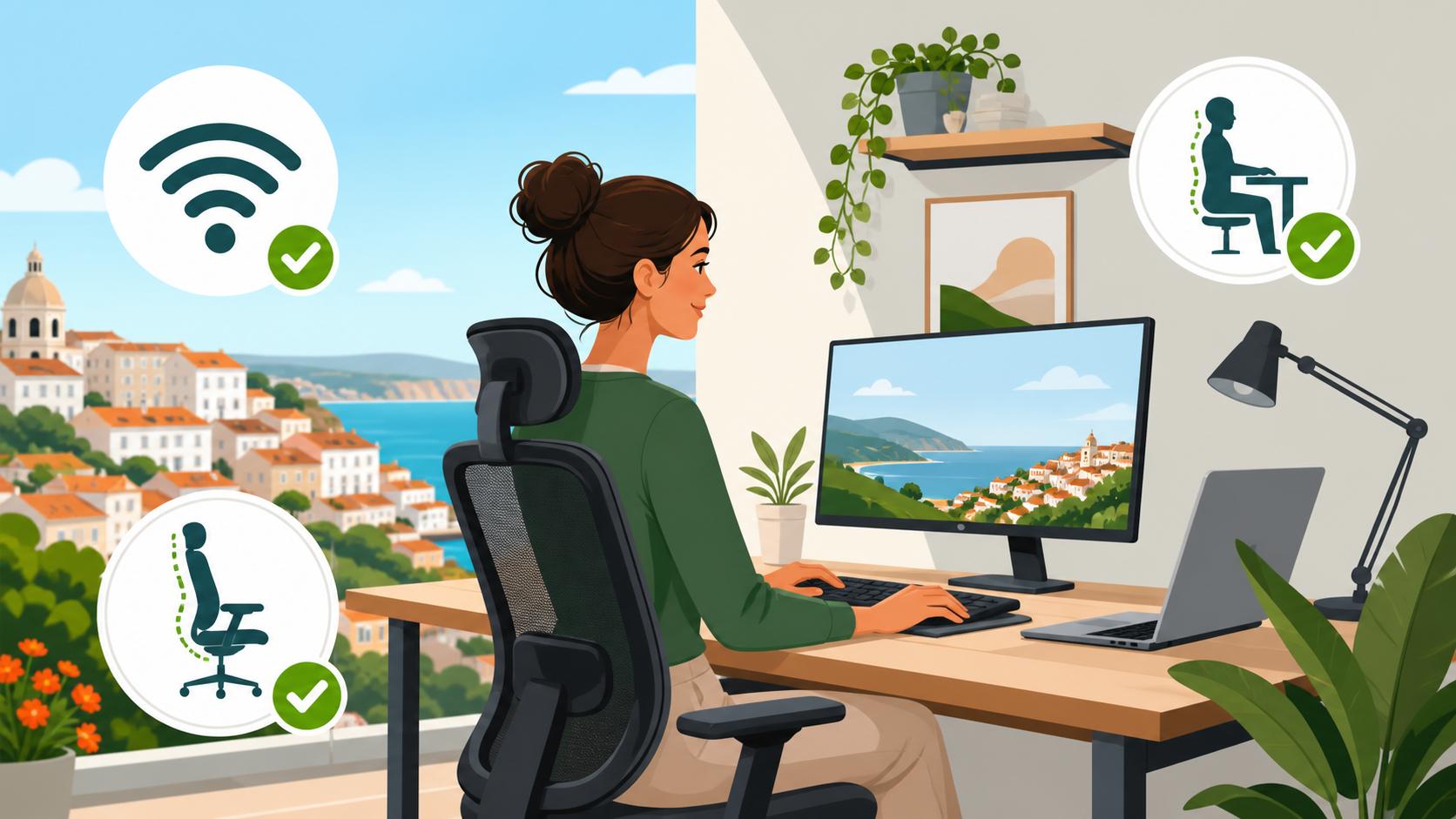
Setting Up a Home Office in Portugal: Internet Stability and Ergonomics
Working from a 200-year-old Pombaline apartment in Lisbon or a rustic villa in the Alentejo sounds like a dream until those thick stone walls kill your Wi-Fi signal and the winter dampness settles into your bones. I spent my first three months in Portugal huddled over a laptop in a puffer jacket because I didn't understand the local climate or the infrastructure. This guide provides the hard-won technical and ergonomic solutions you need to build a professional, productive workspace in your Portuguese home.
Navigating Internet Infrastructure and Service Providers
The backbone of any home office is a stable connection, and in Portugal, this usually means finding a "Fibra" (fiber) connection. While the country has surprisingly high fiber penetration, the experience of getting it installed can be a bureaucratic marathon. You aren't just buying a service; you are entering into a long-term relationship with a provider that often requires a 24-month commitment, known locally as "fidelização."
Comparing the Big Three: MEO, Vodafone, and NOS
When you start your search, you will find three dominant players. Vodafone is widely considered the expat favorite because their infrastructure tends to be the most modern, and their customer service often has English-speaking lines. Their fiber speeds are consistent, which is vital if you are working for a US company remotely while living in Portugal on a D8 Visa and need to maintain high-definition video calls with minimal latency.
MEO (owned by Altice) has the widest coverage, especially if you are venturing into more rural areas or the interior. They have taken over much of the old national infrastructure, meaning if a house can get fiber, MEO can usually provide it. However, their billing can sometimes be a labyrinth of hidden fees and promotional periods that end abruptly. NOS is the third major player, often leveraging a hybrid fiber-coaxial network. While they offer competitive bundles, their upload speeds can sometimes lag behind the symmetrical fiber offered by Vodafone.
Before signing anything, always check the "cobertura" (coverage) on the provider’s website using your specific Portuguese address. Don't take a neighbor's word for it; coverage can vary from one side of the street to the other. If you are struggling to explain your technical needs to an installer, using a resource like PortuguesePod101 to learn basic telecommunications vocabulary can save you hours of frustration and miscommunication during the setup phase.
Dealing with the "Stone Wall" Problem
One of the biggest shocks for new expats is discovering that their high-speed fiber router is useless once they move two rooms away. Portuguese construction, especially in historic centers, relies on thick masonry, stone, and sometimes even metal reinforcements that act like a Faraday cage. A standard router provided by MEO or Vodafone will rarely cover a traditional T2 or T3 apartment effectively.
To solve this, skip the "range extenders" sold in supermarkets, which often just repeat a degraded signal. Instead, invest in a high-quality Mesh Wi-Fi system. By placing nodes in strategic hallways or near doorways, you can leapfrog the signal around those heavy walls. Alternatively, if your apartment has been recently renovated, check for Ethernet ports in the walls. Many modern "reabilitação" projects include internal wiring that allows you to hardwire your desk directly to the router, ensuring a lag-free experience.
If you find that your home internet is temporarily down or the installation is taking weeks—a common occurrence—it is worth knowing the best co-working spaces in Lisbon and Porto with reliable fiber internet where you can find a professional fallback. Having a local SIM card with a massive data plan from a provider like Woo or Digi can also serve as a vital hotspot backup during these "blackout" periods.
The Bureaucracy of Installation and Contracts
To get internet installed, you will typically need your NIF (tax number), a proof of address (like a rental contract), and a Portuguese bank account for the "débito direto" (direct debit). Most providers offer a discount if you agree to the 24-month fidelização. If you are on a shorter lease, be very careful. Breaking a contract early in Portugal can result in heavy fines, often totaling the remaining months of the contract.
The physical installation usually requires a technician to visit. My advice is to clear your entire morning for this. Technicians often call 10 minutes before they arrive, and if you don't answer, they may cancel the appointment. This is a great time to practice your listening skills with PortuguesePod101, as being able to understand "Estou à porta" (I'm at the door) is a critical life skill here. Once they are inside, ensure they test the speed in your specific office area, not just next to the router.
| Provider | Typical Speed (Download/Upload) | Best For | Contract Length |
|---|---|---|---|
| Vodafone | 500Mbps – 1Gbps | Stability & Expats | 24 Months |
| MEO | 200Mbps – 1Gbps | Rural Coverage | 24 Months |
| NOS | 200Mbps – 1Gbps | Entertainment Bundles | 24 Months |
| Digi | 1Gbps | Low Cost (No Loyalty) | Monthly / Short |
Ergonomics and the Physical Workspace
Once the internet is humming, you have to face the physical reality of your workspace. Many Portuguese apartments are sold or rented "unfurnished" or with very basic furniture that wasn't designed for an eight-hour workday. If you plan to be productive, you cannot rely on a dining room chair and a low coffee table.
Sourcing Quality Office Furniture in Portugal
IKEA is the most accessible option for most expats, with major stores in Alfragide, Loures, and Matosinhos. Their "Markus" or "Järvfjället" chairs are the standard entry-level ergonomic choices. However, if you want something more professional, look for stores like Staples (which has a large presence in Portugal) or Office Total. For those looking for high-end options like Herman Miller, you will usually need to look at specialized dealers in Lisbon or Porto.
Don't overlook the local "segunda mão" (second-hand) market. Apps like OLX and Facebook Marketplace are goldmines for office furniture, as many startups in the hubs of Lisbon and Porto frequently refresh their gear. You might find a high-quality standing desk for a fraction of the retail price. If you are living on a budget, checking the cost of living in Lisbon 2026: Rent, groceries, and eating out breakdown can help you decide how much to allocate for your initial office setup.
When setting up your desk, pay attention to the light. Portugal is the land of "300 days of sunshine," but that sun is intense. If your desk faces a window, the glare will be blinding by 2 PM. Invest in "estores" (blinds) or "cortinas" (curtains) that can diffuse the light without making the room pitch black.
Managing the Winter Cold and Humidity
This is the ergonomic factor that no one tells you about: Portuguese houses are notoriously cold in the winter. Because many buildings lack central heating and insulation, the indoor temperature can actually drop lower than the outdoor temperature. Sitting still for hours in a 14°C (57°F) room will lead to stiff joints and a significant drop in productivity.
To counter this, your home office needs a dedicated heating strategy. Avoid the cheap "termoventiladores" (fan heaters) which consume massive amounts of electricity for very little lasting heat. Instead, look for oil-filled radiators or, if your landlord allows it, an AC unit (ar condicionado) with a heating function. Since electricity is expensive here, you should learn how to read an EDP electricity bill: Taxes, bi-hourly tariffs, and peak hours to ensure you aren't running your heaters during the most expensive "cheias" (peak) times.
Humidity is the other silent enemy. High humidity levels can lead to mold behind your desk or even damage your electronic equipment. Investing in a compressor-driven dehumidifier is non-negotiable for a home office in Portugal. Look for the best dehumidifiers to buy in Portugal to prevent winter wall mold and run it in your office space for at least a few hours every day during the "época das chuvas" (rainy season).
Lighting and Power Stability
Traditional Portuguese apartments often have limited electrical outlets, and they are rarely where you need them. You will likely need high-quality power strips with surge protection. The power grid in Portugal is generally stable, but during heavy winter storms, "picos de tensão" (power surges) can occur. Protecting your laptop and external monitors with a surge protector is a small investment that prevents a total disaster.
Regarding lighting, the "warm white" bulbs common in many Portuguese homes are great for dinner but terrible for focus. Replace the bulbs in your office area with "cool white" or daylight-balanced LEDs. This is particularly important during the shorter winter days when the lack of light can contribute to seasonal affective disorder, a surprisingly common issue for expats moving from sunnier climes who expect "eternal summer" in Portugal.
Legal, Tax, and Cultural Considerations
Setting up your office isn't just about the physical space; it’s about the legal framework you are operating within. Portugal has recently modernized its labor laws to reflect the rise of remote work, and whether you are an employee or a freelancer, there are rules you should be aware of to protect your work-life balance.
Teleworking Laws and Employee Rights
If you are employed by a Portuguese company, you are covered by specific teleworking laws in Portugal: Can employers force you back to the office?. These laws generally require a written agreement for remote work and state that the employer is responsible for providing the necessary equipment. Furthermore, Portugal was a pioneer in implementing the Right to Disconnect: Portugal's law against bosses calling after hours, which prohibits employers from contacting workers outside of their established working hours except in emergencies.
For those on the Portugal D8 Digital Nomad Visa: How to Work Remotely and Live Legally, the rules are slightly different as your employer is likely abroad. However, you should still maintain a clear boundary between your professional and personal life. The "always-on" culture of some foreign tech companies can clash with the more relaxed, social-oriented Portuguese lifestyle. Learning to navigate these cultural waters is easier when you use PortuguesePod101 to understand the local nuances of workplace etiquette and social norms.
Tax Deductions for Office Expenses
If you are registered as a "trabalhador independente" (freelancer) in Portugal, you may be able to deduct some of your home office expenses from your taxes. This includes a portion of your internet bill, electricity, and even office supplies. However, the "regime simplificado" (simplified regime) often used by new expats has specific rules about what is actually deductible.
It is highly recommended to consult with a local accountant to see how your home office setup impacts your IRS (income tax) filings. In some cases, if your home is also your registered place of business, you might have different requirements for your rental contract. Navigating these administrative hurdles is part of the "initiation" into Portuguese life, but once settled, the freedom of working from a balcony overlooking the Tagus or the Douro makes the paperwork worth it.
Finding Community and Avoiding Isolation
The danger of a perfect home office is that you might never leave it. Isolation is a real challenge for remote-working expats. Portugal has a vibrant community of digital nomads and remote workers, and you should make a conscious effort to step outside. Whether it's the Digital Nomad communities: Madeira's Nomad Village vs Lisbon hubs or local meetups in smaller cities like Braga or Ericeira, there are plenty of opportunities to network.
Even if your home office is a productivity sanctuary, try the "café office" occasionally. The Portuguese "quiiosque" or a local pastelaria is a great place to spend an hour answering emails. It keeps you connected to the rhythm of the neighborhood and provides a much-needed break from your screen. Just remember that in smaller, traditional cafés, staying for four hours on a single "bica" (espresso) with your laptop is generally frowned upon; if you're going to stay, keep ordering.
Technical Setup Checklist for Your First Week
To ensure you don't lose your first week of work to technical glitches, follow this rapid-setup checklist. Most delays in Portugal happen because of a missing document or a missed phone call, so being proactive is the key to success.
- Secure a NIF: You cannot get an internet contract without your tax number.
- Proof of Residency: Have a signed and registered rental contract ready for the ISP.
- SIM Card Backup: Get a local SIM with high data limits immediately upon arrival at the airport or a local mall.
- The "Kit" for Cold: If moving in winter, buy your dehumidifier and heater before your first day of work.
- Language Prep: Spend 15 minutes on PortuguesePod101 learning terms for "router," "connection," "speed," and "plug."
- The Via Verde of Internet: If you can find a provider like Digi that offers no-contract fiber, start there while you evaluate your long-term needs.
Building a home office here is more than just buying a desk; it's about adapting to a different infrastructure and climate. By acknowledging the challenges of the "stone wall" and the "winter damp," you can create a workspace that allows you to enjoy everything Portugal has to offer without sacrificing your career.
Disclaimer
The information provided in this guide is for general informational purposes only and does not constitute legal, financial, or professional technical advice. Infrastructure availability and laws in Portugal are subject to change; always verify current regulations with official sources or qualified professionals.