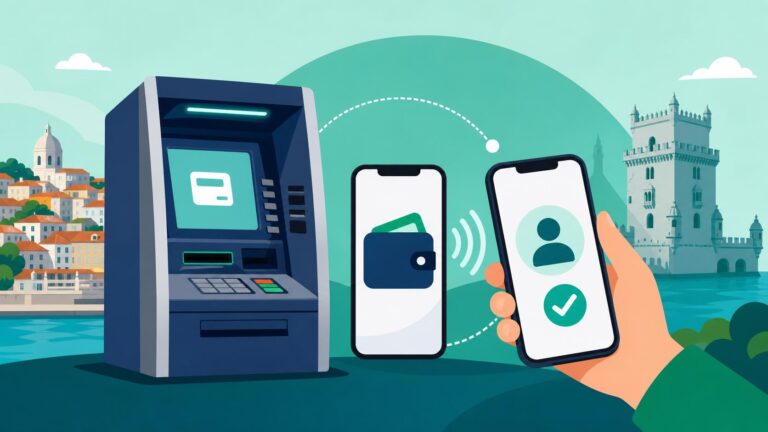
Traditional Portuguese Banks: Millennium, CGD, Santander, and Novobanco
Disclosure: This article contains affiliate links. If you buy through them, we may earn a commission at no extra cost to you. Read our full disclosure.
Your visa lawyer wants a Portuguese IBAN, your landlord wants a local direct debit, and the employer’s HR team frowns at your foreign card. Then you walk into a branch and leave with a stack of forms and no account. This guide explains how Millennium bcp, Caixa Geral de Depósitos, Santander and Novobanco actually work for foreigners, and how to pick the right one.
Why Traditional Banks Still Matter for Expats in Portugal
When I first arrived, I was convinced I could live entirely on app-based accounts. That lasted about three weeks, until a utility company refused my foreign IBAN and a landlord’s agent asked, very politely, for “uma conta portuguesa.” Digital banking is excellent here, but the country’s financial plumbing was built around a handful of large domestic banks. Knowing how they think will save you a lot of wasted mornings.
The Portuguese Relationship With Branch Banking
Portugal is a highly digital country in many ways. The Multibanco ATM network is famously capable, letting you pay taxes, utility bills and even immigration fees from a machine on the street. Yet the relationship with your bank still often starts in a physical branch, with a gestor de conta, an account manager, who becomes your point of contact. For many Portuguese families, the same bank has held their salary, their mortgage and their savings for decades.
For foreigners, this means the first meeting matters. A manager who understands your situation can approve an account quickly, explain the fee package and later help with a mortgage. A manager who is rushed, or unfamiliar with residence permits and foreign income, can stall you for weeks. I learned to book an appointment rather than walk in, to bring printed copies of everything and to ask early whether anyone on the team was comfortable in English.
If you want to understand the payment rails these banks sit on, see The Multibanco System and MB Way: Portugal’s Unique Payment Network, which covers why a Portuguese card unlocks so much everyday convenience.
What a Local IBAN Actually Unlocks
Legally, SEPA rules mean a business in the eurozone should accept any euro IBAN. In practice, Portuguese companies, landlords and public bodies are far more comfortable with a PT50 IBAN. Some payroll systems are set up only for domestic accounts, and some smaller utilities simply have not updated their forms.
A traditional bank also gives you access to MB Way with a Portuguese phone number, local credit products, mortgages and the sort of bank statements a consulate or AIMA officer recognises immediately. Picture a D7 applicant who shows a statement from a branch in Lisbon versus one showing a foreign fintech: both may be valid, but the Portuguese one rarely triggers a follow-up question. For the broader picture of choosing an account, see Opening a Bank Account in Portugal: Best Banks for Foreigners and Expats.
Millennium bcp and Caixa Geral de Depósitos
These two are the giants you will hear about first. One is the largest private bank in the country; the other is owned by the Portuguese state. They feel different in practice, and that difference matters more than any brochure suggests.
Millennium bcp: The Private Heavyweight
Millennium bcp, usually just called Millennium, has a large branch network and one of the more polished banking apps among the traditional players. It also owns ActivoBank, its leaner digital sibling, which many expats use as a lower-maintenance alternative while still sitting inside the same banking group. Comparing the two is worthwhile, and Online and Neobanks in Portugal: ActivoBank, Moey!, Revolut, and N26 walks through that digital side.
Millennium has a reputation among expats for being relatively open to foreign clients, including people who want to open an account before they move. That process tends to involve a video call or remote document submission, then a final step once you are in the country. The details change from time to time, so check the bank’s own non-resident page before relying on any route; the step-by-step version lives in How to open a Millennium bcp account before arriving in Portugal.
The trade-off is the classic private-bank one: account packages come with monthly maintenance charges unless you meet certain conditions, such as having your salary paid in or holding a minimum balance. When you eventually leave the country, Millennium’s closure process is another thing to plan for; see Closing a Millennium bcp account: Can you do it from outside the country?.
Caixa Geral de Depósitos: The State-Owned Anchor
CGD, often just called Caixa, is the bank your Portuguese neighbour’s grandmother probably uses. Being state-owned gives it a reputation for stability, and its branch network reaches into small towns in the interior where private banks have pulled back. If you are moving to a village in the Beiras or the Alentejo, Caixa may be the only bank within easy driving distance.
That reach comes with a slightly more traditional feel. Branch staff in smaller towns may speak limited English, and processes can be paper-heavy. On the other hand, I have found Caixa staff in rural branches remarkably patient once they see you are making an effort with Portuguese. A retired couple I know in the Serra da Estrela area opened their account over two visits, with the manager writing down each missing document by hand. It was slow, but they still bank there years later and value the personal relationship.
Caixa’s online banking and app cover the essentials, including transfers, card controls and bill payments through Multibanco references. For residents planning to buy property outside the big cities, Caixa is often a natural first mortgage conversation, since local branches understand regional property markets.
Santander and Novobanco
The other two big names approach the market differently. Santander brings the scale of an international group, while Novobanco carries the history of the Portuguese banking crisis and has rebuilt itself into a mainstream retail bank.
Santander in Portugal: International Group, Local Operation
Santander’s Portuguese operation is a full domestic bank, not a branch of the Spanish one. That is an important distinction: having a Santander account in the UK, Spain or Brazil does not mean you can simply walk into a Lisbon branch and use it as a local account. You will still need to open a Portuguese account with Portuguese paperwork.
That said, Santander’s familiarity can be reassuring for people coming from countries where the brand is common. Its app and online banking are well regarded, and its larger branches in Lisbon, Porto and the Algarve often have staff used to foreign clients. Expats on employment contracts frequently end up here because some employers have payroll relationships with the bank, which can make fee waivers easier.
Santander also tends to feature in mortgage conversations for foreign buyers. If that is your long-term plan, building a relationship with the bank first, with salary or regular income flowing in, often helps. See Mortgages in Portugal for Non-Residents: Rates and Deposit Requirements for how that process works.
Novobanco: The Rebuilt Retail Bank
Novobanco was created out of the resolution of Banco Espírito Santo, one of the defining moments of Portugal’s financial crisis. You may still hear older Portuguese people mention that history when the bank comes up. Today it operates as a standard retail bank with branches nationwide, everyday accounts, cards, mortgages and business banking.
For expats, Novobanco is often a pragmatic choice: decent branch coverage, a functional app and account managers who can be competitive when they want your business. In my experience, smaller banks in the big-four tier are sometimes more flexible in negotiating package fees, especially if you bring a regular income or savings. It never hurts to ask the manager directly which conditions would waive the monthly charge.
Like all Portuguese banks, Novobanco is supervised by the Banco de Portugal, and deposits are protected by the national deposit guarantee scheme, which applies across the banks covered in this guide. Check the scheme’s own guidance for the current coverage limit.
Comparing the Big Four: Fees, Apps and Account Opening
Here is the summary I wish someone had handed me in my first month. It describes general character rather than fixed fees, because each bank changes its packages regularly.
| Bank | Ownership | Branch Network | Digital Option | Often Suits |
|---|---|---|---|---|
| Millennium bcp | Private, largest domestic private bank | Large, strong in cities | ActivoBank sister brand plus main app | Pre-arrival account openers, app-focused users |
| Caixa Geral de Depósitos | State-owned | Very wide, including rural towns | Caixa app and online banking | Interior and rural residents, stability seekers |
| Santander | Part of an international group, operated locally | Large, strong in cities and the Algarve | Well regarded app | Salaried employees, future mortgage applicants |
| Novobanco | Private, rebuilt after the BES resolution | Nationwide | Standard app and online banking | People willing to negotiate a package |
Maintenance Fees and How Expats Avoid Them
The biggest shock for newcomers from countries with free current accounts is the comissão de manutenção, the monthly account maintenance fee, plus stamp duty on top. Each bank bundles accounts into packages, sometimes called contas pacote or soluções integradas, that include a debit card, transfers and online banking for a single monthly charge.
The usual ways to reduce or remove this charge follow a similar pattern across all four banks:
- Domiciliação de ordenado, having your salary or pension paid directly into the account
- Holding a minimum average balance or investment amount
- Age-based or student accounts, where eligibility applies
- Asking for the Serviços Mínimos Bancários, the legally regulated basic account with capped fees, which all banks must offer
The basic account is a lifesaver for retirees or freelancers who do not need the bells and whistles. Not every branch volunteers it, so ask for it by name. For more ideas on cutting costs, see How to Pay Less in Bank Fees in Portugal.
The Account Opening Process Step by Step
Whichever bank you pick, the process looks broadly like this:
- Get your NIF first, since no Portuguese bank will open an account without a tax number. See Getting a NIF in Portugal: The Tax Number You Need First.
- Gather your passport, proof of address in Portugal or abroad, and proof of income or occupation.
- Book an appointment at a branch, or start the remote process if the bank offers one for non-residents.
- Complete the KYC questionnaire, which covers your job, expected monthly movements and the origin of your money.
- Sign the account contract and the fee schedule, reading the package conditions carefully.
- Activate online banking with the codes sent by post or SMS, and collect or receive your debit card.
- Update the bank once you get your residence permit, so the account changes from non-resident to resident status.
Step four is where expats are most often surprised. Banks may ask for an employment contract, a pension statement or tax returns. That questioning is about compliance obligations rather than suspicion of you personally, and Why do Portuguese banks require your employment contract to open an account? explains the reasoning in more detail.
Source of Funds and Crypto Transfers
Portuguese banks take anti-money-laundering rules seriously. Large incoming transfers, especially from abroad, can trigger a request for documents showing where the money came from. Proceeds from a house sale, an inheritance or an investment account are all fine, but you need the paper trail.
This is particularly relevant if part of your savings came from cryptocurrency. Transfers from an exchange such as Binance can lead a compliance officer to ask for exchange statements, trade histories and proof of the original purchase. A friend in Porto had a transfer held for several days until she provided a full export of her transaction history. Prepare that documentation before the money moves, and send a smaller test transfer first.
US citizens should also know that their bank will ask about tax status for reporting purposes; see US Expats: Do Portuguese banks report my balance directly to the IRS via FATCA?.
Pairing a Traditional Bank With Digital Tools
The smartest setup often seen among long-term expats is not choosing one or the other. It is a traditional Portuguese account for local life, combined with specialist tools for the things traditional banks do expensively.
Moving Money In Without Losing It to Exchange Rates
Traditional Portuguese banks will happily receive international transfers, but if your income arrives in dollars or pounds, their conversion rates and incoming transfer charges can quietly eat into every payment. Many expats receive their foreign income into a Wise account, convert it at a transparent rate and then send euros to their Millennium or Caixa IBAN. Check the provider’s own pricing page for current fees, which vary by currency and amount.
The same logic applies to your first rent payment and deposit, when you may not have a Portuguese account yet. Paying from Wise to a landlord’s PT50 IBAN works well and creates a clear record. For a detailed cost comparison, see Wise vs Revolut vs Bank Transfers: Cheapest Way to Move USD/GBP to EUR.
Saving and Investing Outside the Branch
Traditional banks will offer you savings deposits and investment funds, often promoted by your account manager. Some are perfectly reasonable, but compare them carefully against alternatives. Many residents keep their emergency fund or long-term investing at a separate platform such as Trade Republic, while the traditional bank handles salary, bills and direct debits. Read each provider’s terms on interest, fees and tax reporting before committing, because investment income has to be declared on your Portuguese tax return.
The split also gives you resilience. If one account is temporarily restricted during a compliance review, you still have access to money elsewhere.
When Your Residence Card Expires or Your Account Gets Restricted
Here is the scenario that keeps expats awake at night: your residence card expires while AIMA processes the renewal, and your bank notices. Traditional banks are required to keep identity documents up to date, so an expired card can lead to restrictions on your account until you provide proof that renewal is underway.
The fix is usually to bring AIMA’s confirmation of your pending application, your passport and any extension documentation to the branch, and to do it before the card actually expires. Having a named account manager makes this far less stressful. If it has already happened, follow the practical steps in What to do if your bank freezes your account because your residence card expired.
Choosing among Millennium, CGD, Santander and Novobanco ultimately comes down to where you live, how you earn and how much personal contact you want. Visit a branch, ask about the basic account and fee waivers, and do not be afraid to walk out and try another bank if the first one does not feel right.
Disclaimer
This article is for general informational purposes only and does not constitute professional advice. Laws, prices and regulations vary by location and change over time. Consult a qualified professional for guidance on your specific situation.