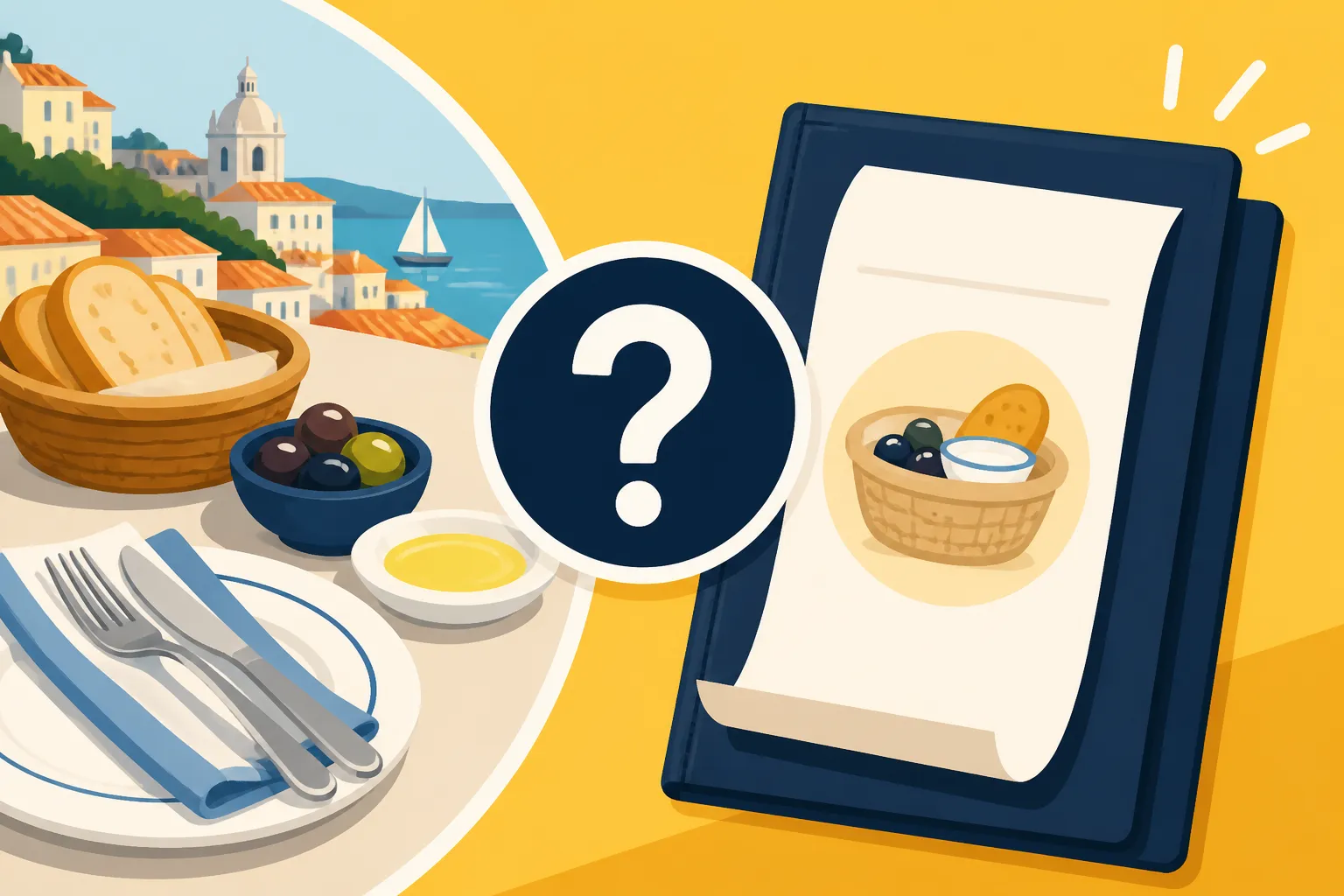
What Is the Couvert on a Portuguese Restaurant Bill?
You’ve just arrived in a charming Portuguese restaurant, settled into your seat, and before you can even glance at the menu, a little plate of bread, olives, and perhaps some butter magically appears on your table. You might think, "Oh, how lovely, a complimentary starter!" and dive right in. Fast forward to the bill, and bam—an unexpected charge for something called 'couvert'. If this sounds familiar, don't worry, you're not alone. This guide is here to demystify this common, often confusing, aspect of dining in Portugal, offering you the lowdown on what it is, your rights, and how to navigate it like a seasoned local.
What Exactly Is the Couvert on a Portuguese Bill?
Ah, the couvert. It’s a term that strikes a mix of curiosity and, at times, mild annoyance for many newcomers to Portugal. But once you understand its place in Portuguese dining culture, it becomes less of a mystery and more of a charming, if sometimes optional, tradition. In essence, the couvert refers to the small appetizers or nibbles that are placed on your table shortly after you sit down in a restaurant.
The Traditional Offering
Think of the couvert as a little welcome spread, designed to whet your appetite while you peruse the menu and wait for your main dishes to be prepared. Historically, it was a way for establishments to offer a small, immediate service, a gesture of hospitality that also, conveniently, encouraged a slightly longer stay and perhaps more drinks.
What you'll find in a couvert can vary wildly from one place to another, from the simplest, most rustic taverna to a Michelin-starred establishment. The most common items include:
- Pão (Bread): This is almost universally present. It could be a simple basket of fresh bread rolls, slices of crusty regional bread, or even a mix of different types. Sometimes, especially in more rural areas, the bread is truly exceptional, baked fresh that morning.
- Azeitonas (Olives): Another staple. Portuguese olives are fantastic, often served simply in their brine, sometimes with a dash of olive oil and oregano.
- Manteiga (Butter): Individual foil-wrapped portions of butter are common, though some places might offer a small dish of whipped or flavored butter.
- Patês (Pâtés): Often patê de atum (tuna pâté) or patê de sardinha (sardine pâté) in small, pre-packaged containers. These are quite popular and can be surprisingly tasty.
- Queijo (Cheese): A small, fresh cheese, typically queijo fresco (a soft, fresh cheese) or a regional hard cheese, might make an appearance.
- Presunto/Chouriço (Cured Ham/Sausage): In more upscale or traditional restaurants, you might be presented with thin slices of presunto (cured ham) or a small portion of local chouriço or salpicão.
While these items seem humble, they can be a delightful start to your meal, especially if you're peckish after a day of exploring. Just remember, the quality can range from basic to gourmet, depending on the restaurant.
It's Not Complimentary: The Crucial Detail
This is the big one, the detail that catches most expats and tourists off guard: the couvert is not free. Despite being placed on your table without you asking, it is an item that will be charged to your bill, usually per person. This is the fundamental difference from many other countries where such initial offerings are typically on the house.
The cost isn't usually exorbitant, but it can add up, especially if you're a larger group or if you visit several restaurants expecting these items to be complimentary. For instance, a simple bread and olive couvert might cost €1.50 to €3.00 per person, while a more elaborate one with cheese and cured meats could be €5.00 or more.
Many people arrive from countries where "free bread" is the norm, and they instinctively assume the same here. The Portuguese system is different. It’s a commercial offering that they put forward for your consideration. If you touch it, you buy it. It's as simple, and as potentially frustrating, as that. But understanding this upfront empowers you to make an informed choice rather than being surprised when the bill arrives.
Understanding Your Rights and Options
Navigating the couvert situation can feel a bit like walking a tightrope, especially when you're just getting used to the local customs. However, it's crucial to understand that while it's a deeply ingrained tradition, you absolutely have rights as a consumer. You are never obligated to accept or pay for the couvert if you don't want it.
The Golden Rule: You Can Refuse It
This is the most important piece of advice: you can always refuse the couvert. It's not rude, it's your right. According to Portuguese law, restaurants are required to explicitly list the price of the couvert items and cannot force you to pay for something you didn't consume or explicitly ask for.
When the waiter brings the couvert to your table, you have a window of opportunity to politely decline. A simple, firm "Não, obrigado/a" (No, thank you) or "Não queremos o couvert" (We don't want the couvert) will usually suffice. The waiter might look a little surprised, but they are obliged to remove it. Don't feel pressured to accept it out of politeness if you don't want it. Your budget, your dietary preferences, or even just your desire to save room for the main course are all valid reasons to say no. I've been there, nodding politely and then regretting it when I see the charge for stale bread I barely touched.
If you have specific dietary restrictions, this is also the moment to mention them. For example, if you're gluten-intolerant or allergic to olives, it's much easier to refuse the couvert upfront than to pick through it later. This proactive approach saves both you and the restaurant staff any awkwardness down the line.
When It's Brought Without Asking: What to Do
One of the most common scenarios that causes confusion is when the couvert just appears on your table without any verbal offer or explicit question from the waiter. This is standard practice in many Portuguese establishments, particularly the more traditional ones. They assume that most customers will appreciate the offering and are prepared to pay for it.
If it arrives unannounced and you don't want it, simply wait for the waiter to return to your table, point to the items, and say, "Por favor, pode retirar o couvert? Não vamos consumir." (Please, can you remove the couvert? We won't be consuming it.) If you haven't touched anything, they must remove it and not charge you. If you accidentally nibble on an olive or a piece of bread before realizing it's chargeable, things can get a little grayer, and some establishments might insist on charging you for the portion consumed. This is why being vigilant from the moment you sit down is key.
Another scenario: you’ve eaten some of the couvert, then seen the price, and decided it's not worth it. At this point, it's much harder to refuse the charge. The general rule is, if you've consumed it, you're expected to pay. If you genuinely feel misled or that the price was not clearly communicated, you can ask for the livro de reclamações (complaint book), which is a legal requirement for all businesses in Portugal and can often prompt a swift resolution. For more on this, check out our guide on What is the 'Livro de Reclamações' and how does it solve consumer disputes?.
The Price Disclosure: Transparency is Key
Legally, restaurants in Portugal are mandated to inform you of the price of all couvert items. This information must be clearly visible, either directly on the main menu, on a separate small card presented with the couvert, or sometimes on a wall display. It cannot be hidden or only revealed when the bill arrives.
Always take a moment to look for these prices. If you can't find them, it's perfectly acceptable to ask, "Qual é o preço do couvert?" (What is the price of the couvert?). A reputable restaurant will be happy to show you. If a restaurant fails to display the prices, you are within your rights to refuse payment for the couvert, even if you've consumed it, as they have not met their legal obligation for transparency. This rarely happens in practice in legitimate establishments, but it's good to know your rights.
This transparency rule is crucial because it ensures that you, the diner, can make an informed decision. It protects you from unknowingly racking up charges for items you thought were complimentary. So, before you reach for that crusty bread, quickly scan for the price list.
The Cultural Nuance and Expat Perspective
Understanding the practicalities of the couvert is one thing, but truly grasping its cultural significance can help you navigate Portuguese dining with more ease and less frustration. It’s more than just an extra charge; it’s a reflection of local customs and a business practice that has evolved over time.
Why it Exists: A Glimpse into Tradition
The couvert tradition stems from a time when dining out was a more leisurely affair. It provided guests with something to nibble on immediately, preventing hunger pangs while they waited for their main courses, which were often prepared from scratch. It was a gesture of welcome, a way to occupy guests, and also an opportunity for the restaurant to offer a little extra.
In many ways, it's similar to the grissini or bread basket offered in Italian restaurants, or the amuse-bouche in French dining, but with the key difference that in Portugal, it's typically charged. It’s part of the fabric of Portuguese hospitality, a way to ensure that from the moment you sit down, your table isn't bare and you have something appealing in front of you.
For many Portuguese, it's simply expected. They know it's coming, they know it costs money, and they decide whether they want it or not. It's not seen as a "trap" or a "scam" but rather as a standard part of the dining experience. When you see it from this perspective, some of the initial expat frustration can dissipate. It's just how things are done here.
Is it a "Scam"? Debunking the Myth
For many foreigners, the unrequested, charged couvert feels like a sneaky trick or a deliberate attempt to inflate the bill. This perception is totally understandable given differing cultural norms. However, from a Portuguese perspective, it's rarely intended as a scam. It's a long-standing, open business practice.
The crucial distinction lies in the transparency requirement. If the prices are displayed, and you choose to eat it, then it's a consensual transaction, not a scam. Where the "scam" feeling arises is when prices are not clearly displayed, or when tourists are pressured into keeping it, or when they simply aren't aware of the custom.
Think of it this way: it's not much different from a hotel charging for items in the mini-bar. They're placed there for your convenience, and the prices are usually listed. If you consume them, you pay. The restaurant couvert operates on a similar principle, just in a different setting. The key is awareness and exercising your right to choose. It’s simply part of the Portuguese Coffee Culture and Restaurant Etiquette: Ordering Like a Local.
Embracing or Avoiding: Your Personal Choice
As an expat or a tourist, you have the full autonomy to decide how you approach the couvert. There's no right or wrong answer; it's all about what suits your preferences, budget, and dining experience.
Reasons to Embrace the Couvert:
- Authentic Experience: Sometimes, indulging in the couvert is part of truly immersing yourself in the local dining culture. Those fresh olives and regional bread can be delightful.
- Convenience: If you're starving and want something to tie you over until the main course, it's a quick and easy solution.
- Quality: In a good restaurant, the couvert items are often high quality, locally sourced, and delicious, adding to the overall meal experience.
- Socializing: It can be a nice way to start a meal with friends or family, sharing small bites and chatting.
Reasons to Avoid the Couvert:
- Budget: If you're dining on a tight budget, those small charges can add up, and you might prefer to save your money for the main dishes. Our guide on the Cost of Living in Portugal 2026: Detailed Budgets for Singles and Families can give you an idea of where to save.
- Dietary Restrictions: If you have allergies or dietary preferences (e.g., gluten-free, low-carb), the standard couvert might not be suitable.
- Saving Room: Sometimes you just want to go straight for the main course and dessert without filling up on bread and olives.
- Preference: You simply might not like the items offered in the couvert.
Ultimately, the choice is yours. Once you're aware of the couvert and your right to decline it, you can make an informed decision every time you sit down to eat. It transforms from a potential annoyance into a conscious choice, which is a much more pleasant way to experience Portugal's incredible food scene.
Common Couvert Items and Their Average Costs
To give you a clearer picture, let's break down some of the most common couvert items you might encounter and provide an estimated range of what you can expect to pay for them. Remember, these are averages, and prices can fluctuate based on the restaurant's location, ambiance, and perceived quality. A small tasca in a quiet village will charge significantly less than a chic restaurant in Lisbon's Chiado district.
Breakdown of Typical Items
When that plate of starters arrives, here’s a typical rundown of what you might see:
- Pão (Bread): This is almost always present. It could be a simple, airy roll (papo-seco), slices of rustic wheat bread (pão de Mafra or pão alentejano), or sometimes even cornbread (broa). The quality varies. A single serving usually means a few slices or a small roll per person.
- Azeitonas (Olives): These are often served in a small bowl. They can be green, black, or a mix, and sometimes seasoned with garlic, herbs, or a drizzle of good olive oil.
- Manteiga (Butter): Typically, these are small, individually wrapped portions. Less common now, but in fancier places, you might get a small ramekin of herbed or flavored butter.
- Patês (Pâtés): The most frequent ones are patê de atum (tuna pâté) and patê de sardinha (sardine pâté), often served in tiny, individual plastic or glass containers. These are quite popular and a nice complement to the bread. Sometimes, a chicken or liver pâté might also appear, especially in more traditional establishments.
- Queijo Fresco (Fresh Cheese): A small, very soft, unripened cheese, often served with a dash of pepper or olive oil. It's light and refreshing.
- Queijo Seco/Curado (Cured/Aged Cheese): In some restaurants, especially in regions known for their cheese (like Serra da Estrela or Azeitão), you might get a small wedge of a firmer, aged cheese. This is usually more expensive.
- Enchidos (Cured Sausages): Slices of chouriço, salpicão, or presunto (cured ham) are common in more generous couverts. These are usually of good quality and can significantly increase the couvert price.
Price Range and Variations
The pricing of couvert items is usually per person or per unit. For example, a basket of bread might be priced as one item, while individual butter packets are priced per packet, and olives per bowl. However, many restaurants will simply have a "Couvert" entry on the menu with a single price per person, encompassing all the items placed on the table.
Here's a general idea of what you might expect:
| Item Type | Typical Price Range (per person/unit) | Notes |
|---|---|---|
| Basic Couvert (Bread & Olives) | €1.50 – €3.50 | Most common, often includes butter. A good budget option if you want a nibble. |
| Couvert with Patê | €2.50 – €4.50 | Adds individual tuna or sardine pâté. Often seen in mid-range restaurants. |
| Couvert with Fresh Cheese | €3.00 – €5.00 | Includes queijo fresco or a small cured cheese. A step up in variety and price. |
| Elaborate Couvert (Meats/Premium Cheese) | €5.00 – €8.00+ | May include presunto, chouriço, premium regional cheeses. Often found in higher-end or specialized restaurants. |
| Individual Items (if separate) | ||
| Pão (Bread basket) | €1.00 – €2.50 | Price varies on type and quantity. |
| Azeitonas (Olives) | €1.00 – €2.00 | Small bowl. |
| Manteiga (Butter) | €0.50 – €1.00 | Per packet. |
| Patê (Tuna/Sardine) | €0.80 – €1.50 | Per individual container. |
These prices are per person for the couvert if it's offered as a single unit, or per item if each component is priced separately. Always check the menu for the exact pricing at your chosen restaurant. In tourist hotspots like central Lisbon or Porto, prices tend to be on the higher end of the spectrum. In smaller towns or more local eateries, you'll generally find more affordable options.
It’s also worth noting that while the cost might seem like a small addition, it can easily add €5-€10 to a meal for two people, which could be better spent on an extra drink, a side dish, or a delicious dessert if you're managing your Cost of Living in Portugal 2026: Detailed Budgets for Singles and Families. So, be mindful, but also don't be afraid to occasionally indulge if the offering looks particularly appealing!
Disclaimer
The information provided in this guide is for general informational purposes only and is based on typical practices and laws in Portugal at the time of writing. Restaurant policies and local customs can vary, and laws regarding consumer rights may be subject to change. Always confirm prices directly with the restaurant and consult official sources or a legal professional for specific advice.