What to do immediately if you lose your Portuguese Residence Card
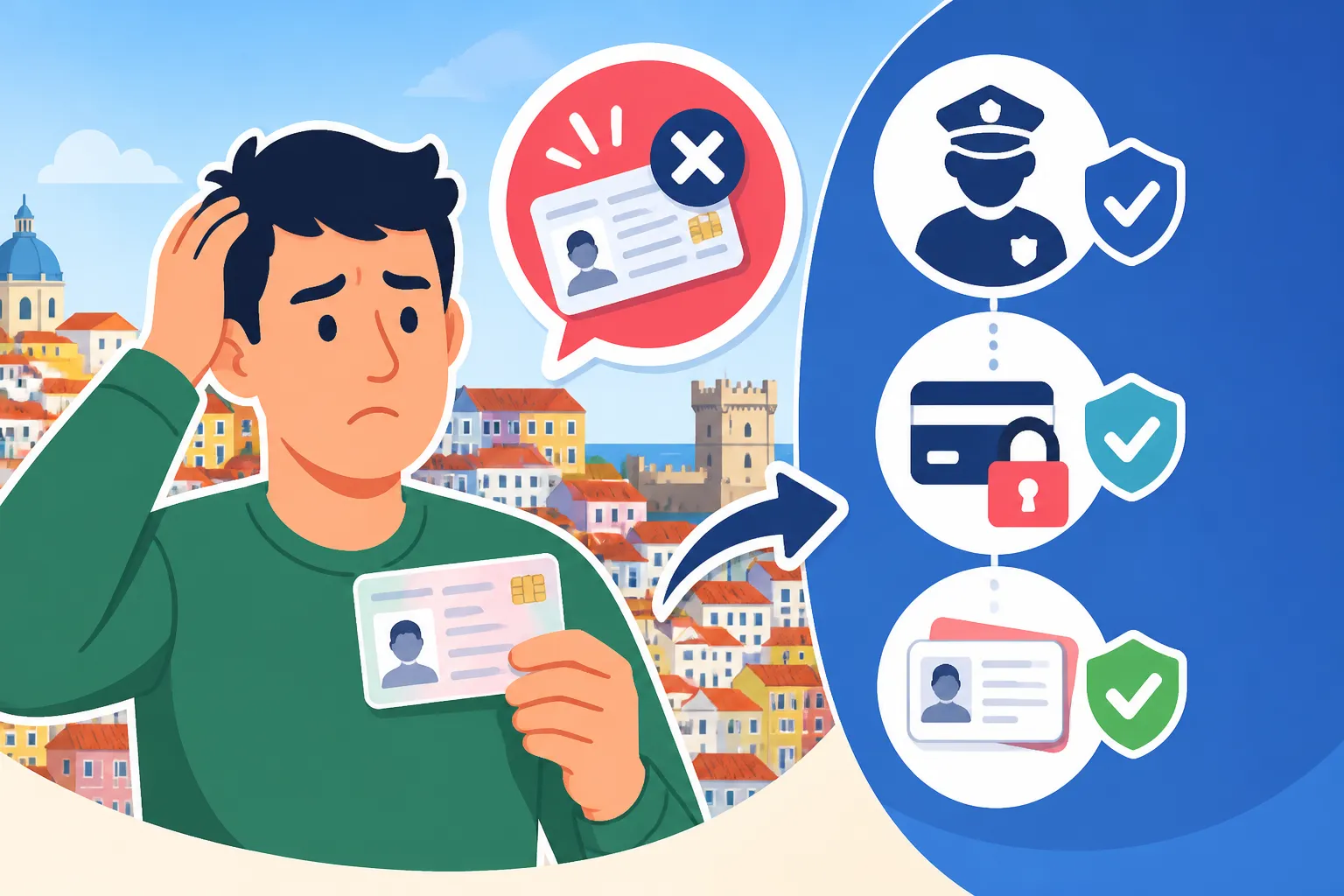
Your wallet is gone. Maybe it was lifted on the 28 tram, left in a Bolt, or slipped out of a beach bag in Lagos. Your Portuguese residence card was inside it. This guide covers what to do in the first hour, the first day and the following weeks: reporting the loss, protecting yourself, requesting a replacement from AIMA, and travelling safely while you wait.
The First Hour After You Lose Your Portuguese Residence Card
I have lost mine once, outside a café in Arroios. The physical card was not the worst part. The worst part was the sudden fear that my whole legal life in Portugal had vanished with a piece of plastic. It had not, and neither has yours. Your residence permit exists in AIMA’s system whether or not you are holding the card. The card is proof of that status. It is not the status itself. Keep that in mind while you work through the steps below.
Retrace Your Steps Before You Panic
Before you file any reports, spend twenty minutes retracing your steps. Many “lost” cards in Portugal turn up within a day, because the country is honestly quite good about this.
- Call the café, restaurant or shop you last visited. Portuguese staff often keep found documents behind the counter for days.
- If you lost it on public transport, contact the operator’s lost property service. In Lisbon that means Carris for trams and buses or Metropolitano de Lisboa. In Porto it means Metro do Porto or STCP.
- If you used a ride-hailing app, use the in-app “lost item” function to reach the driver.
- Check the local Junta de Freguesia and the nearest police station. People often hand in documents there.
Here is a scenario that often comes up in expat groups. Someone drops their card on the Cais do Sodré ferry, assumes it is gone for good, and starts a replacement request. Two days later the card arrives at the police station, and by then the replacement process is already underway. Give the quick recovery options a fair try first, but do not wait too long if you suspect theft.
Decide Whether It Was Lost or Stolen
This distinction matters more than you might think. If your bag was snatched or your pocket was picked, you are dealing with a crime. That calls for a police report that records the theft. If you simply misplaced the card, you still want an official record of the loss.
In either case, a stolen card raises an extra risk: someone holding a document with your photo, name and identifying details. Treat theft as urgent. Report it the same day if you can.
Gather What You Still Have
Before you head anywhere official, collect every document that proves who you are and that you live here legally:
- Your passport. This is the big one. If it was stolen as well, your situation is more complex, and your embassy becomes your first call.
- A photo or scan of your residence card, front and back. If you never took one, take one of your replacement card the day it arrives.
- Any AIMA emails, appointment confirmations or approval letters.
- Your NIF certificate, your NISS and your SNS utente number.
- Your rental contract or an Atestado de Residência from your Junta.
Filing the Police Report and Notifying AIMA
This is the part that turns a stressful moment into a paperwork task. It is tedious, but it is manageable.
Getting a Police Report From the PSP or GNR
In cities and larger towns you go to the PSP (Polícia de Segurança Pública). In many rural areas and smaller villages the GNR (Guarda Nacional Republicana) handles policing. Either one can record a loss or theft.
- Go to the nearest PSP or GNR station in person and bring your passport.
- Say clearly that you lost your título de residência, or that it was stolen. “Perdi o meu título de residência” works for a loss, and “Roubaram o meu título de residência” for a theft.
- Give the approximate time, place and circumstances.
- Ask for a copy of the report, the auto de denúncia or a declaration of loss, before you leave.
- Keep that copy safe and scan it straight away.
Officers at big city stations such as the PSP in Restauradores or in Porto’s Baixa often handle tourists and speak some English. In a village GNR post in the Alentejo, you may need Google Translate and a lot of patience. Speak slowly, show your passport, and say “título de residência” more than once. The phrase does a lot of work.
Some expats skip the police report because the card was “just lost”. I would not. The report protects you if someone later misuses your identity. AIMA or other bodies may also ask for it during the replacement process.
Requesting a Replacement From AIMA
The replacement card is usually called a segunda via, a second copy. The exact way to request it can change, so check AIMA’s official website and portal for the current procedure before you do anything else. The general shape tends to look like this:
- Check whether AIMA currently lets you request a replacement online through its portal, or whether you need to book an in-person appointment.
- Prepare your passport, the police report, proof of address and your AIMA reference details.
- Pay the replacement fee, often through a DUC payment reference. See How to pay the AIMA residence permit issuance fee (DUC) at a Multibanco ATM for the payment step itself.
- Attend biometrics if AIMA asks you to. Some replacements need a new photo and fingerprints.
- Wait for the new card. It is usually posted to your registered address.
Check the official fee schedule on AIMA’s own pages. Fees and procedures are revised periodically. If you need to book a slot, AIMA Appointments in Portugal: How to Book and What to Bring covers the documents to bring and what the visit is like.
Be very wary of anyone in a Facebook group or on WhatsApp who offers to “get you a replacement appointment quickly” for a fee. Appointment sellers are a real problem here. Immigration Scams in Portugal: Fake Contracts and Appointment Sellers explains how to spot them.
Making Sure Your Address Is Correct Before the Card Ships
This step is easy to miss and causes real pain. AIMA usually sends replacement cards by registered post through CTT. If you have moved since your card was issued and never updated your address, your new card could go to your old flat in Benfica while you now live in Setúbal.
Update your address first. Changing your address on your Residence Card: The new online AIMA process walks through it. Once the card is on its way, How to track your AIMA residence card delivery via CTT registered mail explains what to do if a CTT “aviso” slip appears in your mailbox while you are out.
Protecting Yourself While You Wait for the New Card
The gap between losing your card and holding a new one is where most of the stress lives. Your status is fine, but the rest of Portugal runs on showing documents.
Banks, Employers and Everyday Identity Checks
Expect to be asked for ID at banks, notaries, mobile phone shops and sometimes at the pharmacy for certain prescriptions. Your passport will cover most of these. Some institutions, though, specifically want to see your residence status.
Practical moves:
- Your bank: Tell your bank about the loss, especially if the card was stolen alongside bank cards. Portuguese banks such as Millennium bcp, CGD and Novobanco run regular compliance checks. A missing residence document on file can sometimes trigger a request to update your details. If your account gets restricted, What to do if your bank freezes your account because your residence card expired covers a similar situation and the steps to resolve it.
- Your employer: HR may need to see proof of legal residence. Give them the police report, a copy of your old card if you have one, and any proof that a replacement has been requested. AIMA appointment delayed: How to prove legal status to Portuguese employers has useful wording and documents for this conversation.
- Your NIF paperwork: If your NIF certificate or your Finanças login details were in the same wallet, recover them through the Portal das Finanças or a Finanças office. If you are dealing with this from abroad or never had a Finanças password, services like Bordr can help sort out NIF admin remotely. Check their site for what they currently offer.
Healthcare Continuity
Losing your residence card does not cancel your SNS registration. Your utente number stays the same, and your Centro de Saúde can find you by name, date of birth and passport. If you need a nurse’s advice while the paperwork is pending, the SNS 24 line still works. SNS 24 Helpline (808 24 24 24): Triage, Advice, and Sick Notes explains how to use it.
If you hold private international cover, for example a Cigna Global plan, your policy is tied to you and your membership details, not to your Portuguese residence card. It is still worth having your insurer’s membership card or app login handy, so you are not hunting for documents during a medical problem.
Travelling Abroad Without Your Residence Card
This is where I urge real caution. Travelling outside Portugal without a valid residence card can be complicated. That is especially true for non-EU nationals who rely on the card to prove they can re-enter Schengen beyond the normal visa-free allowance.
Before you book anything:
- Check with AIMA and your airline whether your passport plus the police report and proof of a replacement request will be accepted on your return.
- Understand that border officers in other Schengen countries may not recognise Portuguese replacement paperwork.
- If you must travel urgently, contact the Portuguese embassy or consulate in the destination country before you leave, not after.
Traveling in the Schengen Area with a Portuguese Residence Permit covers how the card works for travel. If you normally use the automated gates on arrival, Using the E-gates at Lisbon airport with a temporary residence permit card explains when the e-gates are an option and when you will need a staffed desk.
If you lose your card while you are already abroad, go to the nearest Portuguese consulate. They can advise on documentation for your return. You will also want a police report from the local authorities. If that report is in a language other than Portuguese or English, a certified translation can help you use it with Portuguese bodies. Services like RushTranslate offer certified translations, and Translating and Certifying Documents for Portuguese Immigration explains which kind of translation Portuguese authorities tend to accept.
Long-Term Effects on Residency and Citizenship
Once the immediate crisis is over, many people start asking whether this affects their future: permanent residence, renewals, or a citizenship application down the line.
Your Legal Residence Is Not Lost With the Card
Losing the physical card does not interrupt your legal residence. What matters is the residence title recorded by AIMA and its validity dates. The plastic in your wallet only shows that the title exists. If the card was valid when you lost it, you were still legally resident the day after. The replacement is simply a new copy of the same proof.
That said, do not let a replacement drag on if your permit is also close to its renewal date. Check whether the renewal and the replacement can be handled together, and keep a paper trail for both.
What Counts Toward Portuguese Citizenship
For those of us working toward permanent residency or citizenship, it helps to understand how residence time is counted. A lost card does not change that count.
As of October 2026, under Lei Orgânica n.º 1/2026, which has been in force since 19 May 2026, naturalisation generally requires at least 10 years of legal residence. For EU citizens and nationals of Portuguese-speaking (CPLP) countries the requirement is 7 years. Only time spent legally resident in Portugal under a residence title, visa or permit counts. Time spent waiting for a permit decision is not added.
Separate periods of legal residence can be added together, whether they were continuous or interrupted. They must all fall within a maximum window. That window is 9 years for EU and CPLP nationals, 12 years for nationals of other countries, and 6 years for stateless persons.
Applications filed on or before 18 May 2026 are decided under the previous rules, which required 5 years of legal residence.
The other requirements include:
- Proof, by a test or certificate, of sufficient knowledge of the Portuguese language and of Portuguese culture, history and national symbols.
- Sufficient knowledge of the fundamental rights and duties of Portuguese nationality and of the political organisation of the Portuguese state.
- A solemn declaration of adherence to the fundamental principles of the democratic rule of law.
- The means to support yourself.
CPLP nationals are presumed to meet the language part unless their lack of Portuguese is manifest. The test details are set by the Regulamento da Nacionalidade, so check the IRN’s current list of accepted tests and certificates before you book anything.
To check you are still on track, see Portuguese Citizenship and Naturalization: The 10-Year Path Explained. When you get closer to applying, How to Apply for Portuguese Citizenship After Ten Years covers the filing stage.
| Situation | Citizenship residence requirement as of October 2026 | Maximum window for adding periods |
|---|---|---|
| EU citizen | 7 years of legal residence | 9 years |
| CPLP national | 7 years of legal residence | 9 years |
| National of another country | 10 years of legal residence | 12 years |
| Stateless person | Check the IRN for your case | 6 years |
| Application filed on or before 18 May 2026 | 5 years under the previous rules | Previous rules apply |
Keeping a Personal Residence File
This experience taught me to keep a residence file. You will need it again for renewals, permanent residence and possibly naturalisation, so it pays to build it now:
- Scan your new card, front and back, the day it arrives.
- Save every AIMA decision, approval letter and renewal confirmation as a PDF in one folder.
- Keep your police report and replacement request receipt in the same folder.
- Write down your permit’s start and end dates so you can track legal residence periods accurately.
- Back the folder up to a cloud account and a USB drive.
| Task | Who to contact | Urgency |
|---|---|---|
| Recover the card from staff or lost property | Café, shop, transport operator, Junta | Same day |
| Report the loss or theft | PSP or GNR | Same day, especially for theft |
| Freeze or replace bank cards | Your bank | Immediately if your wallet was stolen |
| Request a replacement card | AIMA portal or appointment | As soon as you have the police report |
| Update your address if you have moved | AIMA | Before the replacement ships |
| Inform your employer | HR department | Within your first working days |
| Check travel plans | AIMA, airline, consulate | Before booking any trip |
One last tip from experience: for real-time reports of how long replacements are taking and how AIMA offices are coping, Best expat Facebook groups for real-time Portugal visa and AIMA updates lists the communities where people share honest timelines. Take individual stories with a pinch of salt. Use them to calibrate your patience, not as official guidance.
Losing your residence card feels like the floor dropping away. It is fixable. Report it, request the replacement, keep your passport close and your paper trail tidy, and within a few weeks this will just be another story you tell other expats over a bica.
Disclaimer
This article is for general informational purposes only and does not constitute professional advice. Laws, prices and regulations vary by location and change over time. Consult a qualified professional for guidance on your specific situation.