Buying firewood (Lenha) in rural Portugal for winter heating
Disclosure: This article contains affiliate links. If you buy through them, we may earn a commission at no extra cost to you. Read our full disclosure.
Moving into a beautiful stone house in the Portuguese countryside often feels like a dream until the first week of November hits and the damp, Atlantic chill begins to seep through the walls. I vividly remember my first winter in central Portugal, huddled under three blankets because I underestimated how cold an uninsulated house could get. This guide solves the mystery of sourcing, buying, and storing firewood (lenha) so you can stay warm without overpaying or getting stuck with wood that won't burn.
Why You Absolutely Need a Wood Strategy in Rural Portugal
When most expats envision their new life in the Alentejo or the Beira Baixa, they picture sun-drenched terraces and crisp wine. However, the reality of rural architecture in Portugal is that these homes were designed to stay cool in the summer, not warm in the winter. Without a robust wood strategy, your living room will quickly feel like a walk-in refrigerator. Most rural homes rely on either an open hearth (lareira) or a more efficient closed wood-burning stove (recuperador de calor).
The challenge is that central heating is rare and incredibly expensive to run given Portuguese electricity prices. If you are currently browsing Where to Live in Portugal: Lisbon, Porto, Algarve, and Silver Coast Compared or have already secured a spot, you need to understand that firewood is the primary fuel for the interior. It isn't just about the aesthetic of a flickering flame; it is a fundamental survival skill for the winter months. Many newcomers make the mistake of waiting until the first frost to look for wood, only to find that the best seasoned supplies are already sold out or the prices have skyrocketed.
Why do Portuguese houses lack central heating? Practical winter solutions is a topic readers are often directed to because it highlights the cultural gap between Northern European or American expectations and the Portuguese reality. You cannot rely on a thermostat here. You rely on your woodpile. If you are transitioning from a temporary rental found on Uniplaces to a permanent rural home, start looking at your fireplace options immediately.
Understanding Lenha: Types of Wood and What to Look For
In Portugal, not all wood is created equal. If you walk into a local cafe and ask for "lenha," the first question you'll likely get is "Que tipo?" (What type?). You need to know the difference between hardwoods that provide long-lasting heat and softwoods that are only good for starting the fire.
The gold standard in Portugal is Azinho (Holm Oak) or Sobreiro (Cork Oak). These are incredibly dense woods that burn slowly and produce an intense, steady heat. Azinho is particularly prized because it leaves behind a bed of hot coals that can keep a room warm for hours. Another common option is Oliveira (Olive), which smells fantastic and burns very hot, though it can be a bit sparky.
On the other end of the spectrum, you have Pinheiro (Pine) and Eucalipto (Eucalyptus). Pine is abundant and cheap, but it burns very fast and creates a lot of soot (creosote) in your chimney, which is a significant fire hazard. I generally recommend using pine only as kindling (aparas) to get the fire going. Eucalyptus is a controversial choice; it burns hot and fast, but it can be difficult to split if you buy it in large logs.
| Wood Type | Burn Quality | Heat Output | Price Point | Best Use |
|---|---|---|---|---|
| Azinho (Holm Oak) | Excellent (Slow) | Very High | High | Overnight/Primary heat |
| Sobreiro (Cork Oak) | Excellent | High | High | General heating |
| Oliveira (Olive) | Good | High | Medium | Cooking/General heat |
| Eucalipto (Eucalyptus) | Fast | Medium-High | Low | Daytime "top-ups" |
| Pinheiro (Pine) | Very Fast | Medium | Very Low | Kindling/Starting |
The most critical factor, however, isn't the species but whether the wood is "seca" (dry) or "verde" (green). Green wood is full of sap and moisture. If you try to burn it, you will get a room full of smoke, very little heat, and a blackened glass door on your stove. Always ask for "lenha seca de um ano" (one-year dry wood). If you are moving in during the summer, you can buy green wood cheaper and let it season in your shed, but if you're buying in October, you must insist on dry stock.
How to Find and Buy Firewood Like a Local
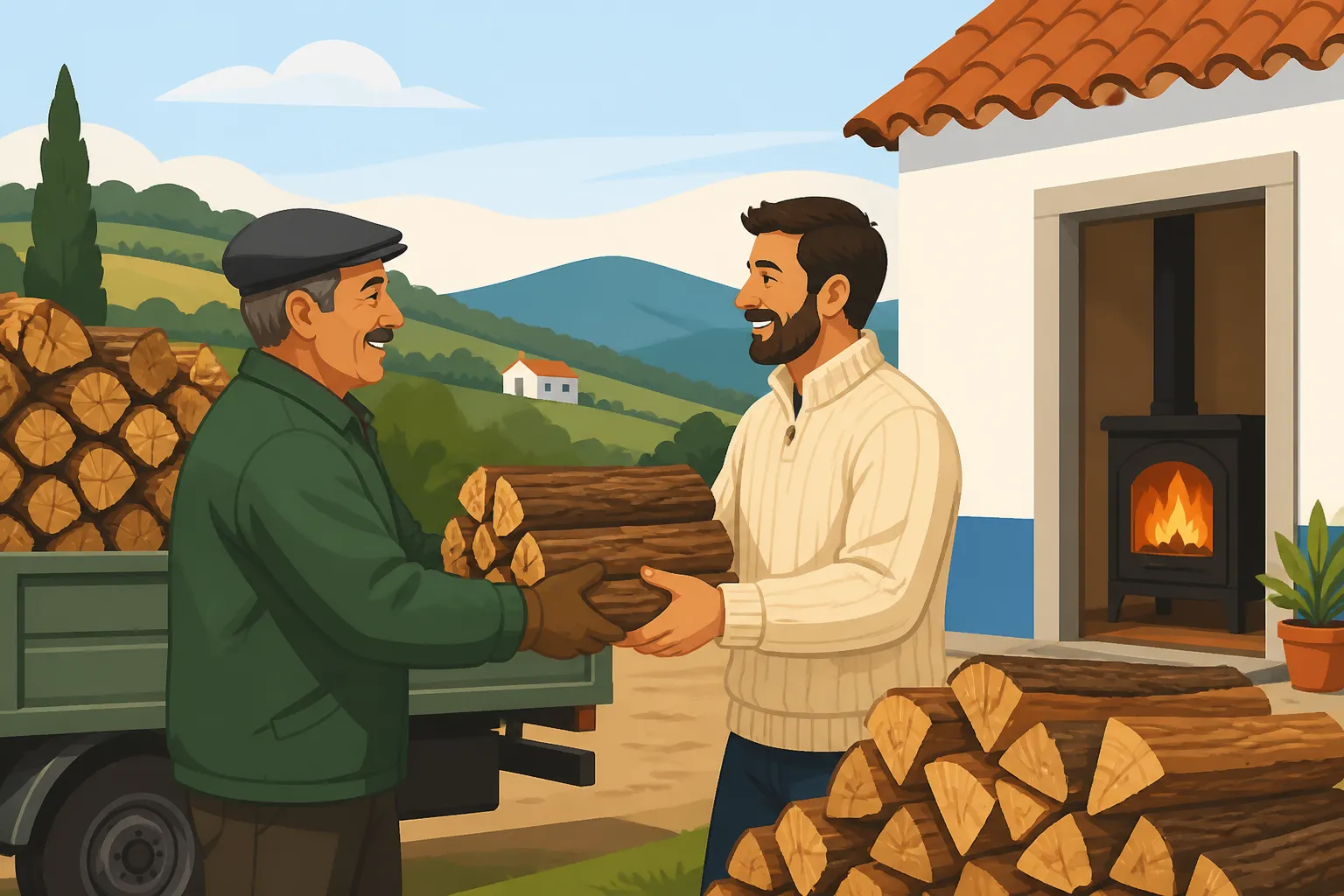
You won't find the best firewood deals on a glossy website. In rural Portugal, the firewood trade is largely informal. It’s about the "man with a truck" who lives three villages over. To find him, you need to go to the local "Junta de Freguesia" (parish council) or, more effectively, the village cafe.
When you sit down for a coffee, simply ask the person behind the counter: "Sabe de alguém que vende lenha?" (Do you know someone who sells wood?). Within minutes, you’ll likely have a phone number scribbled on a napkin. Because you’ll be making these calls, having a reliable local connection is key; if you’ve just arrived, using an eSIM from Airalo can ensure you have data and calling capabilities before your permanent SIM is sorted.
Pricing is usually done by the "tonelada" (ton) or by the "metro cúbico" (cubic meter). In 2026, prices can vary wildly depending on your region. In the Algarve or near Lisbon, prices are higher, whereas in the deep interior like Castelo Branco or Guarda, you might find better deals. A standard delivery for a medium-sized house is usually 2 to 3 tons to get through a full winter.
When the truck arrives, don't just point to the driveway. You need to consider the "acesso." Portuguese village streets were built for donkeys, not 10-ton trucks. If the driver can't get his vehicle close to your storage area, you will be spending the next three days moving wood by hand. Also, clarify if the price includes "arrumação" (stacking). Most drivers will just dump the load in a heap (a granel). If you want them to stack it neatly, expect to pay an extra €20-€30, and you must agree on this beforehand.
If you are still in the process of moving and haven't mastered the language yet, checking the Cost of Living in Portugal 2026: Detailed Budgets for Singles and Families can help you understand where firewood fits into your monthly utility expenses. It is often cheaper than gas or electricity, but the upfront cost can be a shock.
Logistics of Delivery, Storage, and Tools
Once the wood is on your property, the real work begins. Stacking wood is an art form in Portugal. You’ll see "pilhas de lenha" (wood piles) stacked with mathematical precision against the sides of houses. This isn't just for aesthetics; it’s for airflow. You want to keep the wood off the ground—using old pallets is a classic expat hack—and covered from the rain while still allowing wind to pass through the stack.
If you don't have a dedicated "lenheiro" (wood shed), you’ll need heavy-duty tarps. You can easily order these from Amazon Spain, which delivers to even the most remote Portuguese villages within a few days. While you are on Amazon Spain, I highly recommend buying a moisture meter. It’s a small device that you press against the wood to see the water percentage. Anything over 20% shouldn't be burned yet.
You will also need a few basic tools. Even if you buy "lenha rachada" (split wood), some logs will inevitably be too big for your stove. A good quality axe (machado) or a small chainsaw is essential. If you aren't comfortable with power tools, you can find manual log splitters that are much safer. Managing your own fuel supply is a significant part of Living in Portugal Guide 2027: The Complete Relocation Manual for Expats, as it represents a shift toward self-sufficiency that defines rural life.
Don't forget the importance of kindling. In Portugal, we often use "pinhas" (pinecones) to start fires. They are nature's perfect fire starters. You’ll see locals gathering them in the forests during autumn. If you’re feeling less "back to nature," you can buy "acendalhas" (firelighters) at any Pingo Doce or Continente supermarket.
Maintenance and Safety for Wood-Burning Homes
Burning wood comes with responsibilities that go beyond just staying warm. The most important is chimney safety. You must have your chimney swept (limpar a chaminé) at least once a year. In rural areas, there are professional "limpa-chaminés," but many locals do it themselves with a weighted brush. If you burn a lot of pine or eucalyptus, you'll need to do this more frequently to prevent chimney fires.
Another consideration is the ash. Do not throw it in your plastic garbage bin while it’s hot; hot ashes or items can melt a plastic bin. Wood ash is actually excellent for your garden, especially for olive and citrus trees, as long as you haven't been burning treated wood or trash.
If you are renting, make sure to check your contract. Some landlords are very particular about how the fireplaces are used. Refer to Renting an Apartment in Portugal: Contracts, Fees, and Tenant Rights to see if there are specific clauses regarding property maintenance. Also, be aware of the "Lei do Ruído" (Noise Law). While it usually applies to music and parties, using a loud chainsaw at 7 AM on a Sunday to cut logs might not endear you to your new neighbors.
Finally, always keep an eye on the weather via the "IPMA" (Portuguese Institute of Sea and Atmosphere). When a "frente fria" (cold front) is predicted, make sure you have enough wood brought inside the house. There is nothing worse than having to go out into a freezing rainstorm at 10 PM because you ran out of logs in the living room basket. This kind of preparation is as vital as knowing Earthquake and wildfire risks in Portugal: How to stay informed via Prociv, as winter storms can sometimes knock out power, making your wood stove your only source of heat and light.
Buying Firewood for a First Winter: A Checklist
To make your first winter a success, follow this simple timeline:
- August/September: Start asking around for suppliers.
- September: Order your wood. Aim for a mix of Azinho (for heat) and a little Eucalipto (for quick warmth).
- October: Ensure your chimney is clean and your "lenheiro" is organized.
- November: Bring your first "cesto" (basket) of wood inside.
- January/February: Monitor your pile. If you are running low, order more immediately; by March, the "lenha seca" is often gone.
Living in the Portuguese countryside is a rewarding experience that connects you to the rhythms of the seasons. There is a specific kind of satisfaction in sitting by a fire you built with wood you sourced from a local neighbor. It makes the house feel like a home. Just remember: in the rural interior, "wood is gold." Treat your woodpile with respect, and it will keep you cozy through the dampest Atlantic winters.
Disclaimer
This guide is intended for informational purposes only. Local laws regarding wood-burning stoves, forestry, and fire safety can vary by municipality (Câmara Municipal). Always consult with a local professional for chimney cleaning and ensure your wood-burning equipment meets current safety standards to prevent carbon monoxide poisoning or structure fires. Use power tools like chainsaws only with proper training and safety gear.