Tipping culture in Portugal: Do you leave 10% or just round up the bill?
Disclosure: This article contains affiliate links. If you buy through them, we may earn a commission at no extra cost to you. Read our full disclosure.
One of the most anxiety-inducing moments for any new arrival in Lisbon or Porto is that awkward pause when the bill arrives at a candlelit table. I distinctly remember my first week in Portugal, paralyzed by a 12€ lunch tab and wondering if leaving a 2€ tip made me a generous benefactor or a confused tourist. This guide solves the "tipping mystery" so you can navigate Portuguese social life with confidence and local grace.
The Reality of Tipping in Portugal: It Is Not North America
If you are coming from the United States or Canada, the first thing you need to do is take your "20% mental calculator" and throw it into the Tagus River. Tipping in Portugal is not a mandatory supplement to a sub-minimum wage; it is a genuine "thank you" for service that went above and beyond. In my early days living in a studio I found via Uniplaces, I struggled to wrap my head around the fact that waiters here are salaried employees with social security and healthcare. They aren't relying on your tip to pay their rent, though they certainly appreciate the extra gesture.
The cultural philosophy here is grounded in the Minimum Wage (€920) vs Average Salary: What to Expect in Portugal. Because wages are relatively low compared to Northern Europe, a tip of a few Euros is actually a significant gesture. However, the expectation is vastly different from the "guilt-tripping" iPad screens you might see elsewhere. In a traditional Portuguese tasca, the service is often brisk, no-nonsense, and efficient. You aren't paying for a theatrical performance of friendliness; you're paying for a well-cooked plate of Bacalhau.
Furthermore, you will rarely see a "Service Charge" added to your bill in Portugal, unlike in the UK or France. If you do see one, it is usually in high-end Michelin-starred restaurants or heavy tourist traps in the Algarve. Most of the time, the price you see on the menu is exactly what you are expected to pay. This transparency is part of why the Cost of Living in Portugal 2026: Detailed Budgets for Singles and Families remains attractive to so many expats—what you see is generally what you get.
Understanding the Service Included Myth
There is a common misconception that service is "included" in the price of the food. While technically true in the sense that the business must pay its staff, there isn't a specific percentage of your bill earmarked for the waiter. If you don't leave a tip, the waiter doesn't "lose money" on the table, which is a common fear for North Americans.
In my experience, the only time you should feel a social obligation to tip is if you are a regular. If you visit the same pastelaria every morning for your galão and toast, leaving the small change (the "moedinhas") once or twice a week builds a rapport that ensures you get the best seat and the freshest pastry. It’s about relationship-building rather than a transactional requirement.
Why the 10 Percent Rule Does Not Apply Here
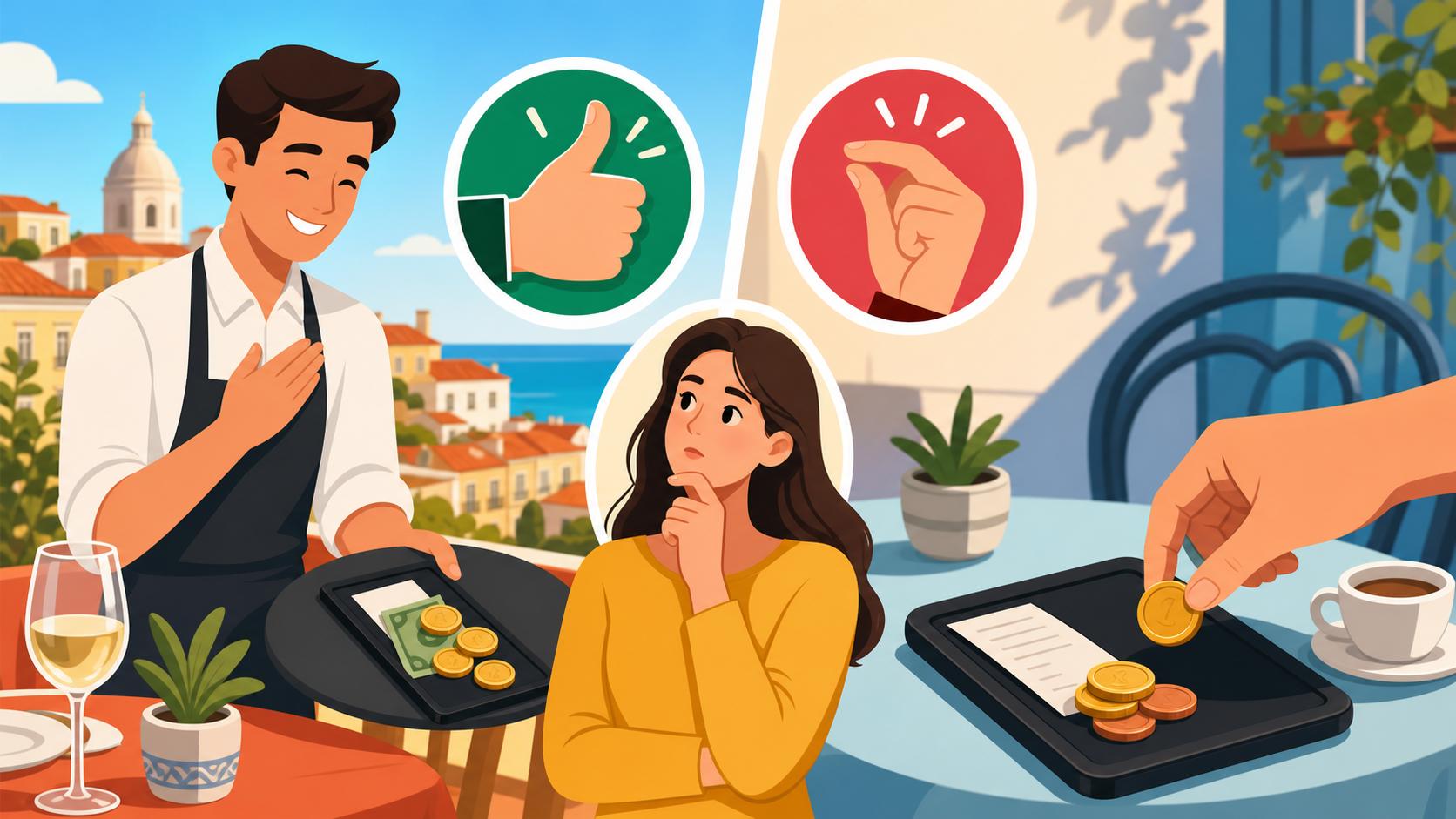
While 10% is often cited as a "standard" for good service in mid-to-high-end restaurants, it is by no means a rule. If your bill is 85€, a 5€ note is considered a very solid tip. Leaving 8.50€ would be seen as exceptionally generous. In casual dining, people rarely calculate percentages. They look at the change they have in their pocket. If a lunch is 12.40€, most locals will leave the 60 cents or round up to 13€.
When you are out exploring using your Airalo eSIM to find the best hidden gems, you’ll notice that locals are quite frugal. Portugal has a deep-seated culture of "poupança" (saving). Over-tipping can actually sometimes mark you as a "clueless tourist," which might lead to higher prices or different treatment in non-regulated environments. Staying within the local norms helps you integrate better into your Lisbon Neighborhood Guide: Best Areas for Expats and Digital Nomads community.
Tipping Etiquette Across Different Scenarios
The "where" is just as important as the "how much." Tipping a bartender for a single beer is almost unheard of in Portugal, whereas tipping a tour guide is almost mandatory. When I moved into my first permanent apartment, I had to learn the nuances of tipping for everything from grocery deliveries to the person who fixed my leaky sink.
Casual Tascas and Pastelarias
In your neighborhood pastelaria, the rules are simple: round up to the nearest Euro or leave the small copper coins. If your espresso (bica) and a pastel de nata cost 2.20€, leaving the 30 cents change is perfectly fine. Many locals don't leave anything at all for a quick coffee at the counter.
If you sit down for a "Prato do Dia" (plate of the day), which is the backbone of the Portuguese Coffee Culture and Restaurant Etiquette: Ordering Like a Local, and the total is 9.50€, leaving a 10€ note and walking away is the classic local move. You've left 50 cents, the waiter is happy, and you've had a full meal for under ten Euros. This is the beauty of the Portuguese mid-day meal.
Fine Dining and Tourist Hubs
In more upscale restaurants in areas like Príncipe Real or Foz do Douro, the expectations shift slightly. Here, the service is more formal, and the staff often speak multiple languages. In these settings, a tip of 5€ to 10€ on a 100€ bill is standard. You don't need to go higher than 10% unless the service was truly transformative.
One thing to watch out for is the "couvert." These are the olives, bread, and cheese placed on your table at the start. Many expats mistake this for a free gift or a service gesture. It is not. You will be charged for what you eat. Heated debates between tourists and waiters over a 5€ plate of cheese that was never "ordered" are common. Just remember: if you touch it, you pay for it. It’s not a tip, and it’s not free.
Deliveries and Ride-Hailing Apps
Since the pandemic, delivery culture has exploded in Portugal. Apps like Glovo and Bolt Food are everywhere. When it comes to Using Bolt vs Uber in Portugal: Which ride-hailing app is cheaper?, you’ll find that the apps always prompt you for a tip.
- Ride-hailing: Usually, 1€ or 2€ is plenty for a standard 10-minute trip. If the driver helped with heavy suitcases, 2€ to 3€ is a nice gesture.
- Food Delivery: 1€ to 2€ in cash is often preferred over the app tip, as the drivers get it immediately.
If you are ordering bulky items from Amazon Spain, you generally don't tip the courier (CTT or SEUR). They are on a very tight schedule and usually just want you to sign the handheld device and move on.
Services and Home Repairs
This is where it gets tricky for many expats. If you are Finding English-speaking plumbers and electricians using the Fixando app, should you tip? Generally, no. If a professional gives you a quote for 50€ to fix a shutter, you pay 50€. However, if the work was particularly messy or they stayed late to ensure everything was perfect, offering them a coffee or "the price of a coffee" (rounding up the bill by 5€) is a very "Portuguese" way to show appreciation. It is more about the gesture of hospitality than the cash value.
Practical Logistics: Cash, Card, and MB Way
The biggest hurdle to tipping in Portugal is the technology—or lack thereof. Unlike in London or New York, where the card terminal offers you a percentage screen, the Portuguese Multibanco system is notoriously "tip-unfriendly."
The Struggle with Tipping on Card
In many traditional restaurants, it is actually impossible to add a tip to a credit card transaction. The waiter enters the amount, you tap your card, and that’s it. There is no line on the receipt for a gratuity. This is why newcomers are often advised to keep a small stash of 1€ and 2€ coins in a drawer. I eventually bought a small decorative coin tray on Amazon Spain because my pockets were always jingling with change.
If you really want to tip and don't have cash, you can ask the waiter: "Posso incluir a gratificação no cartão?" (Can I include the tip on the card?). Some modern systems allow them to manually change the total before you tap. However, be aware that card tips are often taxed or kept by the house rather than going directly to the server. Cash is king if you want to ensure the person who served you actually gets the money.
Using the MB Way Method
For the tech-savvy expat, Using the MB Way app: Why it’s better than carrying cash in Portugal can be a lifesaver. If you have a local bank account, you can actually send a tip directly to a waiter if they are willing to give you their phone number. While this is becoming more common with younger staff in trendy areas, it might be a bit "too much" for the older waiter at your local grill house. When in doubt, stick to physical coins or small notes.
Summary of Tipping Expectations
To make your life easier, I’ve put together this quick reference table. Keep this in mind as you navigate your first few months of Grocery Shopping in Portugal: Continente, Pingo Doce, Auchan, and Mercados and dining out.
| Scenario | Typical Bill | Suggested Tip | Logic |
|---|---|---|---|
| Quick Coffee / Bica | 0.80€ – 1.50€ | The 5/10c change | Small "moedinhas" are standard. |
| Casual Lunch (Prato do Dia) | 10€ – 15€ | Round up to nearest Euro | Makes the transaction simple. |
| Mid-range Dinner for Two | 40€ – 60€ | 2€ – 5€ | A "gesture" tip showing appreciation. |
| Fine Dining / Fancy Date | 100€+ | 5% – 10% | Closer to international standards. |
| Uber / Bolt Ride | 8€ | 1€ | App-based rounding or a small coin. |
| Hairdresser / Barber | 15€ – 30€ | 1€ – 2€ | Only if you love the cut. |
| Hotel Porter | N/A | 1€ – 2€ per bag | Standard service industry etiquette. |
| Free Walking Tour | N/A | 10€ – 20€ | These guides live on tips alone. |
Final Thoughts for the "Newbie" Expat
Don't let tipping stress you out. The Portuguese are famous for their "brandos costumes" (gentle manners). If you forget to tip, or if you tip "too little" by your home country's standards, no one is going to chase you down the street or spit in your soup next time. The most important thing you can do to show appreciation in Portugal isn't through your wallet—it’s through your words.
A sincere "Estava tudo excelente, obrigado" (Everything was excellent, thank you) often carries more weight than a 50-cent coin. Take the time to learn the names of the staff at your regular spots. Treat the tipping as a secondary layer of your social integration. Once you’ve settled in and mastered the art of the "round up," you’ll feel less like a guest and more like a neighbor. And remember, if you ever feel like you've been overcharged or treated unfairly, you always have the right to ask for the "Livro de Reclamações" (Yellow Complaint Book), though hopefully, your tipping journey will be filled with nothing but "muito obrigado" moments.
Disclaimer
The information provided in this guide is based on cultural norms and personal experiences in Portugal as of 2026. Tipping is ultimately a personal choice and is not legally required for any service in Portugal. Prices and average wages mentioned are subject to change based on government policy and inflation. Always check the specific house rules of an establishment if you are unsure about service charges.