Using the European Health Insurance Card (EHIC) in Portugal
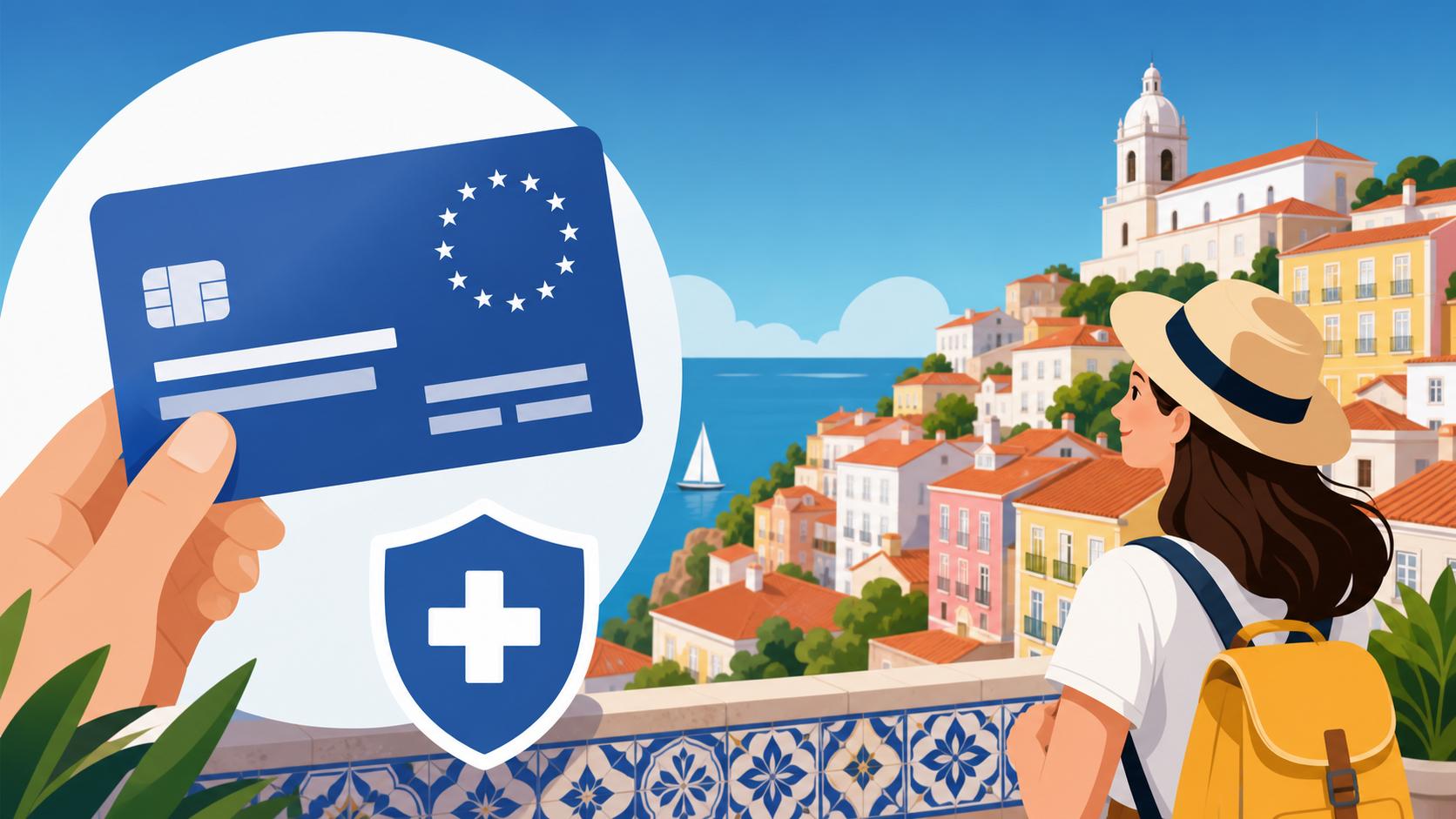
Imagine you’re on holiday in Lagos with a high fever, or your child slips on wet cobblestones in Porto’s Ribeira and needs stitches. You have a blue European Health Insurance Card in your wallet, but you don’t know what it covers, where to show it, or whether the clinic will accept it. This guide explains how the EHIC works in Portugal, step by step.
What the EHIC Actually Covers in Portugal
I spent my first months in Portugal on an EHIC before I sorted out residency. The card is useful, but it is narrower than many people think. It is not travel insurance and it is not private health cover. It entitles you to the same public healthcare that Portuguese residents get, on the same terms, while you are temporarily in the country.
Medically Necessary Care on Equal Terms
The key phrase is “medically necessary.” The EHIC covers care that becomes necessary during your stay and cannot reasonably wait until you go home. That includes a sudden infection, a sprained ankle from hiking the Seven Hanging Valleys trail, an asthma flare-up, or an unexpected complication from a chronic condition you already have.
In Portugal, that care is delivered through the Serviço Nacional de Saúde, the SNS. You use the same health centres, the same public hospital emergency departments and the same pharmacies as locals. If you want to understand how the system fits together before you need it, read Portugal’s National Health Service (SNS): How the Public System Works.
“Equal terms” applies to costs as well. If a Portuguese resident pays a user charge for a service, you pay it too. If residents get a service free, so do you. You do not get special treatment, but you are not treated as a paying foreigner either. The rules on user charges have changed over the years, so check them at the time of your visit. For the full picture, see Taxas Moderadoras: Co-payments and Costs in the Public Health System.
Pre-existing and Chronic Conditions
People with a chronic condition sometimes worry that it is excluded. It is not. If you have diabetes and run out of insulin, or kidney disease and need dialysis, the EHIC can cover that care. Dialysis and certain specialised treatments, such as oxygen therapy, usually need to be arranged with the Portuguese unit before you travel. Treatment centres have limited capacity and cannot always fit in a walk-in visitor.
Pregnancy is handled the same way. Routine antenatal care and childbirth that happens unexpectedly during a temporary stay are covered. Travelling to Portugal specifically to give birth in a public hospital is a different situation.
Who Can Use the Card
The EHIC is issued by the public health systems of EU member states, plus Iceland, Liechtenstein, Norway and Switzerland. If you are British, the UK Global Health Insurance Card, the GHIC, works in Portugal in the same way for necessary state healthcare. Some older UK-issued EHICs also remain valid until their printed expiry date.
The card is personal. Every family member, including children, needs their own. When my sister visited with her two kids, she had only her own card. We spent a stressful afternoon at a health centre in Cascais waiting while she arranged a Provisional Replacement Certificate from her home country so her son could be seen.
What the EHIC Does Not Cover
This is where people get caught out, and it usually happens at the worst moment.
Private Hospitals and Clinics
Portugal has an excellent private hospital sector, and private hospitals are often the most visible facilities in tourist areas. Groups such as CUF, Hospital da Luz and Lusíadas run large, modern hospitals with English-speaking staff and short waits. In general, they do not accept the EHIC. If you walk into one, you will be treated as a private patient and billed accordingly.
Usually nobody warns you at the door. If you are in a tourist area and search for “hospital near me,” check whether the result is a public SNS hospital or a private one before you go in. For how the private groups operate, see Hospital da Luz and CUF: Navigating Portugal’s Biggest Private Hospitals.
Repatriation, Rescue and Planned Treatment
The EHIC does not pay to fly you home on a medical flight. It does not cover mountain or sea rescue costs where these are charged. It does not cover lost belongings or cancelled trips. It also does not cover travelling to Portugal to get treatment, such as cheaper dental implants or an elective operation. Planned cross-border treatment needs separate prior authorisation through your home health system, usually with an S2 form.
This is why visitors should always carry travel insurance as well as their EHIC. The two do different jobs. For how to choose a policy, see Travel Insurance for Trips to Portugal.
Long-Term Residents
Once you move to Portugal and become resident, the EHIC is no longer the right document. Your home country’s card is meant for temporary stays. Residents register with the SNS directly, and state pensioners from another EU country normally do so with an S1 form issued by their home system.
I see people on Algarve forums who have lived here for years and still show their old card at the health centre. Sometimes it works because a receptionist doesn’t ask. Relying on that can create billing problems with your home country later. If you are relocating, start with EU/EEA Citizens Moving to Portugal: CRUE Registration and Residency Steps and then sort out your SNS user number.
| Situation | Covered by EHIC | What to do instead |
|---|---|---|
| Sudden illness or injury on holiday | Yes, at SNS facilities | Show EHIC and passport or ID |
| Chronic condition care during a short trip | Yes, if medically necessary | Pre-arrange dialysis or oxygen |
| Treatment at a private hospital | No | Use travel or private insurance |
| Medical repatriation flight | No | Travel insurance |
| Travelling to Portugal for planned surgery | No | Request prior authorisation, such as S2 |
| Living in Portugal as a resident | No | Register with the SNS, or use S1 if a pensioner |
| Prescriptions from an SNS doctor | Yes, state contribution applies | Show EHIC at the pharmacy |
How to Use the EHIC Step by Step
The process is simple once you know it. Here is how it usually works, depending on how urgent your problem is.
Start With SNS 24 for Non-Emergencies
For anything that is not life-threatening, the best first step is the SNS 24 helpline, which as of October 2026 is on 808 24 24 24. Clinical contact, meaning triage, advice and referral when you are ill, is available 24 hours a day, every day. Administrative, non-clinical contact runs from 8:00 to 22:00 every day. The call is charged as a call to a landline. Nurses can answer in English. Depending on your symptoms, they will advise self-care, send you to a health centre, or refer you to an emergency department.
The referral matters. Patients who arrive at a public emergency department with an SNS 24 referral are generally prioritised in the system and may avoid charges that apply to walk-ins. I called SNS 24 at midnight when my partner had severe stomach pain in Tavira. The nurse was calm and thorough, and she sent us to the hospital in Faro with a referral that the reception desk processed straight away. For a detailed guide to the line, read SNS 24 Helpline (808 24 24 24): Triage, Advice, and Sick Notes.
Visiting a Centro de Saúde
For a minor illness, a prescription you have run out of, or a wound that needs checking, the local health centre, the Centro de Saúde, is the place to go. Here is what I suggest:
- Find the health centre that covers the area where you are staying. Your hotel or host can usually point you to it.
- Go early in the morning. Same-day slots for walk-in or acute cases, often called “consulta aberta” or “atendimento complementar,” fill quickly.
- At reception, show your EHIC together with your passport or national ID card.
- Give your local address and a phone number. Staff may register you as a temporary user so the doctor can see you in the system.
- Wait to be called. This can take time, so bring water and something to read.
- After the consultation, keep any paperwork. Prescriptions are usually electronic and linked to a code sent by SMS or printed on paper.
Not every health centre handles visitors in exactly the same way, and some smaller ones have limited acute hours. For what to expect as a walk-in visitor, see Can tourists walk into a Centro de Saúde if they feel sick? If you later become resident, Registering with the Centro de Saúde: Getting Your SNS Número de Utente covers the next step.
Going to a Public Emergency Department
For genuine emergencies such as chest pain, difficulty breathing, serious bleeding, suspected fractures or signs of a stroke, call 112. The call is free. Ambulances take you to the nearest appropriate public hospital.
If you go by yourself, make sure you are going to the “Urgência” of a public hospital. Examples include Hospital de Santa Maria in Lisbon, Hospital de São João in Porto, or Hospital de Faro in the Algarve. At reception, show your EHIC and ID. A nurse then assesses you using the Manchester Triage System, which gives you a colour based on urgency. Red cases are seen immediately. Blue cases can wait many hours, especially in summer when tourist areas are crowded.
For what the colours mean and how to manage the wait, read Emergency Rooms (Urgências) in Portugal: Triage Colors and Wait Times.
Pharmacies, Prescriptions and Everyday Supplies
Medication is where many visitors spend their money, so this part deserves a closer look.
Filling an SNS Prescription With Your EHIC
When an SNS doctor prescribes medication, the state usually pays part of the price, and the rate depends on the drug. Take the prescription to any pharmacy with the green cross and show your EHIC. The pharmacist applies the same state contribution that a resident would get. You pay the remaining part at the counter.
If a private doctor writes the prescription, you can still buy the medication, but the state contribution may not apply in the same way. Keep receipts in case your travel insurer reimburses you.
If you need medication at night, every town has a rota of pharmacies open late, called the “farmácia de serviço.” Notices on pharmacy doors show which one is on duty. For how to find one quickly, see What is a Farmácia de Serviço and how to find one open at 2 AM.
Bringing Your Own Medication
If you take regular medication, bring enough for the whole trip, plus extra in case of delays. Keep it in the original packaging with a copy of your prescription. Portuguese pharmacists will not always recognise foreign brand names, so ask your doctor at home to write the generic active ingredient on your paperwork.
Controlled substances, such as some ADHD medications or strong painkillers, need extra documents. Before you pack, read Bringing Prescription Drugs to Portugal: Customs and Import Rules.
Vitamins and Supplements
Pharmacies and parafarmácias in Portugal stock plenty of vitamins, but the brands may be unfamiliar and the selection can feel limited compared with home. Some longer-stay visitors and new arrivals order familiar supplements online from iHerb, which ships to Portugal. Delivery times and import charges vary by order, so check before relying on it for anything you take every day. Prescription medication is a different matter and should always come from a pharmacy.
Real Scenarios and Practical Tips
Here are a few situations I have either lived through or helped friends with.
Scenario: A Holiday Injury in the Algarve
A German friend twisted her knee badly on the rocks at Praia da Marinha. The beach bar staff pointed her toward a private clinic in Lagoa, which is common in the Algarve. Fortunately, she called SNS 24 first. The nurse directed her to the public hospital in Portimão. She showed her EHIC, was triaged yellow, had an X-ray, and left with a brace and crutches.
If she had gone to the private clinic, she would have paid upfront and then claimed back from her travel insurance. If you have travel insurance with direct billing, the private route may be faster. If you are relying on the EHIC alone, you need the public system.
Scenario: A Child With an Ear Infection in Lisbon
A Dutch family I know arrived in Lisbon and their five-year-old developed an ear infection on day two. Each child had their own EHIC, so the morning visit to the health centre in Arroios went smoothly. A family doctor saw the child, an antibiotic prescription arrived by SMS, and the pharmacy on the corner filled it with the standard state contribution.
Their advice afterwards was practical: photograph every family member’s EHIC and passport and save the photos on your phone. That way you are covered even if the physical cards stay in the hotel safe.
When You Need More Than the EHIC
For long stays, remote work periods, or anyone who wants private hospital access with English-speaking specialists, the EHIC alone is often not enough. International health insurers such as Cigna Global offer policies that work in private hospitals across Portugal and in other countries. Coverage levels, exclusions and premiums vary widely by age and plan, so check the provider’s own page for current details and read the policy wording before you buy.
Some people who split their year between Portugal and home combine the EHIC for unexpected public care with a plan from a provider like Cigna Global for private and elective care. Whether this makes sense depends on how long you stay, your health and your budget.
Before any trip, run through this short checklist:
- Check that your EHIC or GHIC has not expired, and order a new one well before you travel.
- Make sure every family member has their own card.
- Save 112 for emergencies and 808 24 24 24 for SNS 24 in your phone.
- Carry your passport or national ID card alongside the EHIC.
- Buy travel insurance that covers repatriation and private treatment.
- Arrange specialised treatment such as dialysis with the Portuguese unit in advance.
- Pack your regular medication with its generic names written down.
Disclaimer
This article is for general informational purposes only and does not constitute professional advice. Laws, prices and regulations vary by location and change over time. Consult a qualified professional for guidance on your specific situation.