Driving in Portugal: Licenses, Tolls, and Via Verde
Disclosure: This article contains affiliate links. If you buy through them, we may earn a commission at no extra cost to you. Read our full disclosure.
You land in Lisbon, pick up a rental car or finally buy that used Renault, and within an hour you’re driving under a toll gantry with no booth and no idea how to pay. You may also be wondering whether your home licence is legal here. This guide covers both: which foreign licences work in Portugal, how the exchange works, and how to pay tolls without collecting fines.
Can You Drive in Portugal on Your Foreign Licence?
This is the question that kept me up during my first winter here. I had a residence card on the way, a car loan conversation booked at the bank, and a vague fear that every police officer on the A5 could pull me over and declare my licence worthless. The answer depends on two things: whether you are a resident or a visitor, and which country issued your licence.
The rules below come from articles 125 and 128 of the Código da Estrada, Portugal’s road traffic code, and from the government’s official guidance on licence exchanges. All of them are as of October 2026. Read them slowly, because the differences between categories matter a lot.
Tourists and Non-Residents: The 185-Day Window
If you are visiting Portugal and you hold a non-EU licence issued under the Geneva or Vienna road traffic conventions, you can drive for 185 days after you enter the country, provided you stay a non-resident. That covers most holidaymakers, snowbirds escaping a northern winter, and people on a long scouting trip before a move.
Picture a Canadian couple who rent a car in Faro in November and spend the winter driving between Tavira, Lagos and the Alentejo. They are not residents, their licences come from a convention country, and their stay fits inside the 185-day window. They simply drive. They should still carry their passports, licences and rental paperwork at all times, because Portuguese police do routine document checks at roadside stops, especially on the N125 in the Algarve.
The window is tied to your status as a non-resident. Once you take up residence, a different set of rules applies, and that is where most of the paperwork starts.
The OECD and CPLP Exemption for Residents
This is the part that surprises people in a good way. If your licence was issued by an OECD country or a CPLP country (the community of Portuguese-speaking nations), you may be able to keep driving on it in Portugal without exchanging it, even after you become a resident. The government guidance names Angola, Brazil, Cabo Verde, the United Kingdom and Switzerland as examples. Other OECD members such as the United States and Canada fall into the same group.
Article 125, n.º 1 c) of the Código da Estrada sets three conditions, and you must meet all of them:
- The issuing state has signed a road traffic convention or a bilateral agreement with Portugal.
- No more than 15 years have passed since the licence was issued or last renewed.
- The holder is under 60.
Take a British retiree aged 58 who renewed her licence a few years ago and moved to Caldas da Rainha on a D7 visa. She meets all three conditions and can keep driving on her UK licence. Her husband, aged 63, does not meet the age condition, so he needs to go through the exchange route. Many couples end up on different tracks like this, so check each licence on its own rather than assuming one answer covers the household.
The exemption is not permanent. The day your licence passes the 15-year mark since issue or renewal, or the day you turn 60, the condition is no longer met. Put both dates in your calendar the week you arrive.
EU and EEA Licence Holders
If your licence comes from another EU or EEA country, it is recognised in Portugal under EU rules, and you can generally keep using it as a resident. Even so, it is worth checking the IMT, the Instituto da Mobilidade e dos Transportes, for any registration steps that apply to your situation, particularly if your licence carries medical restrictions or an expiry date that will arrive while you live here.
| Your situation | Can you drive on your foreign licence? | Key condition |
|---|---|---|
| Non-resident with a Geneva or Vienna convention licence | Yes | Up to 185 days after entry while non-resident |
| Resident with an OECD or CPLP licence | Yes, without exchange | Convention or bilateral agreement, licence issued or renewed within 15 years, holder under 60 |
| Resident with an OECD or CPLP licence who no longer meets those conditions | Exchange required | Apply to the IMT |
| Resident with another convention licence | Exchange required | Apply within 90 days of taking up residence |
| Exchange requested more than two years after residence began | Exchange possible | Practical driving test required |
| EU or EEA licence | Yes, recognised | Check the IMT for any registration steps |
For a deeper walk-through of the exchange itself, see Driving in Portugal: Exchanging Your Foreign License to a Portuguese One.
Exchanging Your Licence at the IMT
If you fall outside the exemption, you need a Portuguese licence. The process is bureaucratic, but it is not as frightening as the expat Facebook threads make it sound. It mostly takes patience and a tidy folder of documents.
When You Must Exchange and the Two-Year Line
Under article 128 of the Código da Estrada, residents who hold a non-EU convention licence and need to exchange it must apply within 90 days of taking up residence. The real cliff edge comes later. If you request the exchange more than two years after your residence began, the IMT requires you to pass a practical driving test before it issues the Portuguese licence.
A practical test here means booking with a driving school (escola de condução), taking lessons on Portuguese roads, possibly in a manual car, and sitting the exam with a Portuguese examiner. For someone who has driven for 30 years, that is humiliating, slow and costly. The two-year line is the one to respect above everything else.
My advice is to apply as soon as you have your residence document in hand. The exchange can take time to process, and starting early protects you if the system backs up.
Step-by-Step: The Exchange Process
The exact route can shift with IMT system updates, but the general sequence looks like this:
- Confirm whether you actually need to exchange by checking the table above against your licence’s issue or renewal date and your age.
- Gather your documents: your foreign licence, passport, residence permit or registration certificate, and your NIF (Portuguese tax number).
- Get a medical certificate from a doctor in Portugal if the IMT asks for one. In many cases the doctor submits it electronically.
- Arrange a certified translation of your licence if it is not in Portuguese or a language the IMT accepts. Check this before you pay anyone.
- Submit the application through the IMT online services or at an IMT service desk, or at an Espaço Cidadão where one offers the service.
- Pay the fee shown on the IMT’s official page at the time you apply.
- Keep the receipt or provisional document you are given. It shows you have applied while you wait for the card.
- Watch for the new licence arriving by post, and expect the IMT to keep your original foreign licence in many cases.
If you hold an American licence, see How to convert a US driver’s license to a Portuguese license (IMT process) for state-specific quirks. British drivers wondering about testing can check Do I need to take a driving test in Portugal if I hold a UK license?.
Documents, Medical Certificates and Translations
The medical certificate step catches people off guard. In Portugal, driving fitness is something a doctor certifies, and the certificate usually has to come from a doctor registered here. Private clinics often handle this quickly. Some driving schools also have arrangements with doctors who do these assessments routinely.
Translations are the other trap. A licence from a country that uses a different alphabet, or one whose categories don’t map neatly onto European ones, may need a certified translation. Ask the IMT exactly what they need before you pay a translator, because requirements differ by issuing country.
Finally, make sure your Portuguese address is settled. The IMT posts the new card to you, and a temporary Airbnb address is a recipe for a lost licence. If you’re still apartment hunting when you arrive, a mid-term furnished rental booked through a platform like Spotahome can give you a stable address for those first months while the paperwork works its way through.
How Portuguese Tolls Actually Work
Portugal’s motorway network is excellent: smooth, well signposted and often nearly empty outside rush hour. It is also tolled almost everywhere. The confusing part is that there are two different systems running side by side, and they behave nothing alike.
Traditional Toll Plazas
On older concession motorways such as the A1 between Lisbon and Porto, the A2 south towards the Algarve and the A5 to Cascais, you’ll find classic toll plazas. You either take a ticket when you join the motorway and pay when you leave, or you pay a fixed amount at a barrier.
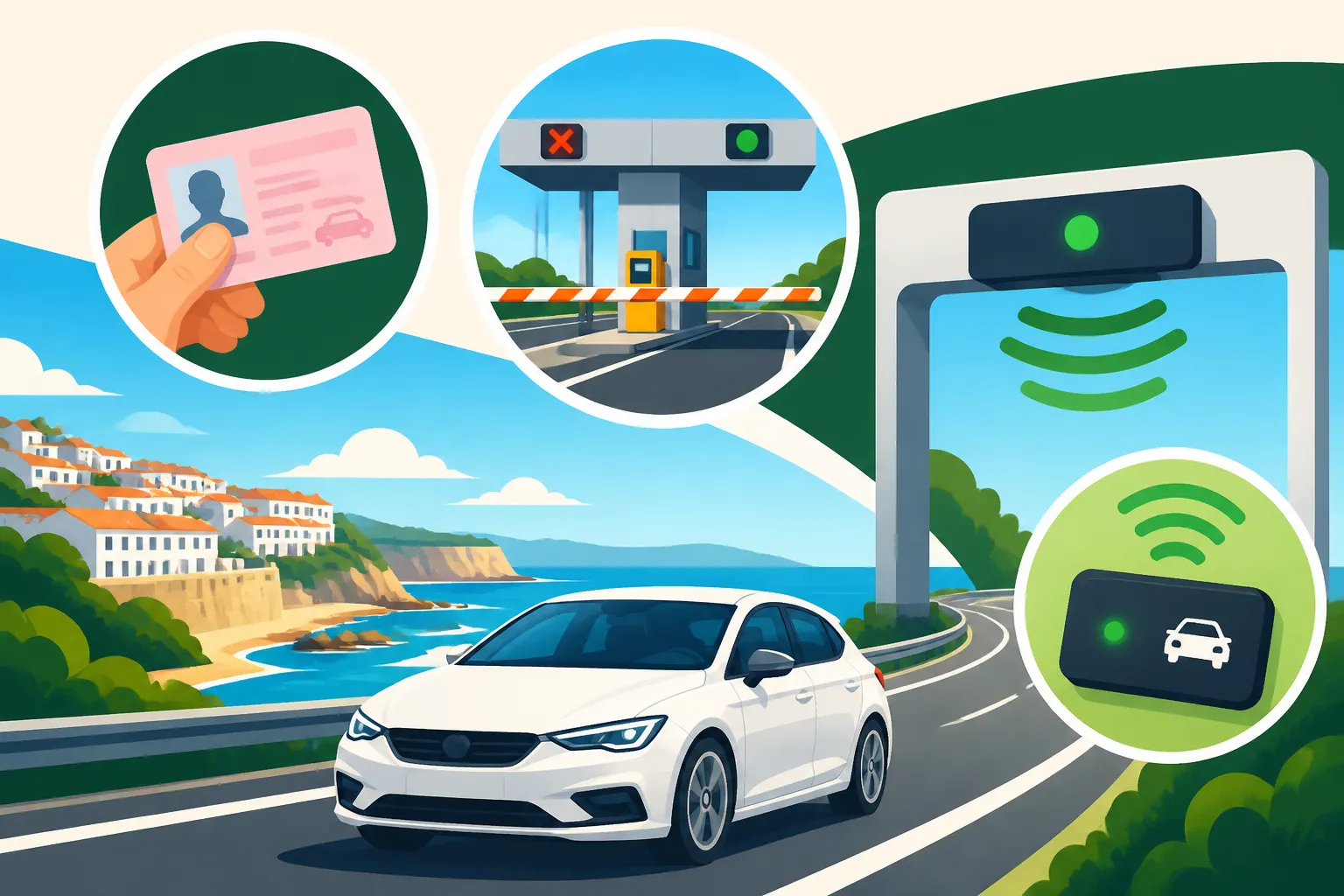
Each plaza has several lane types. Lanes with a person or a card machine accept payment directly. Lanes marked with a green “V” are for Via Verde transponders only. Do not drive into a green V lane without a device. The barrier may lift, the camera will record your plate, and the bill plus penalties will find you later.
If you’re nervous, stay in the right-hand lanes at plazas, keep your bank card on the dashboard, and accept that a local in a hurry may beep at you. It happens to all of us.
Electronic-Only Tolls on the Former SCUT Motorways
This is the system that makes newcomers’ hearts sink. Several motorways that used to be free under the old SCUT scheme now charge tolls using overhead gantries only. There are no booths and no barriers. Cameras and sensors read your plate or your transponder as you drive underneath. Which motorways use this system has changed over time, so check the current list on the official toll operator pages before you drive.
Look for signs reading “Portagem Electrónica” or “Electronic Toll Only” before each section. If your car has a Via Verde device, the charge is debited automatically. If it doesn’t, the passage is logged against your plate, and you then need to pay at a CTT post office or a Payshop agent, usually after a short processing delay and before the operator’s payment window closes. Check the operator’s guidance for the current window. Miss it, and an administrative process begins that adds charges and can end up as a debt registered with the tax authority.
If you have already missed one, How to pay an unpaid SCUT electronic toll online before getting fined explains how to fix it before it escalates.
Paying Tolls on Foreign-Plated and Rental Cars
Driving your own car down from France or the UK? Foreign-plated vehicles have dedicated options. EasyToll machines at certain border entry points let you link your bank card to your plate, so electronic tolls are charged automatically. Prepaid toll cards and online plate-registration services also exist for short visits. Because the availability and conditions of these schemes change, confirm them on the official toll operator pages before your trip.
Rental cars are usually simpler. Most rental companies offer a toll transponder for a daily or per-rental charge, and the tolls you use are added to your final bill. Accept it. Declining it to save a little often means chasing post-office payments for weeks or receiving a surprise admin fee from the rental company months later. For a detailed breakdown, see How Do Tolls Work in Portugal for Rental Cars?.
| Payment method | Works at toll plazas | Works on electronic-only tolls | Best for |
|---|---|---|---|
| Via Verde transponder | Yes, green V lanes | Yes, automatic | Residents and long-term drivers |
| Cash or card at booth | Yes | No | Occasional plaza-only trips |
| Post office or Payshop after passage | No | Yes, within the payment window | Drivers without a device |
| EasyToll at border entry | Not generally | Yes, linked to bank card | Foreign-plated cars |
| Rental company transponder | Yes | Yes | Tourists in rental cars |
Via Verde: The Transponder That Makes Life Easier
If you live here and drive more than a handful of times a year, Via Verde is the single best administrative decision you’ll make. I put off getting mine for months, spent several afternoons in CTT queues paying electronic tolls, and then felt silly once the little box was on my windscreen.
What Via Verde Is and What It Does
Via Verde is Portugal’s electronic toll payment system. It uses a small identifier device mounted on your windscreen behind the rear-view mirror. Every time you pass a green V lane at a plaza or drive under an electronic gantry, the toll is recorded and later debited from the bank account linked to your contract.
It also does more than tolls. Depending on the location and your plan, the device or the Via Verde app can pay for some car parks, including at airports and shopping centres, some fuel stations and certain drive-through services. Your monthly statement lists every passage, which is handy if you claim travel costs as a freelancer.
Plans differ in how you pay for the device itself. Some involve buying it outright, others a periodic subscription, and features vary between tiers. Compare the options on Via Verde’s own site before you sign.
How to Get a Via Verde Device
The process is straightforward once you have the basics:
- Make sure you have a NIF, a Portuguese bank account or a SEPA-compatible account that accepts direct debit, and your vehicle registration document.
- Choose a plan on Via Verde’s website or in person at a Via Verde store, where staff can explain the differences.
- Sign the contract and link your bank account for direct debit.
- Collect the device in store or wait for it to arrive by post.
- Mount it in the marked position on your windscreen, usually behind the mirror, as instructed in the pack.
- Download the Via Verde app so you can check passages and manage your vehicles.
- If you switch cars, update the registration plate on your account before driving the new car under any gantry.
The full registration walkthrough, including what to do if your bank rejects the debit mandate, is in How to register for a Via Verde tag for electronic highway tolls.
Pros and Cons of Via Verde for Expats
The advantages are real. You never stop at a plaza again, electronic tolls take care of themselves, you avoid post-office queues, and you get a single digital record of every trip. For anyone commuting on the A5 from Cascais or the A1 from the Silver Coast, it saves hours over a year.
The downsides are smaller but worth knowing. You need a NIF and a bank account that accepts the direct debit, which can be a hurdle in your first weeks. There is a cost attached to the device or plan, so very occasional drivers may not find it worthwhile. And if your linked card or account changes and you forget to update it, unpaid passages can pile up quietly.
On balance, for residents, it’s a clear yes. For a two-week tourist, the rental company’s transponder does the same job without a contract. The bigger picture of plaza versus gantry routes is covered in Navigating the Portuguese Toll System: Via Verde and Electronic Tolls.
Everyday Driving Realities in Portugal
Licences and tolls are the paperwork. The real culture shock happens on the road, and it isn’t always on motorways.
Roundabouts, Narrow Streets and Lisbon Hills
Portugal drives on the right, and roundabouts (rotundas) are everywhere. Traffic already on the roundabout has priority. In multi-lane roundabouts, the official rule is that you should take the outer lane if you plan to exit at the first available exit and move outward before leaving. In practice, local habits vary a lot, so give everyone space and signal clearly.
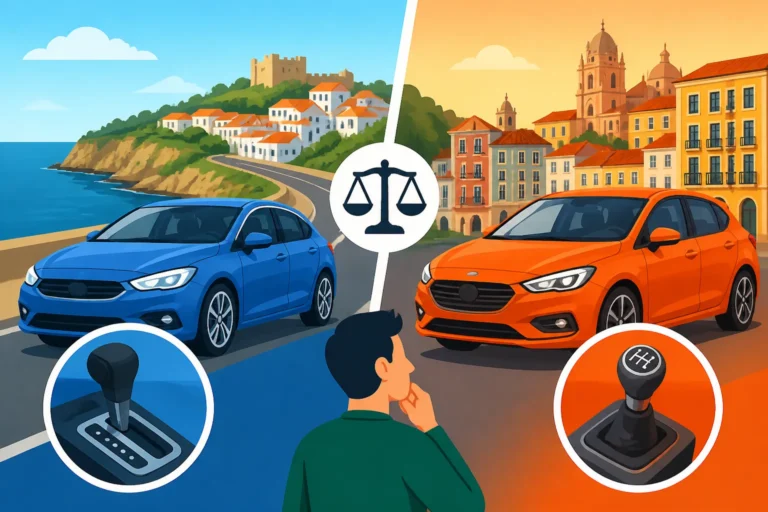
Historic centres are another challenge altogether. Alfama in Lisbon, the Ribeira in Porto and the old towns of Sintra and Óbidos have streets barely wider than a car, steep cobbled gradients and trams that will not move for you. Many visitors find a manual gearbox on a wet cobbled hill in Graça terrifying. If that sounds like you, read Driving an automatic vs manual car in Portugal: Rental and purchase tips before you book a car or buy one.
Rural roads bring their own surprises: tractors, stray dogs, blind bends on mountain N-roads in the Serra da Estrela and the Douro, and the occasional flock of sheep. Drive as if something is around every corner, because sometimes something is.
Parking, Fines and Mandatory Kit
Parking in Lisbon is managed largely by EMEL, and in other cities by municipal companies. Pay-and-display zones are colour-coded, enforcement is active, and unpaid parking can lead to a fine or a wheel clamp. If you live in the city, residents’ permits can make life much easier. See Finding long-term parking in Lisbon: EMEL residential permits explained.
Traffic fines arrive by post to the address linked to the vehicle registration, which is another reason to keep your address current. Many can be settled online. How to pay a Portuguese traffic fine (Multa) using the Portal das Finanças walks through the steps. Speed cameras are common on approach roads into towns, and some are set up to measure your average speed between two points, so watch the limit signs rather than your satnav.
Portuguese law also expects certain equipment in the car, including a warning triangle and a reflective vest for use if you stop at the roadside. Check the current list of required items with the IMT or your insurer. If you are equipping a newly bought car, ordering a vest, a triangle and a sturdy phone mount from Amazon Spain is often quicker than hunting for them in local shops, and deliveries to mainland Portugal are usually fast. For the wider picture on ownership costs, see Buying a Car in Portugal: IUC Tax, Inspections (IPO), and High Vehicle Costs.
Staying Connected on the Road
Navigation apps are essential here. Many electronic toll sections and motorway junctions appear quickly, and Google Maps or Waze will warn you about tolls and let you avoid them if you prefer the slower national roads. That only works if you have mobile data from the moment you leave the airport car park.
Most newcomers sort out a Portuguese SIM within the first week, but the drive from the airport to your first apartment is exactly when you need data most. Installing an Airalo eSIM before you fly means your maps work the second you switch your phone on at arrivals, with no hunt for a phone shop while your rental car sits on a meter.
One last tip from experience: download offline maps for rural areas before road trips into the interior. Signal can drop in the valleys of Trás-os-Montes and parts of the Alentejo, and a frozen map at an unmarked junction is a stressful way to learn the local geography.
Disclaimer
This article is for general informational purposes only and does not constitute professional advice. Laws, prices and regulations vary by location and change over time. Consult a qualified professional for guidance on your specific situation.