IRS Tax Brackets in Portugal: How Income Tax Works
Disclosure: This article contains affiliate links. If you buy through them, we may earn a commission at no extra cost to you. Read our full disclosure.
The complexity of the Portuguese IRS system often feels like a deliberate initiation ritual for new arrivals. I remember sitting in a sun-drenched cafe in Lisbon, staring at my first pay slip and feeling a genuine sense of panic as I tried to reconcile my gross salary with the much smaller number that actually hit my bank account. This guide untangles the web of tax brackets, progressive rates, and the critical role of your NIF in reducing your final tax bill.
Understanding the Portuguese IRS System
When you first land in Portugal, the term IRS (Imposto sobre o Rendimento de Pessoas Singulares) will start appearing everywhere, from your employment contract to the local news. Unlike some countries where tax is a simple flat percentage, Portugal utilizes a progressive system that can be quite aggressive if you aren't prepared for it. The system is designed to tax those who earn more at a higher rate, but the "steps" or brackets often feel quite narrow to those coming from North America or Northern Europe.
Navigating this requires a shift in mindset. You are no longer just an earner; you are a participant in a highly bureaucratic fiscal machine. The Money and Finance in Portugal: The Ultimate 2026 Guide for Expats provides a broader look at this environment, but for income tax specifically, you need to understand that the Portuguese government views every Euro through the lens of your global residency status.
Resident vs Non-Resident Tax Status
The very first hurdle is determining whether the Tax Authority (Autoridade Tributária or "Finanças") considers you a resident. This isn't just about having a rental contract; it is primarily dictated by the 183-day rule. If you spend more than 183 days in Portugal during a calendar year, you are typically deemed a tax resident, meaning you owe tax on your worldwide income. This is a massive trap for unsuspecting digital nomads who think they are just "visiting" while working for a company back home.
If you are a non-resident, the rules change significantly. Generally, non-residents are taxed at a flat rate of 25% on income sourced specifically within Portugal. However, you don't get access to the same deductions or the progressive bracket benefits that residents do. For many expats, moving from non-resident to resident status is a double-edged sword: you get the progressive brackets, but you also bring your foreign savings and remote salaries into the Portuguese tax net. This is why services like Taxes for Expats are so frequently utilized by the community to ensure they aren't being double-taxed.
The Concept of Taxable Income
One of the most confusing aspects for expats is the difference between your gross income and your "Rendimento Coletável" (taxable income). Before the tax brackets are even applied, the government allows for certain automatic deductions, such as a standard deduction for employees (Specific Deductions). You aren't taxed on every single cent you earn; you are taxed on what remains after these initial subtractions.
I spent months thinking my tax was calculated on my total invoice amount as a freelancer, only to realize later that the "simplified regime" actually assumes a certain percentage of your income is spent on business expenses. Understanding this distinction is vital because it determines which bracket you actually fall into. If you are struggling with the math, checking your status on the Portuguese Taxes for Expats: IRS, Tax Residency, and Filing Deadlines page can help clarify how these initial deductions are structured for different types of workers.
2026 IRS Tax Brackets and Rates
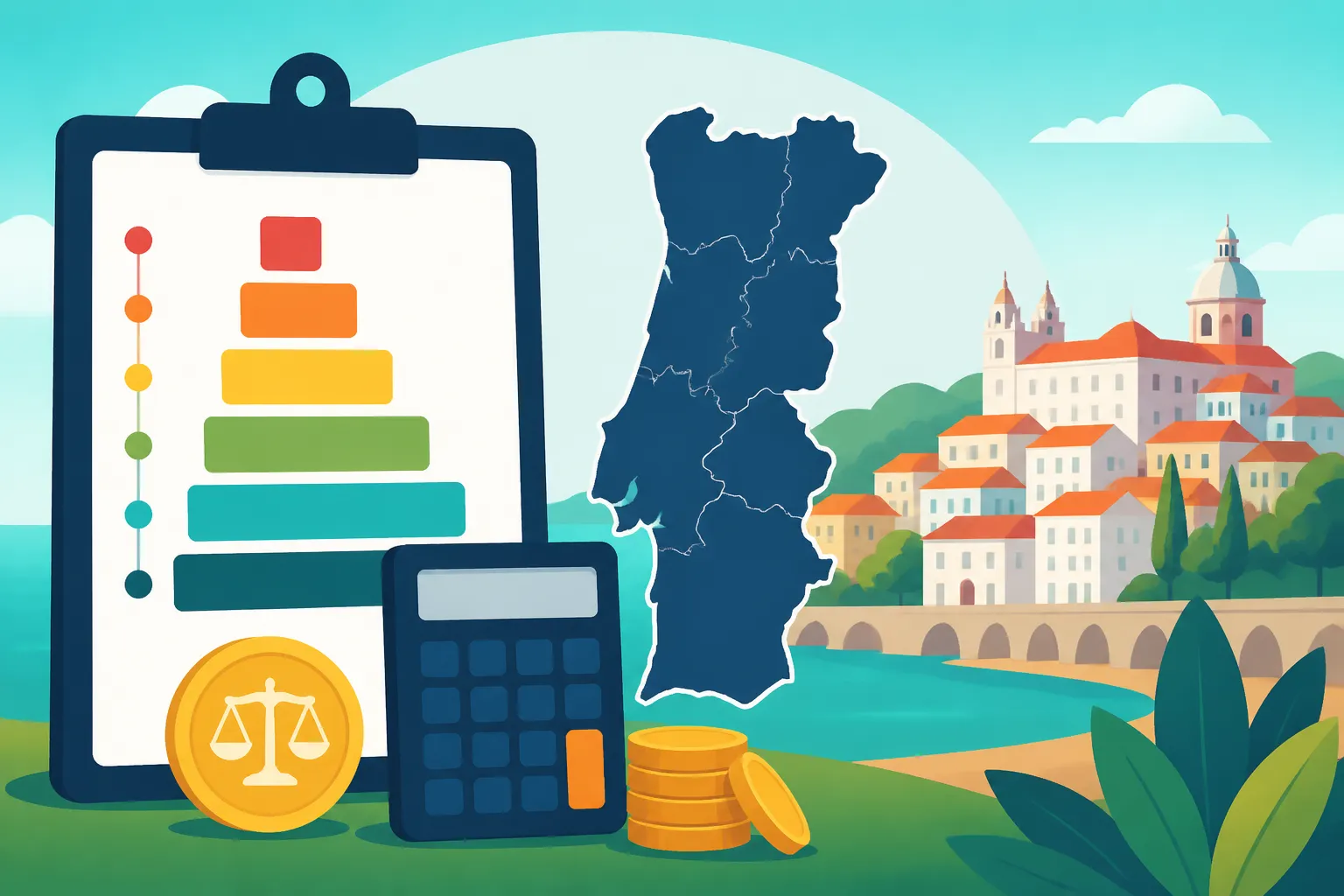
The tax brackets in Portugal are updated annually in the State Budget (Orçamento do Estado). For 2026, the government has adjusted the thresholds to account for inflation, but the progressive nature remains the cornerstone of the system. It is a "sliced" system, meaning that if you move into a higher bracket, only the portion of your income that exceeds the previous threshold is taxed at the higher rate.
Many expats mistakenly believe that if they earn €1 into the next bracket, their entire salary is now taxed at 37% or 45%. This is not the case. Your income is poured into the "buckets" of each bracket until it reaches your total. This progressive structure is meant to be fair, but because the thresholds start quite low compared to high-cost-of-living countries, many middle-income expats find themselves in the 30% to 40% range much faster than they anticipated.
Progressive Tax Table Breakdown
The following table outlines the standard IRS brackets for 2026. Keep in mind that these rates apply to residents. The "Average Rate" column is a helpful way to see the cumulative impact on your total income within that specific bracket.
| Taxable Income (€) | Tax Rate (%) | Average Rate (%) |
|---|---|---|
| Up to 7,703 | 13.00% | 13.000% |
| 7,703 to 11,623 | 16.50% | 14.181% |
| 11,623 to 16,472 | 22.00% | 16.474% |
| 16,472 to 21,321 | 25.00% | 18.411% |
| 21,321 to 27,146 | 32.00% | 21.327% |
| 27,146 to 39,791 | 35.50% | 25.826% |
| 39,791 to 52,435 | 43.50% | 30.086% |
| 52,435 to 81,199 | 45.00% | 35.374% |
| Over 81,199 | 48.00% | – |
As you can see, once you cross the €81,199 mark, nearly half of every additional Euro goes to the state. This is a significant consideration for high-earning tech workers or business owners. When moving funds to cover these tax obligations, using a service like Wise can save you a surprising amount on exchange rate markups, especially when dealing with the large sums required for quarterly or annual tax payments.
The Impact of the Solidarity Surcharge
In addition to the standard brackets, Portugal implements a "Taxa de Solidariedade" (Solidarity Surcharge). This is an extra tax aimed at the highest earners in the country. If your taxable income exceeds €80,000, an additional 2.5% is applied. If you are fortunate enough to earn over €250,000, that surcharge jumps to 5%.
This surcharge is often the "hidden" cost that expats forget when they are calculating their Income Tax brackets (IRS) 2026: Calculating your true net salary in Portugal. While it only affects a small percentage of the population, it underscores the importance of tax planning. If you are in this income tier, working with a specialist like Taxes for Expats becomes less of a luxury and more of a necessity to navigate the interplay between Portuguese surcharges and your home country's tax treaties.
How Your Net Salary is Calculated
Understanding the brackets is only half the battle. Your actual take-home pay—the money you use to pay rent in Graça or buy groceries at Pingo Doce—is influenced by "Retenção na Fonte" (Retention at Source). This is the amount your employer withholds every month and sends to the government on your behalf. It is essentially an interest-free loan you give to the state, which is settled when you file your tax return the following year.
I remember being baffled that two colleagues with the same gross salary had different net pay. The reason? One was married with two children, and the other was single. The retention tables account for your "household situation," which can drastically change your monthly cash flow. You can dive deeper into this in our guide on Understanding Portuguese Pay Slips: Gross vs Net Salary and Deductions.
Social Security Contributions and Deductions
Before the IRS brackets are even touched, Social Security (Segurança Social) takes its cut. For most employees, this is a flat 11% deducted from your gross salary. Employers pay an additional 23.75% on top of your salary, though you never see that money. For freelancers, the calculation is different and often involves a quarterly declaration process that can be a logistical nightmare during your first year.
These contributions are mandatory and provide you with access to the public healthcare system and future pension rights. However, for an expat who might only stay for five years, it often feels like a steep price to pay. It is important to factor this 11% into your calculations alongside the IRS brackets to find your true "effective tax rate." Often, when you combine Social Security and IRS, a mid-level manager in Lisbon is effectively paying 35-40% in total "payroll" taxes.
The Role of the Retention at Source
The retention tables are separate from the final IRS brackets. They are a monthly estimate. If your employer withholds too much, you get a refund (reembolso) after you file your taxes in April-June of the following year. If they withhold too little, you get a bill. For expats who receive bonuses or have fluctuating commissions, this "settling of accounts" can result in thousands of Euros moving in either direction.
When they filed their first return, they were hit with a €5,000 bill they hadn't budgeted for. To avoid this, many residents use Wise to set up a dedicated "Tax Jar" where they move a percentage of every paycheck, ensuring the money is there when Finanças comes calling.
Maximizing Deductions through e-Fatura
If the tax brackets seem high, the e-Fatura system is your best friend. This is Portugal's unique way of fighting the shadow economy while giving taxpayers a break. By asking for your NIF (Tax Identification Number) on every purchase, you accumulate small tax credits that are deducted directly from your final IRS bill.
It sounds tedious—and it is—but it's the only way to lower your effective tax rate. You will quickly learn the phrase "Contribuinte?" or "NIF na fatura?" which cashiers ask at every single transaction. Whether you are buying a coffee for €1 or a new laptop for €1,000, that NIF makes a difference. For a detailed breakdown of how this works, see our e-Fatura guide: Why cashiers ask for your NIF at the supermarket.
Why You Must Ask for Your NIF Everywhere
Every time you associate your NIF with a purchase, the merchant is required to report that sale to the tax office. In return, the government gives you back a percentage of the VAT (IVA) you paid. For example, in the general expenses category, you can get a small credit for almost anything, but in specialized categories like healthcare, education, or home repairs, the deductions are much more significant.
I used to feel embarrassed asking for my NIF at a busy grocery store, but then I realized that those tiny 30-cent credits added up to a €400 refund at the end of the year. In a country where the cost of living is rising, ignoring the e-Fatura system is essentially leaving money on the table. It is one of the most culturally specific parts of Money and Finance in Portugal: The Ultimate 2026 Guide for Expats.
Categories of Eligible Tax Deductions
The Finanças portal (Portal das Finanças) categorizes your spending. You must log in periodically to "validate" these invoices, especially if a merchant hasn't properly categorized them. The main categories that help reduce your IRS burden include:
- General Household Expenses: A capped amount for everyday spending.
- Health: 15% of your health expenses (including pharmacy and private insurance premiums) can be deducted.
- Education: Expenses for schools, books, and tuition.
- Housing: A portion of the interest on older mortgages or a percentage of your rent (subject to caps).
- Auto Repairs and Hairdressers: Specialized categories designed to encourage "on-the-books" business.
This system is so important that if you don't use it, you could end up paying hundreds of Euros more in tax than your neighbor who earns the exact same salary. If you find the portal overwhelming, Finding an English-Speaking Certified Accountant (Contabilista Certificado) is highly recommended for your first year to ensure you aren't missing out on these critical subtractions.
Filing Your Annual Tax Return (Modelo 3)
The climax of the Portuguese fiscal year happens between April 1st and June 30th. This is when every resident must file the "Modelo 3," which is the annual income tax declaration. For expats, this is rarely as simple as clicking "submit" on the pre-filled form (IRS Automático), because the automated system often misses foreign income or complex deduction categories.
If you have bank accounts abroad, rental income from your home country, or remote work invoices, you must navigate the dreaded "Anexo J." This is the annex for foreign income, and it is where most expats make mistakes that lead to audits. Filing correctly is the difference between a smooth residency and a legal nightmare. You can find more about the logistics in our guide on Filing the Annual IRS Tax Return (Modelo 3): Deadlines and Process.
Deadlines and the Portal das Finanças
The April-to-June window is non-negotiable. Missing the deadline leads to automatic fines that increase the longer you wait. The Portal das Finanças is surprisingly robust, but it is almost entirely in Portuguese. Even with browser translation, the technical tax terms can be misleading.
One of the best tips I received was to file early in April. This way, if there is an error, you have time to fix it before the June deadline. Additionally, if you are owed a refund, filing early usually means the money hits your Opening a Bank Account in Portugal: Best Banks for Foreigners and Expats much sooner. Many expats keep their tax savings in a Wise account to easily transfer the exact Euro amount to Finanças if they end up owing money.
Common Mistakes for Expats (Anexo J)
The most frequent error I see in the expat community is the failure to declare foreign bank accounts. Even if there is no money in the account, Portuguese law requires you to list the IBAN/BIC of every foreign account you hold. Finanças has become much more adept at cross-referencing this data with other EU countries and the US through FATCA/CRS agreements.
Another common pitfall is misunderstanding the tax treaties. For example, US citizens often assume that because they pay tax in the US, they don't have to declare it here. While the Double Taxation Agreement usually prevents you from paying twice, you still have to report it. This is where a consultation with Taxes for Expats pays for itself by preventing future penalties.
Special Tax Regimes for Expats
If the standard progressive brackets look terrifying, don't despair just yet. Portugal has long used tax incentives to attract "high-value" residents. While the original NHR (Non-Habitual Resident) program has been replaced, the new iteration, often called NHR 2.0 or IFICI, still offers significant benefits for those in specific professions or those moving for research and development roles.
These regimes are designed to bypass the 48% top bracket and offer a flat 20% rate for a period of ten years. However, the entry requirements have become much stricter in 2026. If you are planning your move, understanding the NHR 2.0 (IFICI) Tax Regime: Eligibility, Flat 20% Tax, and Rules in 2026 is the most important step you can take.
The NHR 2.0 (IFICI) Alternative
The IFICI (Incentivo Fiscal à Investigação Científica e Inovação) is the successor to the NHR. It focuses heavily on "High Value Added" activities. If you are a software engineer, a doctor, or a high-level researcher, you may qualify for a flat 20% tax rate on your Portuguese employment or freelance income.
The catch? You must not have been a tax resident in Portugal for the previous five years. This is a one-time "golden ticket." some people move to Portugal without checking their eligibility, only to realize months later that they could have saved on taxes had they applied for the right status during their first 90 days. It is a critical component of any long-term financial strategy here.
Tax Implications for Digital Nomads and Remote Workers
For those on the D8 Digital Nomad visa, the tax situation can be complex. If you are working remotely for a company outside of Portugal, you are still generally considered a tax resident if you stay long enough. This means you fall into the standard progressive brackets unless you qualify for the IFICI.
Many digital nomads try to "stay under the radar," but with the integration of the NIF into everything from your phone bill to your lease, the tax office will eventually catch up. It is far better to set up a "Recibos Verdes" (Green Receipts) system early and take advantage of the first-year exemptions for Social Security. Using Transferring Money to Portugal: Saving on Exchange Rates and Fees through services like Wise ensures that when you do move your foreign-earned salary into the country to pay your local taxes, you aren't losing 3-5% to hidden bank fees.
Professional Advice and Tax Planning
Ultimately, the Portuguese tax system is not a DIY project for most expats, especially those with assets in multiple countries. While the "I've-been-there" advice from friends is helpful, it cannot replace a certified accountant who understands the latest 2026 updates to the tax code.
A "Contabilista Certificado" is not just someone who does your math; they are legally responsible for the accuracy of your filing. In Portugal, having a professional representative can be the difference between an effortless life in the sun and a decade-long dispute with the tax authorities. Start your journey by getting your NIF and your password for the Portal das Finanças early, and don't be afraid to ask for help from specialists like Taxes for Expats who bridge the gap between your home country's rules and the local Portuguese reality.
Disclaimer
This guide is for informational purposes only and does not constitute professional tax, legal, or financial advice. Tax laws in Portugal are subject to frequent changes, and individual circumstances can significantly alter your tax liability. Always consult with a certified accountant (Contabilista Certificado) or a qualified tax professional before making financial decisions or filing tax returns in Portugal.