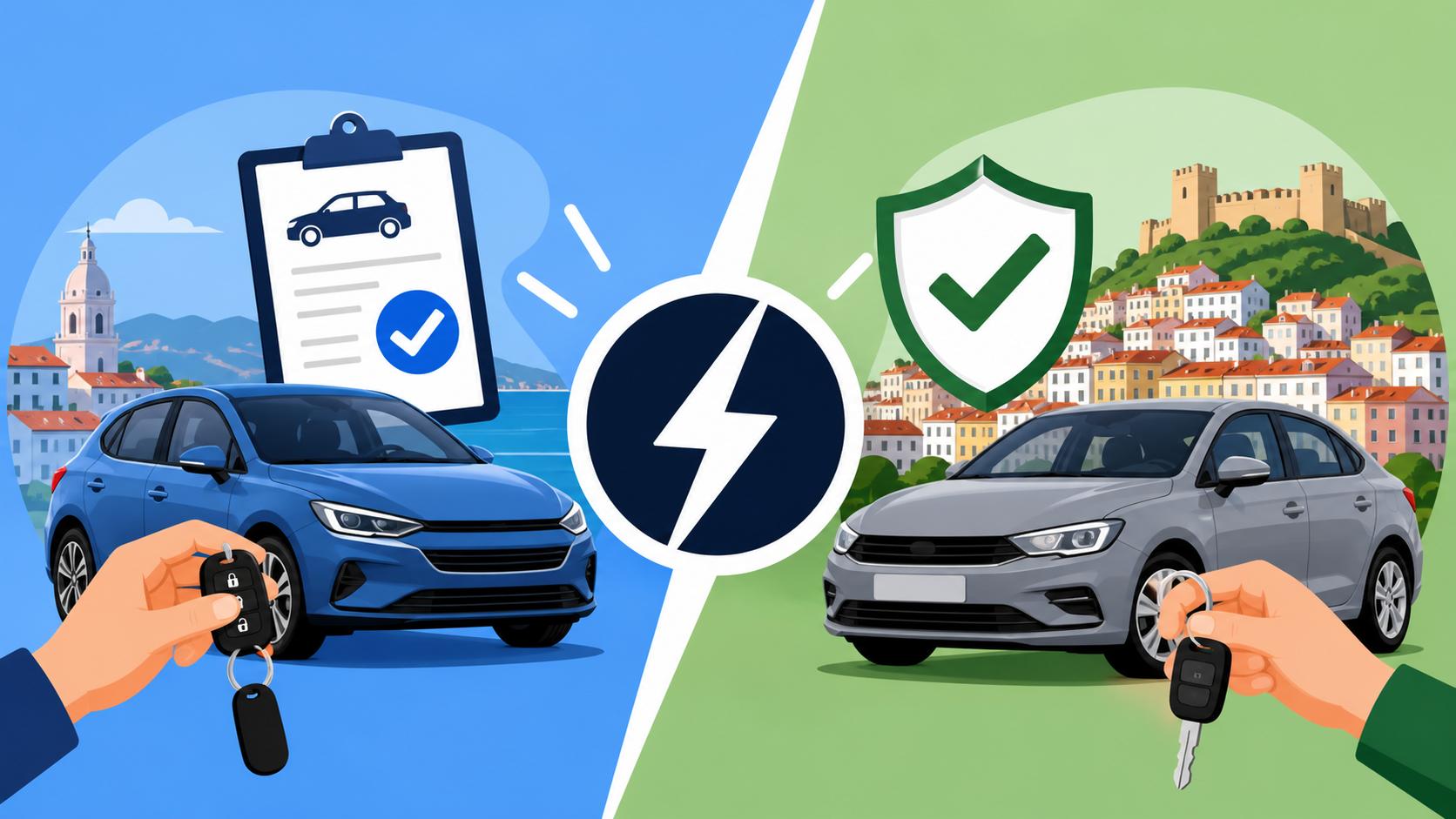
Leasing a car (Renting) vs Buying a used car in Portugal for a 2-year stay
Disclosure: This article contains affiliate links. If you buy through them, we may earn a commission at no extra cost to you. Read our full disclosure.
You’ve moved to Portugal for roughly two years, the used car listings on Standvirtual look absurdly expensive, and every leasing offer seems to want a Portuguese payslip you don’t have yet. This guide compares long-term renting with buying a used car for a two-year stay. It covers the paperwork, the hidden running costs and the exit plan for each route.
How Car Leasing and Buying Actually Work in Portugal
I spent my first two winters here borrowing a friend’s ancient Renault Clio and quietly panicking every time the engine light flickered. When I finally had to decide between renting long-term and buying, I learned that the two options look nothing like they do back home. Before you compare monthly figures, it helps to understand what each word means locally.
What Renting Means to a Portuguese Dealer
In Portugal, “renting” usually does not mean a holiday rental from the airport. It refers to aluguer operacional de veículos, a long-term operational lease. You pay one fixed monthly fee, and the leasing company keeps ownership of the car. That fee normally bundles in:
- Insurance, often with a choice between third-party and fuller cover
- Scheduled maintenance and servicing
- The annual circulation tax, known as IUC
- Tyre replacement, depending on the package
- Roadside assistance
At the end of the contract you hand the keys back and walk away. You never deal with a buyer, a registration transfer or a resale price. That is a huge attraction when you already know your departure date.
There is a catch. Contracts are usually built around a fixed annual mileage, and going over it is charged per kilometre at return. Ending the contract early normally triggers a penalty, so check the termination clause carefully if your two years might shrink.
What Buying Used Involves
Buying used means you own the car outright and carry every cost and risk that comes with it. You arrange insurance yourself and pay IUC every year. You book the periodic inspection at an IPO centre once the car reaches the age where inspections become mandatory. You also handle repairs. Then, when you leave, you have to sell it.
Used cars in Portugal hold their value unusually well. Much of that comes from the vehicle import tax baked into the original price, which Why are used cars so expensive in Portugal? Understanding the ISV import tax explains in detail. The painful side is that the purchase price feels inflated. The silver lining is that depreciation over two years is often gentler than you might expect.
Renting vs Buying Compared for a Two-Year Stay
Here is how the two routes stack up on the things that matter most to someone with a fixed departure date.
| Factor | Long-Term Renting | Buying a Used Car |
|---|---|---|
| Upfront cash | Usually a deposit or first payment | Full purchase price, or a loan |
| Monthly cost | Fixed and predictable | Variable, with repair spikes |
| Insurance | Usually included | Arranged and paid separately |
| IUC circulation tax | Usually included | Paid yearly by the owner |
| Maintenance and tyres | Usually included | Owner pays |
| Eligibility for new arrivals | Often strict on proof of income | Easier once you have a NIF |
| Mileage limits | Yes, with excess charges | None |
| Leaving Portugal | Return the keys at term end | Must sell, ideally before departure |
| Resale risk | None | Yours, though prices hold up fairly well |
| Choice of cars | Mostly newer models | Huge range of age and price |
When Renting Wins
Renting tends to make sense if your stay is genuinely fixed and you value peace of mind over the lowest possible total cost. A colleague of mine arrived in Porto on a two-year engineering assignment with a company letter and a Portuguese employment contract. The leasing company approved her quickly. She budgeted one number every month and never once thought about inspections or tyres. On her last week she dropped the car at the dealer and caught her flight.
It also suits people who don’t want to learn the ownership admin in a second language. You will still need to understand tolls, and Navigating the Portuguese Toll System: Via Verde and Electronic Tolls is worth reading either way. The leasing company handles the rest.
When Buying Wins
Buying usually wins if you drive a lot, need an older or cheaper car, or can’t pass a leasing company’s income checks yet. Remote workers paid from abroad and freelancers in their first year often run into exactly this wall. Buying also suits anyone who might extend their stay, because you aren’t locked into a contract end date.
I bought a modest used hatchback after my leasing application stalled for weeks on paperwork. Over two years I paid for one set of tyres, a brake job and the inspection. When I sold it to a neighbour, I recovered a solid share of what I’d paid. It wasn’t effortless, but it was cheaper overall than the lease quotes I’d received.
The Hidden Costs on Both Sides
On the renting side, watch for return damage assessments. Small scratches, kerb-scuffed wheels and interior stains can all be billed when you hand the car back. Photograph the car thoroughly on delivery and again at return.
On the buying side, the costs are less visible but very real:
- Registration transfer fees
- Separate insurance, which How to Get Car Insurance in Portugal walks through step by step
- Yearly IUC, which Paying your car tax (IUC) online before your vehicle’s registration anniversary covers in full
- Unexpected repairs on an older car
Parking is the same pain either way. If you are in the capital, read Finding long-term parking in Lisbon: EMEL residential permits explained before committing to any car at all.
Step-by-Step: Getting a Car Under Each Option
How to Apply for a Long-Term Lease
- Get your NIF tax number and open a Portuguese bank account. Leasing companies collect payments by direct debit.
- Gather proof of income. This usually means an employment contract, recent payslips or a Portuguese tax return. A foreign income history may need extra supporting documents.
- Confirm that your driving licence is valid for residents. Many non-EU licences must be exchanged after you settle, so see Driving in Portugal: Exchanging Your Foreign License to a Portuguese One.
- Request quotes from several dealers and leasing companies, and ask specifically whether a 24-month term is offered.
- Compare the mileage allowance, the excess-kilometre charge, insurance cover levels and the early termination terms. Check each provider’s own page or quote for current figures.
- Sign the contract, agree a delivery date, and photograph the car in detail on handover.
If your application is declined because you are newly arrived, ask whether a larger deposit or a guarantor would change the answer. Some companies are flexible, and others simply aren’t.
How to Buy a Used Car
- Get your NIF first. You cannot register a car in your name without it.
- Search dealer stands and private listings on platforms like Standvirtual and OLX. Decide early whether you want a manual or an automatic, because automatics are scarcer and pricier here. Driving an automatic vs manual car in Portugal: Rental and purchase tips covers the trade-offs.
- Request a vehicle registration certificate before paying. It shows whether the car carries a reservation of ownership from an unpaid loan or any legal seizure.
- Check the inspection history and the date of the next IPO inspection due.
- Prefer a professional dealer if you want a legal warranty, since private sales come with far less protection.
- Arrange insurance before you drive away. Driving uninsured is illegal and heavily penalised.
- Complete the ownership registration through the Registo Automóvel, either online or at a registry office.
- Fit the mandatory warning triangle and reflective vest if the car doesn’t already have them.
For a deeper walkthrough of the buying paperwork, see How to Buy a Used Car in Portugal as a Foreigner.
Kitting Out Your Car Cheaply
Whichever route you choose, you’ll want a phone mount, a charging cable and possibly a dash cam. You’ll also need the reflective vest and triangle if they’re missing. Local supermarkets and auto shops stock the basics, but I ordered my mount and dash cam from Amazon Spain because the delivery to Portugal was quick and the selection was much wider.
If you are picking up a car on your first days in the country, you’ll need mobile data for navigation and toll apps. Your Portuguese SIM may not be sorted yet. A travel eSIM from Airalo covered me for the drive back from the dealer before my local plan was active.
Planning Your Exit Before You Even Start
Selling Before You Leave
If you buy, start the sale early. Listing the car at least a couple of months before departure gives you time to negotiate rather than accept a lowball offer at the last minute. Dealers will often buy outright for less than a private buyer would pay. That trade-off can be worth it if your flight is booked.
You also need to cancel your insurance and make sure the registration transfer is completed by the buyer. Until the transfer is registered, fines and tax can still land on you. Keep copies of the signed sale documents.
Returning a Lease Without Surprises
Book the return inspection in advance and get the car cleaned inside and out. Fix any minor bodywork damage at an independent shop if it would cost less than the leasing company’s charge. Bring your delivery photos so any disputed marks can be checked against the car’s original condition.
Could You Skip the Car Entirely?
This is a genuine option. In Lisbon and Porto, plenty of expats manage two years on the metro, trains and ride-hailing, renting a car only for weekend trips. If you go this route, where you live matters enormously. Some people book their first furnished room through Uniplaces in a neighbourhood near a metro line, then use the first months to test whether they actually need a car. If you later decide you do want to go electric, read Electric vehicles in Portugal: Charging stations and government subsidies first.
For most two-year stays, the decision comes down to two questions. Can you pass the leasing income checks right now? And how much do you value walking away cleanly at the end? If the answer to both is yes, renting removes a lot of stress. If not, a carefully checked used car is often the cheaper and more flexible path. The broader running costs are covered in Buying a Car in Portugal: IUC Tax, Inspections (IPO), and High Vehicle Costs.
Disclaimer
This article is for general informational purposes only and does not constitute professional advice. Laws, prices and regulations vary by location and change over time. Consult a qualified professional for guidance on your specific situation.