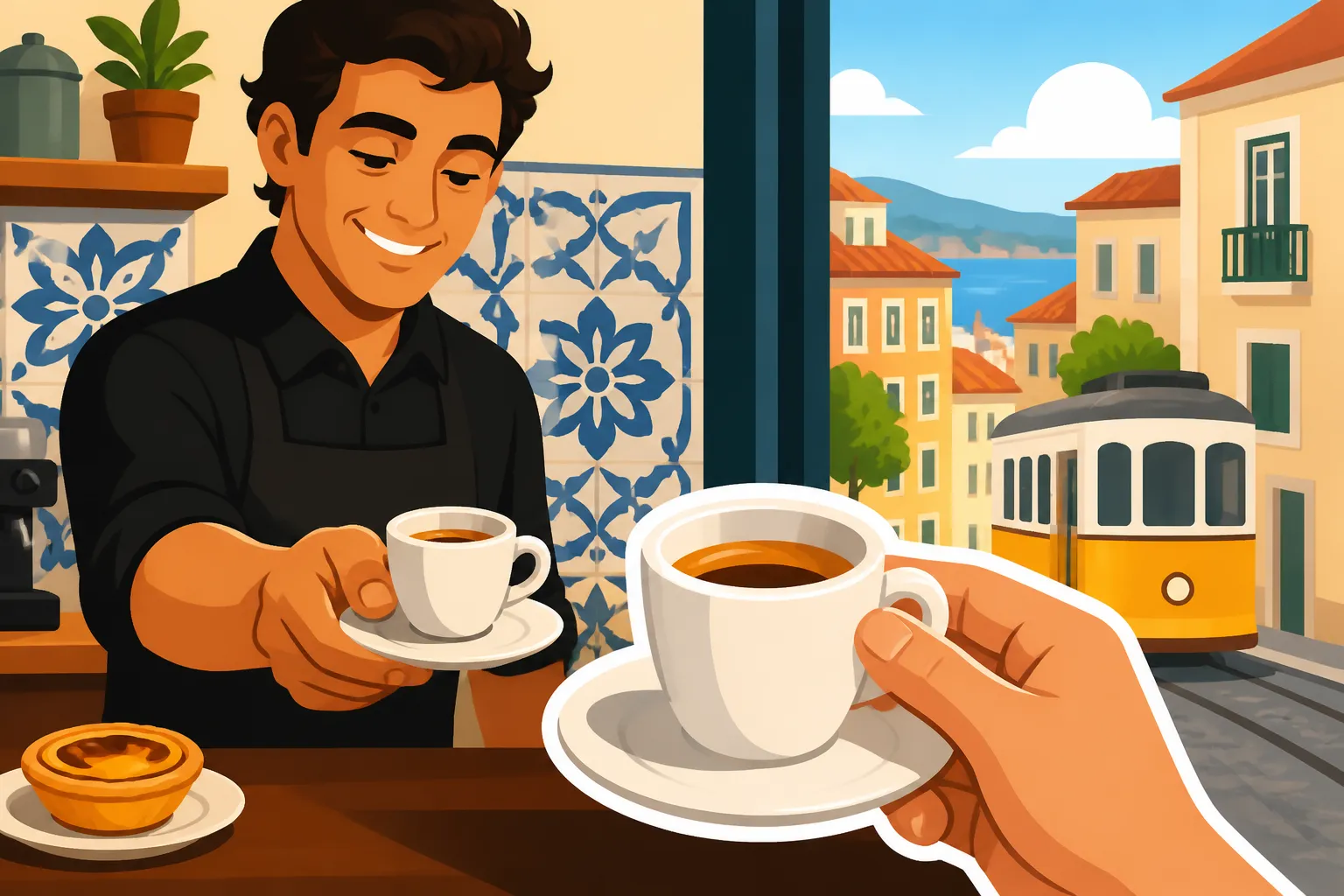
Portuguese Coffee Culture: How to Order Like a Local
Disclosure: This article contains affiliate links. If you buy through them, we may earn a commission at no extra cost to you. Read our full disclosure.
Your first morning in Lisbon, you walk into a busy pastelaria, ask for “a coffee,” and get a tiny espresso while the person beside you receives a tall glass of milky coffee you can’t name. Portuguese coffee culture runs on its own vocabulary and its own unwritten rules. This guide covers what to order, how to say it, where to stand, and how to pay.
Why Coffee in Portugal Is a Daily Ritual
Coffee here is less a drink than a punctuation mark in the day. People stop for one on the way to work, after lunch, mid-afternoon, and sometimes after dinner. It’s quick, sociable and cheap enough to drink several times a day. When I first moved here, I expected the slow cappuccino-and-laptop culture I knew from home. What I found was faster, louder and more intimate. Once you learn the rhythm, it becomes one of the best parts of living here.
The Pastelaria and the Balcão
Most coffee in Portugal is not drunk in specialty coffee shops. It’s drunk in the pastelaria, the café or the snack bar on almost every corner. These places sell coffee, pastries, toasted sandwiches, beer and fresh juice from early morning until evening. The heart of each one is the balcão, the counter. Regulars stand there, order in a few words, drink in two or three sips, and leave.
Picture a Tuesday at 8:15 in Arroios. A builder in paint-spattered trousers, a lawyer in a suit and a grandmother with her shopping trolley all stand shoulder to shoulder at the counter. Each gets the same small cup without saying much more than one word. Nobody is rushing you, but nobody is lingering either. The counter is the great equalizer, and standing at it is the most local thing you can do.
Bica, Cimbalino, and Regional Vocabulary
Here’s the first surprise. In Portugal, “um café” means an espresso. In Lisbon and much of the south, the same drink is also called a bica. A popular folk story says the name comes from “Beba Isto Com Açúcar,” or “drink this with sugar.” Locals love repeating it, whether or not it’s historically true. In Porto and the north, you’ll hear older customers ask for a cimbalino, a nod to the Cimbali espresso machines that arrived decades ago.
If you say “bica” in Porto, you’ll still get your coffee, and “café” works everywhere. Using the local word, though, earns a small smile from the person behind the counter. That smile matters when you’re new and trying to become a recognized face. For a broader look at how this vocabulary sits inside daily life, see Portuguese Daily Rhythm and Café Culture for Visitors.
The Portuguese Coffee Menu Decoded
Café menus are often a chalkboard or a laminated card with no descriptions at all. Locals don’t need them. The list below covers what you’ll actually hear ordered. For a focused breakdown of the four most common drinks, see How to order coffee in Portugal: Bica, Meia de Leite, Pingado, and Galão.
Espresso-Based Orders
The standard café is short, strong and served in a small, thick cup, usually with a sugar sachet on the saucer. If you want it slightly longer, ask for a café cheio, meaning “full.” If you want it more concentrated, ask for a café curto or an italiana, which is closer to a ristretto. A café duplo is a double. A descafeinado is decaf, and every café has it.
For those who want something closer to an americano, ask for an abatanado. It’s a long black coffee, usually in a bigger cup. Some people order a café com água, an espresso with a little hot water. A carioca de café is a weak espresso made by running water through grounds that have already been used. It’s gentle, and older customers often order it in the afternoon. Then there’s the pingado: an espresso “dripped” with a splash of milk, the Portuguese cousin of a macchiato.
Milky Coffees: Galão, Meia de Leite, Garoto
The galão is the drink that confused me on my first morning. It arrives in a tall glass, with a lot of hot milk and a little coffee. Locals often drink it with a buttered toast for breakfast. You can adjust it: galão escuro has more coffee, galão claro has less. The meia de leite is half coffee, half milk, served in a regular cup. It’s the closest thing to a café latte on most menus.
The garoto, meaning “little boy,” is a small cup of milk with a little coffee. It was traditionally given to children, but plenty of adults order it too. If you prefer your milk cold, say “com leite frio.” If you’d like plant milk, ask “tem leite de soja?” or “leite de aveia?” Larger cafés usually have it. Small village snack bars often don’t.
Unusual Orders Worth Trying
On a winter morning in a rural café, you may hear someone ask for a café com cheirinho, literally “coffee with a little smell.” That means an espresso with a splash of aguardente, a strong grape brandy. It’s an old-school order and you’ll mostly see it among older men in small towns. In summer, look for a mazagran, an iced coffee with lemon and sugar that is a refreshing surprise on a hot Alentejo afternoon.
Some people also ask for their café em chávena escaldada, meaning in a pre-warmed cup, or em copo, served in a small glass. These are small personal quirks. Café staff remember them, and soon they’ll start preparing yours the moment you walk in.
| Order | What Arrives | Closest Equivalent | Good Time to Order |
|---|---|---|---|
| Café or Bica | Short, strong espresso in a small cup | Espresso | Any time, especially after meals |
| Cimbalino | Same as a café, northern name | Espresso | Any time in Porto and the north |
| Café Cheio | Espresso with the cup filled a little higher | Lungo | Any time |
| Italiana | Very short, concentrated shot | Ristretto | When you need a jolt |
| Pingado | Espresso with a drop of milk | Macchiato | Mid-morning or afternoon |
| Abatanado | Long black coffee in a larger cup | Americano | Breakfast or slow mornings |
| Carioca de Café | Weak espresso from used grounds | Mild short coffee | Late afternoon |
| Meia de Leite | Half coffee, half milk in a cup | Latte | Breakfast |
| Galão | Mostly milk, a little coffee, in a tall glass | Large latte | Breakfast with toast |
| Garoto | Small cup of milk with a touch of coffee | Babyccino with coffee | Morning or for kids |
| Café com Cheirinho | Espresso with a splash of aguardente | Coffee with brandy | Cold mornings in the countryside |
| Mazagran | Iced coffee with lemon and sugar | Coffee lemonade | Hot summer afternoons |
How to Order Step by Step
The biggest hurdle isn’t the vocabulary. It’s the moment of standing in a crowded café without knowing whether to queue, sit or shout. Here’s the sequence that works in nine out of ten places.
Standing at the Counter vs Sitting at the Esplanada
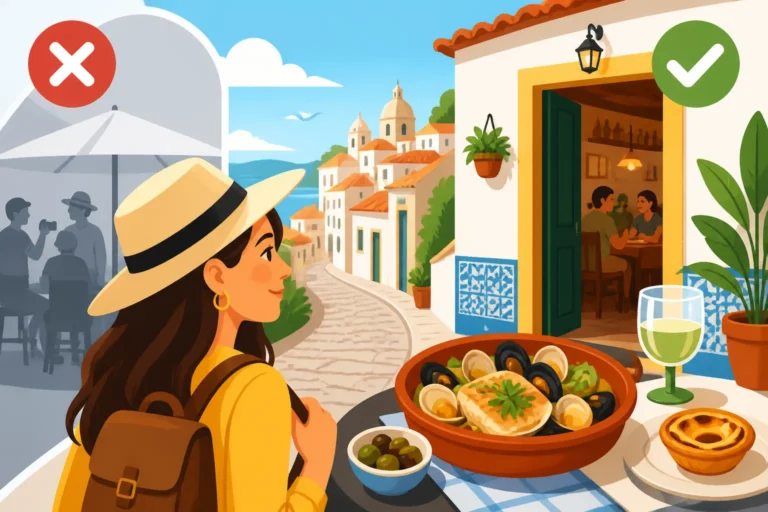
Decide first where you want to be. At the balcão, you order directly and drink standing. At a table inside or on the esplanada, the outdoor terrace, you wait for someone to serve you. Table service, and especially terrace service in tourist areas, is often priced higher than counter service. Some cafés post two price columns on the menu. Standing is cheaper, faster and more local.
If you sit, don’t walk up to the counter to order unless the place clearly works that way. Catch the server’s eye, raise a hand slightly, and say “se faz favor” when they pass. Service at tables can feel slow if you come from a place with constant check-ins. Here, leaving you alone is a courtesy, not neglect.
- Walk in and greet the room with “bom dia” before noon, “boa tarde” in the afternoon or “boa noite” in the evening.
- Go to the counter and find a gap. A ticket or numbered queue is rare outside bakery chains, so just make eye contact.
- Order with one item and “se faz favor,” for example “uma bica, se faz favor.”
- Add any pastry or water in the same sentence so they can prepare it together.
- Drink at the counter, then ask for the bill or simply say “quanto é?”
- Pay, say “obrigado” or “obrigada,” and leave with a “bom dia” or “até logo.”
Phrases That Actually Work
You don’t need fluent Portuguese to order coffee, but a few phrases change the whole interaction. “Um café, se faz favor” is the bedrock. “Se faz favor” is more typically European Portuguese than “por favor,” though both are fine. “Pode ser” means “that works” and helps when the server suggests an alternative. “Mais um” means “one more.”
When something isn’t right, a calm “desculpe, pedi uma meia de leite” (“sorry, I asked for a meia de leite”) is perfectly polite. For basic courtesy words with pronunciation, see How to Say Please, Thank You, and Sorry in Portuguese. If you get nervous at a busy counter, there’s a practical walk-through in How to Order at a Café in Portuguese Without Stress. For pastries, toasts and drinks beyond coffee, see Ordering Food and Drinks in Portuguese: A Practical Phrasebook.
Paying and Tipping
In most neighborhood cafés, you pay after you’ve finished. You say “quanto é?” at the counter, or ask for “a conta, se faz favor” at a table. Some busy places, particularly bakery chains and station cafés, ask you to pay first at the caixa (till) and then hand your receipt to the barista. Cards and contactless are widely accepted in cities, though small village cafés sometimes still prefer cash for a single coffee. For card and payment-terminal tips, see How to Pay With Multibanco and Cards in Portugal.
You may also be asked “contribuinte?” when paying. That’s the cashier asking whether you want your tax number on the receipt, and you can simply say “não, obrigado.” Tipping for a coffee is not expected. Leaving the small coins from your change on the saucer is a friendly gesture, especially at a place you visit often. For the wider picture in restaurants and bars, see Tipping in Portugal: When, Where, and How Much.
Café Etiquette and Daily Rhythm
Ordering correctly is half the battle. The other half is knowing the social choreography: when certain drinks feel natural, how long to stay, and what comes alongside the cup.
When People Drink What
Milky drinks like the galão and the meia de leite are mostly breakfast and mid-morning orders. Portugal is relaxed about this, though, and nobody will glare at you for ordering a galão at four in the afternoon. After lunch and dinner, the short café is close to universal. Many Portuguese end every meal with one, even late at night.
A typical day for a Lisbon office worker might go like this: galão and toast at the pastelaria near home, a bica at the café downstairs around eleven, another bica after lunch, and maybe a pingado mid-afternoon to fight the slump. Each one is a short social break. Adjusting to that pace is one of the cultural shifts covered in Expat life hacks: Never rush a coffee, and other daily cultural adjustments.
Lingering, Water, and Pastries
Lingering at a table is perfectly acceptable. Retirees reading the newspaper for an hour over a single coffee are a fixture of every neighborhood. In a tiny café at peak lunch hour, though, it’s considerate to free up a table once you’re done. If you want water with your coffee, ask for “um copo de água,” a glass of tap water. Some places will charge for bottled water, so check if you’re unsure.
Coffee and pastry go together. The pastel de nata is the obvious pairing. Also look for a bola de Berlim, a cream-filled doughnut, a queijada, a small cheese tart, or a simple torrada (thick buttered toast). For the full pastry counter, see Pastéis de Nata and Portuguese Pastries. If something goes wrong, every café must keep a Livro de Reclamações, the official complaints book, and What is the ‘Livro de Reclamações’ and how does it solve consumer disputes? explains how it works.
Famous Cafés vs Neighborhood Spots
Portugal has historic cafés that belong on any visitor’s list, and thousands of unremarkable corner places where the real culture lives. Both are worth your time, for very different reasons.
Lisbon and Porto Landmarks
In Lisbon, A Brasileira in Chiado is the classic stop, with its Art Deco interior and the bronze statue of Fernando Pessoa outside. Café Nicola on Rossio square has been serving coffee for generations. In Belém, Pastéis de Belém draws long queues for its custard tarts, which go perfectly with a bica. For where to find the best tarts across the city, see Where to Eat the Best Pastéis de Nata in Lisbon. If you’d like a guided introduction, GetYourGuide lists food walks in Lisbon and Porto that typically include a café stop and pastry tasting.
In Porto, Majestic Café on Rua de Santa Catarina is the showpiece, all mirrors, carved wood and Belle Époque grandeur. Expect to sit, expect table service, and expect higher prices than a corner café. Go for the setting, not the bargain. If you’re travelling between the two cities to compare their café cultures, Omio is handy for checking train and bus options side by side before you book.
Finding Your Local and Exploring Further
The real reward comes when you find your own café. Pick a place close to where you live or stay, go at the same time each day, and order the same thing. Within a week or two, the owner will start your bica the moment you step inside and ask how your day is going. That’s when Portugal starts to feel like home. When choosing a short-term stay, filtering Booking.com listings for neighborhoods like Campo de Ourique in Lisbon or Bonfim in Porto puts you among genuine local cafés rather than tourist strips.
Outside the big cities, café culture gets even more personal. In a small Minho village, the café may double as the post office gossip hub and the place where the football is on. In the Alentejo, the morning crowd will notice the newcomer immediately, and a polite “bom dia” goes a long way. Familiar coffee brands like Delta, Nicola and Sical appear on awnings and cups nationwide, so the taste stays consistent wherever you wander. The welcome, though, is always local.
Disclaimer
This article is for general informational purposes only and does not constitute professional advice. Laws, prices and regulations vary by location and change over time. Consult a qualified professional for guidance on your specific situation.