Getting an IRS tax refund (Reembolso) deposited after you have left Portugal
Disclosure: This article contains affiliate links. If you buy through them, we may earn a commission at no extra cost to you. Read our full disclosure.
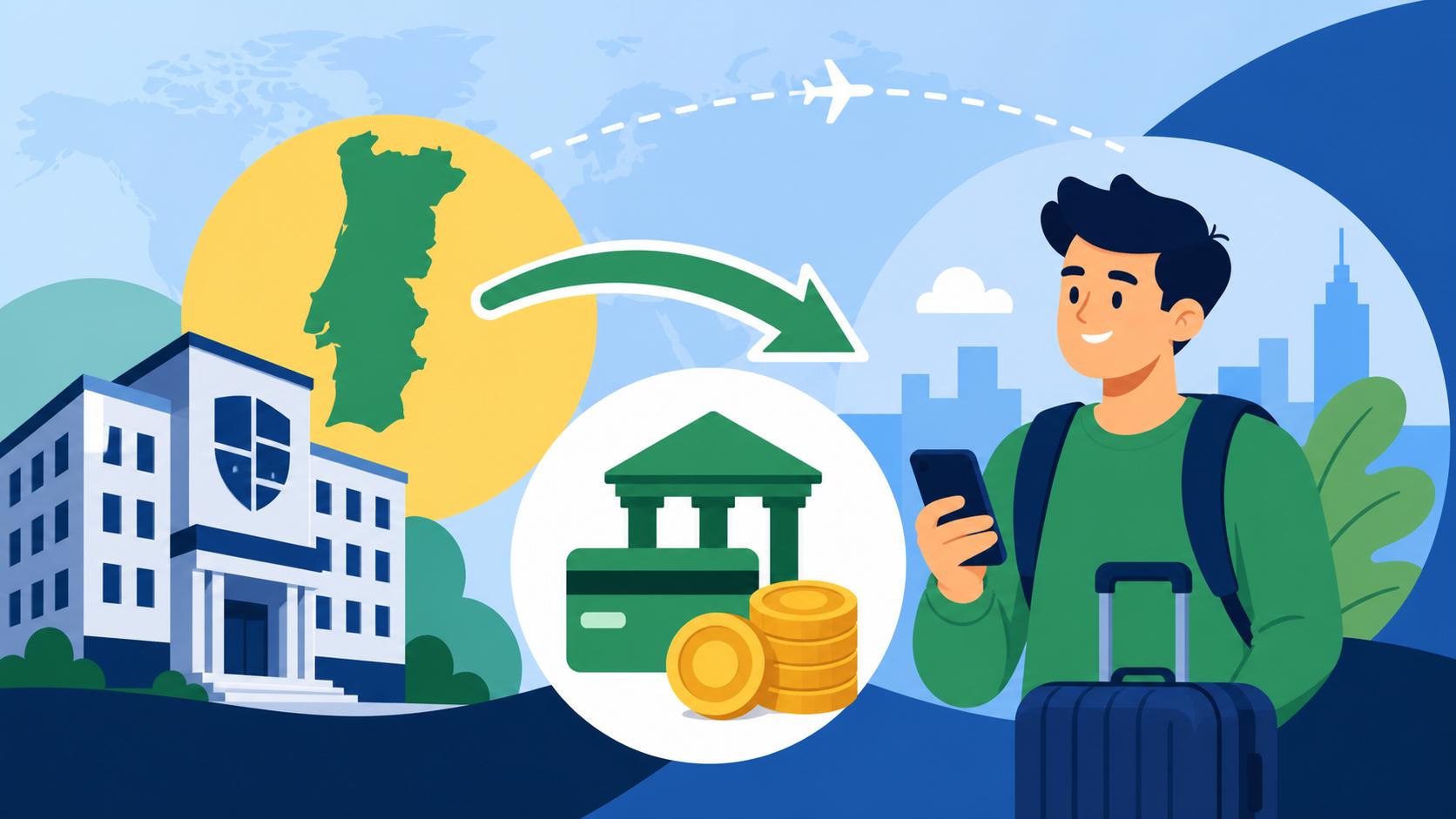
You have packed up, said goodbye to your favourite pastelaria, and moved on. Then spring arrives and you realise Portugal still owes you money from your final tax year. The Autoridade Tributária pays every reembolso to one bank account, and only you can update it from abroad. This guide explains how to make sure your IRS refund reaches you after you leave Portugal.
Why Your Refund Is Tied to Decisions You Make Before Leaving
When I left Lisbon, I treated taxes as next year’s problem. I closed my Portuguese bank account in the last week, cancelled my phone contract, and flew out feeling organised. The following spring, my refund was approved and sent to an account that no longer existed. Getting it reissued took far longer than any of the steps I could have done in ten minutes before my flight.
The point is simple. The Portuguese tax system pays refunds automatically to the IBAN registered on your taxpayer file at the Portal das Finanças. It does not send a cheque to your new address in Berlin or Boston, and it does not track you down. If your registered IBAN is wrong, closed, or not accepted, the refund stalls. What you do with your NIF, your password, and your bank details before you leave decides whether your money arrives easily or slowly.
Your Final Year Is Usually a Split Year
Before you work out whether you are due a refund, you need to know which part of the year Portugal treats you as resident. As of October 2026, article 16 of the IRS Code says you pass the residence test in two ways. One is spending more than 183 days in Portugal in any 12-month period that starts or ends in the year in question. The other is having a home there that you appear to intend to keep as your habitual residence.
The timing rule matters for leavers. You stop being resident from your last day of stay in Portugal. Your departure year is normally split. You are resident up to the day you leave and non-resident afterwards. Your Portuguese tax return for that year normally covers your resident period, so withholding taken from your salary during those months is what produces a refund.
There are two exceptions that can make you resident for the whole departure year:
- You spent more than 183 days in Portugal that year and, after leaving, you earn income that Portugal would have taxed. The exception does not apply if that income is taxed in another EU or EEA state, or elsewhere at no less than 60% of the Portuguese rate.
- You become resident in Portugal again in the year after you leave.
If either applies, your final return looks very different. In that case it is worth paying a professional to check your position. For the full logic of the residence test, see Becoming a Tax Resident in Portugal: The 183-Day Rule Explained.
Why Leavers Are Often Due Money Back
Portuguese employers withhold IRS from each payslip using tables that assume you will earn that salary all year. If you leave in July, withholding was calibrated for twelve months of income, but you only earned six or seven. Your actual annual tax on the resident period is often lower than what was withheld. Add deductions such as healthcare, education, rent, and general family expenses validated on e-Fatura, and the gap can grow. For a lot of people who leave mid-year, the reembolso is a real sum of money.
Setting Up Your Portal das Finanças Before You Fly
Most of the work happens on the Portal das Finanças. If the portal is unfamiliar, read The Portuguese Tax Authority Portal (Portal das Finanças) first. It explains the menus, which are a maze even for people who speak Portuguese.
Step One: Protect Your Access
Your Senha das Finanças is the key to everything. If you forget it after you leave, the standard recovery route sends a new code by post to your registered address. That is useless if the address is a flat you handed back months ago. Before you leave, I would:
- Log in and confirm your password works. Store it somewhere you will not lose it.
- Activate Chave Móvel Digital if you are eligible. It gives you a second way into the portal that does not depend on posted letters.
- Check which email and phone number are on your file, and update them to contacts you will still use abroad.
If you never had a password or need to rebuild access, see NIF password (Senha das Finanças): How to request and activate it by mail, and plan ahead, because the letter takes time.
Step Two: Update Your Tax Address and Representation
When you leave Portugal, you should change your tax address on your NIF record to your new foreign address. This tells the Autoridade Tributária you are now non-resident. It also affects whether you need a fiscal representative. Depending on where you move and whether you sign up for the electronic notification system, a representative may be required. Check the current rules on the Portal das Finanças before you change anything. The fiscal representative rules for people outside the EU are covered in Getting a NIF as a non-EU citizen: The Fiscal Representative requirement explained.
I also recommend switching on electronic notifications so official letters reach you digitally. Notices about your refund, a request for documents, or a correction to your return can then reach you wherever you live. Missing one of those letters because it went to an empty mailbox in Porto is a common cause of delays.
For the wider checklist of cancelling residency and tax status properly, see Leaving Portugal: How to Cancel Your Residency and Tax Status Properly.
Step Three: Register an IBAN That Will Still Exist Next Year
This is the most important step. In the portal, find the IBAN section under your personal data, called Dados Pessoais. Check what is there. The account must be in your name as the taxpayer, or a joint account where you are a holder. The portal may ask you to confirm the change, so do it while you still have easy access to your Portuguese phone number and address.
You have three realistic choices, which I compare below.
| Option | How It Works | Pros | Cons |
|---|---|---|---|
| Keep your Portuguese bank account open | The refund lands in the same account your salary used | Simplest route, with no IBAN change needed | Maintenance fees, and Portuguese banks may ask for updated documents from non-residents |
| Register a euro IBAN from another SEPA country | You change the IBAN on the portal to a SEPA account in your name, such as a multi-currency account | You can close your Portuguese account, and the money arrives in euros | You must complete the change before closing anything, and the account must be in your name |
| Register a non-SEPA account | For example, a US or Canadian bank account | You avoid intermediary accounts | Not the standard refund route; check the portal’s current options first |
Many expats keep a Portuguese account open with minimal balance just for the refund year and close it once the money arrives. Others open a euro account with Wise, which provides euro account details with an IBAN. They register that IBAN on the portal and close the Portuguese bank account straight away. Trade Republic is another option some leavers use, because it provides a European IBAN account that can receive SEPA transfers. Whichever you pick, confirm with the provider that the account accepts incoming SEPA transfers from government bodies in your name.
If you plan to close a traditional bank account, read Leaving Portugal: Closing Bank Accounts and Settling Final Tax Bills first, and only close it after your new IBAN shows as registered on the portal. If yours was a Millennium account, Closing a Millennium bcp account: Can you do it from outside the country? covers that bank in detail.
Filing Your Final Return from Abroad
Your final Modelo 3 is filed during the normal filing window the year after you leave, not on your departure day. Check the Portal das Finanças for the current filing period, because the calendar is set officially and can change. The process is laid out in Filing the Annual IRS Tax Return (Modelo 3): Deadlines and Process.
Choosing Between Automatic and Manual Filing
Many salaried workers in Portugal qualify for IRS Automático, where the system prepares a provisional return for you to confirm. For leavers it is less straightforward. Your split-year residence, foreign income after departure, or a mid-year change of address can mean the automatic return does not reflect your real situation. A good friend of mine, a designer who moved from Lisbon to Amsterdam, confirmed her automatic return without reading it. It treated her as resident for the full year. She had to file a correction, and her refund was delayed by months.
My practical advice:
- Open the provisional return and check the residence status and the period it covers.
- Make sure your Portuguese employment income and withholding match your final payslip and the annual income declaration your employer gives you.
- Check that your e-Fatura deductions are there and correctly categorised.
- If anything about residence is wrong, use the manual Modelo 3 instead of confirming the automatic version.
- Submit the return and keep the submission receipt as a PDF.
When to Bring in a Contabilista
If you had only Portuguese salary and left mid-year, you can usually handle this yourself. I would hire help in these cases:
- You might fall under one of the whole-year residence exceptions.
- You had freelance income on recibos verdes, rental income, or investment income during your Portuguese period.
- You held a special tax status during your residence.
- You need to file in your new country as well and want the two returns to line up.
An accountant can also act through the portal on your behalf, which helps when you are abroad and short on time. See Finding a reliable English-speaking Contabilista for your complex IRS return for how to find someone who will answer an email from another time zone.
Tracking the Refund Once You Have Filed
After filing, you can follow your return on the portal under the option to consult your declarations. The status moves through stages: received, processed, and eventually issued refund or settled. Once it shows the refund as issued, the money goes to whatever IBAN is registered at that moment. That is why changing your IBAN late is risky. If the refund is already issued to the old account, updating the portal will not redirect it.
I check the status every week or two during refund season. The portal does not give a firm timetable, and processing speed varies from year to year and with the complexity of your return.
When the Refund Does Not Arrive
Even with good preparation, things go wrong. These are the situations I see most often among friends who have left Portugal.
The Refund Was Sent to a Closed Account
If the bank rejects the transfer because the account is closed, the funds return to the Autoridade Tributária. Here is what to do:
- Log in and register a valid IBAN in your name.
- Open a request through e-Balcão, the portal’s messaging service. Explain in simple Portuguese, or clear English with a Portuguese summary, that your refund was returned and that you have registered new bank details.
- Attach proof that the new account is in your name, such as a bank statement header showing your name and IBAN.
- Keep the e-Balcão reference number and check for a reply.
A short message in Portuguese helps. Something like this works: “Bom dia, o meu reembolso de IRS foi devolvido porque a conta anterior foi encerrada. Já atualizei o IBAN. Peço a reemissão do reembolso. Obrigado.” Short, polite, and specific is what gets a quick reply.
Your Refund Was Reduced or Offset
The Autoridade Tributária can apply a refund against debts you owe, a process called compensação. That can include unpaid road tax on a car you sold but never deregistered, an old fine, or property tax on a home you still own. If your refund is smaller than expected, check the tax situation section of the portal for outstanding debts. If you still own property in Portugal after leaving, see What happens if you forget to pay your IMI property tax on time? so a missed payment does not eat into your refund.
Before you leave, it is worth checking that you have no outstanding debts at all. A clean record makes the final refund much smoother.
You Cannot Get Into the Portal
If your password does not work and the recovery letter would go to an old address, your options are:
- Use Chave Móvel Digital if you set it up before leaving.
- Ask your fiscal representative or accountant to act through their own access, if they have been authorised.
- Contact the Autoridade Tributária through the official channels listed on the portal and explain you live abroad. Expect this to take time.
Honestly, this is the scenario that most deserves those ten minutes of preparation before your flight. Losing access from abroad turns a simple refund into a long chain of emails.
Moving the Money Once It Arrives
Once the refund lands in euros, you may want to move it to your new home currency. Transfers out of a Portuguese bank to another country can carry fees and weak exchange rates. If the refund lands in a multi-currency account such as Wise, you can convert inside the account and move it to your local bank. Compare the total cost, including the exchange rate margin, on the provider’s own pricing page before you send anything. For a deeper comparison, see Wise vs Revolut vs Bank Transfers: Cheapest Way to Move USD/GBP to EUR.
Should You Close Your NIF Afterwards?
Not too early. Your NIF stays your link to the tax system, and closing or neglecting it before your final refund is paid and your last return is settled creates more problems than it solves. Once everything is finished, and you have no Portuguese property, income, or debts, you can think about what to do with your NIF. See Step-by-step: Closing your NIF and legally leaving the Portuguese tax system when that time comes.
Leaving a country is emotional and messy, and Portuguese bureaucracy is rarely what you want to think about in your final weeks. Protect your portal access, change your address and representation correctly, register an IBAN that will still exist, and read your final return carefully. Do those four things and your reembolso should arrive without much effort, even if you are drinking a lesser coffee somewhere far from Lisbon.
Disclaimer
This article is for general informational purposes only and does not constitute professional advice. Laws, prices and regulations vary by location and change over time. Consult a qualified professional for guidance on your specific situation.