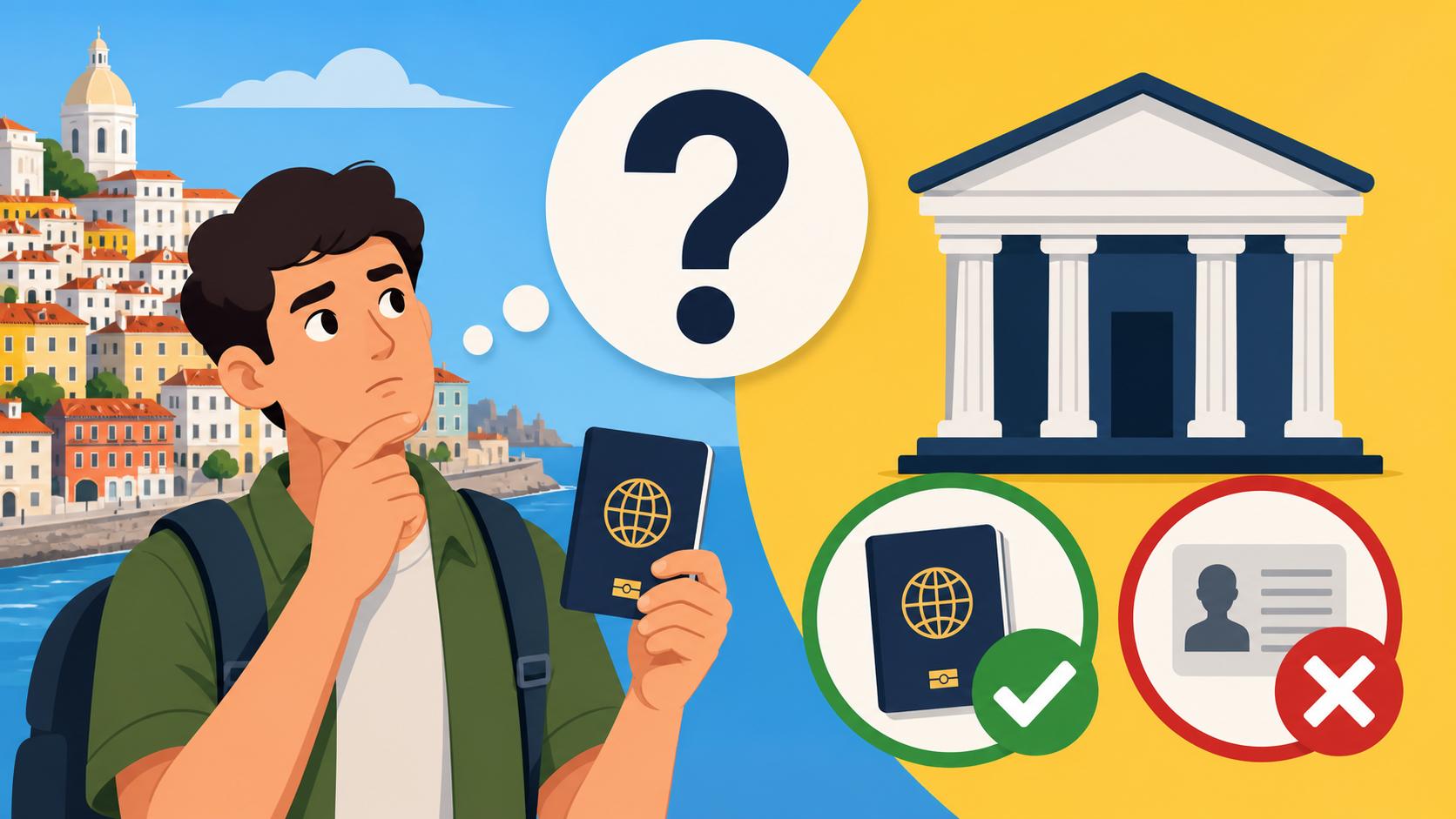
Can tourists open a bank account in Portugal with just a passport and no NIF?
Disclosure: This article contains affiliate links. If you buy through them, we may earn a commission at no extra cost to you. Read our full disclosure.
Most travelers land in Lisbon or Porto dreaming of pastéis de nata and sunset views, only to realize that simple tasks like signing a rental lease or getting a local SIM card often require a Portuguese bank account. I remember standing in a chilly bank branch in Chiado, passport in hand, feeling completely defeated when the clerk told me I was missing the one thing I didn't even know existed. This guide explains why a passport alone won't work and provides the exact roadmap to getting your finances settled in Portugal.
The Mandatory Golden Ticket: Why a NIF is Non-Negotiable
If you walk into a traditional high-street bank in Portugal—think Millennium BCP, Santander, or Caixa Geral de Depósitos—and present only your passport, the conversation will likely end before it begins. To the Portuguese administrative system, your passport proves who you are, but it does not prove your existence within the tax ecosystem. For that, you need a NIF (Número de Identificação Fiscal).
Understanding the NIF (Número de Identificação Fiscal)
The NIF is a nine-digit tax identification number that is essential for almost every transaction in the country. Whether you are buying a car, signing up for home internet, or even just getting a loyalty card at the local Pingo Doce supermarket, people will ask for your NIF. Portuguese law requires banks to associate a NIF with every account holder to comply with Anti-Money Laundering (AML) and Know Your Customer (KYC) regulations. Even if you are a temporary tourist, the bank must report your financial activity to the Tax Authority (Finanças), and they cannot do that without this number.
When I first arrived, I assumed that being a "non-resident" meant I could bypass this. I was wrong. Even for a non-resident account, the tax number is the baseline. If you are planning to stay for any significant amount of time, you should look into Money and Finance in Portugal: The Ultimate 2026 Guide for Expats to understand how this number weaves into your daily life.
The Fiscal Representative Requirement for Non-EU Tourists
For many tourists, especially those coming from outside the European Union or EEA, there is an added layer of complexity. If you do not have a residential address in the EU/EEA, you generally cannot just walk into a tax office and get a NIF on your own. You will need a "Fiscal Representative"—someone who is a permanent resident of Portugal or a Portuguese company—to act as a liaison between you and the tax office.
This representative ensures that any official tax correspondence reaches you. In the past, you could ask a friend to do this, but the rules have become stricter and the responsibility for the representative has increased. Most tourists now find it much easier and faster to use professional services. You can find out more about How to get an NIF remotely using services like Bordr, Anchorless, or e-residence if you want to skip the headache of finding a willing local friend.
Why Banks Are Getting Stricter
The banking landscape in Portugal has shifted significantly over the last few years. Increased scrutiny from European regulators means that banks are terrified of fines related to money laundering. As a result, they have "de-risked" their portfolios, often making it difficult for non-residents to open accounts. A passport is simply too easy to forge or misread compared to the digital verification linked to a NIF. Furthermore, the bank needs to establish your tax residency to determine which country has the right to tax your interest earnings. Without a NIF, they cannot verify your status with the Portuguese authorities, leaving them in a legal grey area they prefer to avoid.
Traditional Banks vs. Neobanks: The Honest Truth for Tourists
While the answer to "just a passport" is a firm no at traditional institutions, the world of fintech has opened up several doors. Depending on your goals—whether you just want to spend Euros without high fees or you need a formal Portuguese IBAN—your strategy will differ.
Trying Your Luck at Traditional Branches
If you absolutely must have a traditional account (perhaps because you are applying for a visa or buying property), you will need to prepare for a "Non-Resident Account." This usually involves higher monthly maintenance fees and a more extensive document list. Even with a NIF, banks like Traditional Portuguese banks: Millennium, CGD, Santander, and Novobanco will ask for proof of your home address (like a utility bill from your home country) and proof of your profession (like a payslip or employment contract).
They usually demand documents from the last 90 days. If you are a tourist, carrying these physical documents is a chore, but necessary. Some branches are more "expat-friendly" than others, particularly in Lisbon, Porto, and the Algarve. You can check Which Portuguese banks offer English mobile apps and customer service to narrow down your search to institutions that won't require a translator for every conversation.
The Rise of the Digital Solution: Wise and Others
For 90% of tourists, a traditional Portuguese bank account is actually overkill. If your goal is to avoid the predatory exchange rates of your home bank and use The Multibanco System and MB Way: Portugal's Unique Payment Network, a digital multi-currency account is often the better path.
Wise is the gold standard for this. You can open a Wise account with just your passport and a selfie for verification while sitting in your hotel room. They allow you to hold a balance in Euros and provide you with a Belgian (BE) IBAN. While it is not a Portuguese (PT) IBAN, under SEPA (Single Euro Payments Area) regulations, it must be accepted for most things in Portugal, including paying utility bills or receiving a salary. It is often recommended Using Wise to pay your first month's rent and deposit to a Portuguese landlord because it saves hundreds of Euros in hidden "international transfer" fees that big banks love to charge.
Comparing Your Options
| Feature | Traditional Portuguese Bank | Digital Neobank (e.g., Wise) |
|---|---|---|
| NIF Required? | Yes, absolutely | No (usually just home tax ID) |
| Physical Branch? | Yes | No |
| Opening Process | 1-3 hours in person | 10 minutes on phone |
| Monthly Fees | €5 to €15 (for non-residents) | €0 (usually) |
| MB Way Access? | Yes | Limited (requires PT phone) |
| Best For | Mortgages, Visas, Large Deposits | Daily spending, ATM withdrawals |
The Essential Document Checklist for a Successful Opening
If you’ve decided to go the traditional route because you’re eyeing a long-term move to Digital Nomad communities: Madeira's Nomad Village vs Lisbon hubs, you need to arrive at the bank armed with a folder of "originals." Portuguese bureaucracy loves a physical stamp and a signature.
Proof of Address and Employment
This is where most tourists trip up. The bank needs to see that you have a "life" somewhere. Even though you are in Portugal as a tourist, they need your tax-resident address from back home.
- Government-issued ID: Your passport must be valid for at least six months.
- NIF Document: The paper certificate you received from Finanças or your representative.
- Proof of Address: A recent utility bill (water, electricity, or landline phone) or a bank statement from your home country.
- Proof of Profession: An employment contract, a recent payslip, or if you are self-employed, a tax return.
If you have already secured a local address, you might also need an Atestado de Morada: How many witnesses do you need at the Junta? to prove where you are staying, though this is usually for residents rather than tourists.
Navigating the Branch Visit Etiquette
Portuguese banks usually operate from 8:30 AM to 3:00 PM. Do not show up at 2:30 PM expecting to open an account; they will politely tell you to come back tomorrow. It is best to go right when they open. Also, be aware that many banks now require appointments. I highly recommend calling ahead or using the bank's app to "take a ticket" digitally.
Once inside, be prepared for "The Interrogation." Because of those AML rules I mentioned earlier, the clerk will ask where your money comes from, how much you expect to deposit monthly, and why you want an account in Portugal. Be honest and keep it simple. If you tell them you’re a tourist who just "likes the country," they might be suspicious. If you tell them you are looking to rent a long-term apartment or are interested in the Portuguese Citizenship and Naturalization: The 10-Year Path Explained, they understand the "legitimate need" for a local account.
Modern Alternatives for the Tech-Savvy Traveler
If you find the traditional system too archaic, you aren't alone. Many expats and long-term tourists now use a hybrid model. They use a Portuguese bank for the bare minimum (like paying property taxes) and keep their "real" money in more flexible, high-yield digital platforms.
Investing and Saving with Trade Republic
While you are navigating the move or your long-term travels, you don't want your Euros sitting in a Portuguese non-resident account earning 0% interest while paying €10 a month in fees. Trade Republic has become a favorite in the expat community because it offers a high interest rate on uninvested cash. You can set it up relatively easily within the EU, and it acts as a great "holding tank" for your moving budget. It’s a much more modern way to manage your liquidity while you wait for the slow wheels of Portuguese bureaucracy to turn.
Managing Digital Assets with Binance
For the "crypto nomads" who frequent the surfing beaches of Ericeira or the tech hubs of Lisbon, Binance is often the primary financial hub. Portugal has historically been a crypto-friendly destination, although the tax laws are catching up. Using a platform like Binance allows you to manage your assets and even use a crypto-linked card for daily purchases at most Portuguese merchants. This bypasses the need for a local bank entirely for daily coffee and groceries, though you'll still face hurdles when it's time to pay for something "official" like a government fee or a car registration.
The Problem with MB Way and Foreign Cards
One major frustration for tourists is MB Way. This is the local version of Venmo or CashApp, and it is used for everything from splitting dinner bills to paying at the local farmers' market. To use it, you generally need a card from a Portuguese bank and a Portuguese phone number. If you are only here for a week, you can live without it. If you are here for three months, the "social friction" of not having MB Way starts to grate. This is the #1 reason tourists eventually cave and get a NIF just to open a basic account at a place like ActivoBank, which is one of the few that offers a free account (if you can get an appointment).
How to Handle Your NIF and Banking After You Leave
A common mistake tourists make is opening an account, using it for a summer, and then flying home and forgetting about it. Portugal is very diligent about its records.
Closing the Loop with Finanças
If you opened a bank account with a NIF and a fiscal representative, you are officially in the system. If you leave and don't properly handle your NIF, you might find that your fiscal representative is still legally responsible for you. Eventually, you may want to look into NIF password (Senha das Finanças): How to request and activate it by mail so you can log in and manage your own status or check if you owe any stray taxes.
Avoiding Ghost Account Fees
Traditional banks will continue to charge you maintenance fees even if your balance is zero. Some expats have reported returning to Portugal years later only to find they owed hundreds of Euros in "overdraft fees" on an account they thought was closed. If you are leaving, go to the branch in person and get a stamped document proving the account is closed. Do not just "empty the account" and hope for the best.
Money and Finance in Portugal: The Ultimate 2026 Guide for Expats
Navigating the financial waters of a new country is never as simple as the brochures make it look. The "passport only" dream is a relic of the past, but the "digital-first" reality is actually much more efficient once you know the rules. Whether you choose to fight the bureaucracy for a traditional PT IBAN or you stick with the ease of Wise and Trade Republic, the key is to have your NIF ready before you even pack your bags.
Disclaimer
The information provided in this article is for informational purposes only and does not constitute legal, financial, or tax advice. Laws and banking regulations in Portugal change frequently. You should consult with a certified professional or the specific financial institution for the most up-to-date requirements and advice regarding your individual situation.