Money and Finance in Portugal: The Ultimate 2026 Guide for Expats
Disclosure: This article contains affiliate links. If you buy through them, we may earn a commission at no extra cost to you. Read our full disclosure.
Navigating the Portuguese financial system feels like trying to solve a Rubik's cube while blindfolded and standing in a three-hour queue at a government office. I remember sobbing in a Lisbon cafe because I couldn't figure out why my American debit card wouldn't pay for a simple coffee at a Multibanco-only terminal. This guide demystifies the administrative maze, from getting your first NIF to mastering the tax updates.
The Foundations of Portuguese Banking
The first thing you’ll realize upon moving to Portugal is that the banking system here is both ancient and surprisingly futuristic. On one hand, you have the "Grand Old Dames" of the banking world—institutions like Caixa Geral de Depósitos (the state-owned bank) and Millennium BCP. These are the places where you might still see people waiting in line to update a physical passbook. On the other hand, Portugal’s Multibanco network is one of the most integrated and advanced in the world, allowing you to do everything from paying your taxes to buying concert tickets at a hole-in-the-wall ATM.
Traditional Banks vs. Neobanks
If you are an expat who values having a physical person to talk to when things go wrong, a traditional bank like Millennium BCP, Santander, or Novo Banco is your best bet. These institutions have extensive branch networks across the country, from the busy streets of Baixa in Lisbon to small villages in the Alentejo. However, be prepared for monthly maintenance fees that can range from 5 to 15 Euros, depending on your account type. For those looking for a more streamlined experience, Opening a Bank Account in Portugal: Best Banks for Foreigners and Expats often points toward ActivoBank. They are the digital-first arm of Millennium, offering accounts with no monthly fees and excellent English-speaking support, provided you can visit one of their few physical hubs (like the one in Chiado) to sign the initial paperwork.
The Documentation Ordeal
Opening an account is not as simple as showing a passport. In 2026, anti-money laundering regulations have tightened significantly. You will need your NIF (Número de Identificação Fiscal), a valid proof of address (which often must be a utility bill or a bank statement from your home country), and, most frustratingly, proof of employment. If you are a freelancer or a digital nomad, this can become a circular nightmare: you need a contract to get a bank account, but you need a bank account to get a contract. Having a "Fiscal Representative" is often the key that unlocks this door for non-EU residents. It is highly recommended to use a service like Wise to manage your initial transfers while you wait for the physical Portuguese bank card to arrive in the mail, which can take anywhere from three days to three weeks.
Understanding the Multibanco System
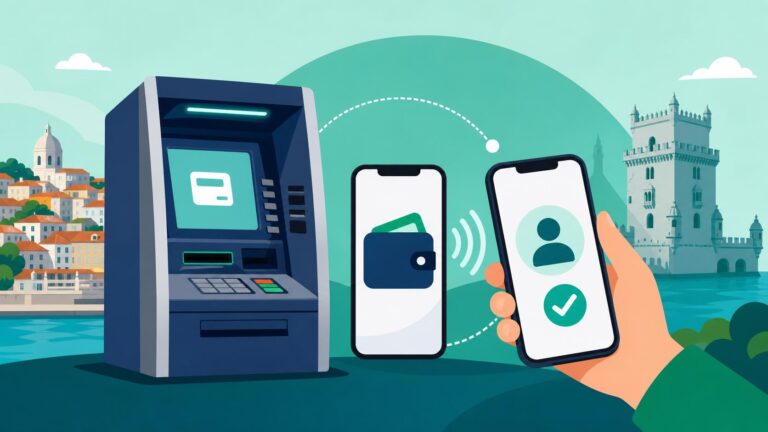
The Multibanco system is the heartbeat of Portuguese finance. Unlike the US or UK, where "debit" and "credit" are the primary distinctions, in Portugal, everything runs through the MB network. If a shop says "Não temos Multibanco," it means they only take cash. If they say "Só cartões Portugueses," it means their terminal won't accept your foreign Visa or Mastercard because those cards don't have the MB software layer. Mastering The Multibanco System and MB Way: Portugal's Unique Payment Network is essential. MB Way, in particular, is a mobile app linked to your phone number that allows for instant peer-to-peer transfers. It has become so ubiquitous that even vegetable sellers at the local mercado in Olhão will often prefer an MB Way transfer over fumbling with coins.
Navigating the Tax System and Residency
Taxes in Portugal are a contact sport. You cannot avoid them, and the penalties for late filing or incorrect declarations are swift and unforgiving. The primary entity you will deal with is the Autoridade Tributária e Aduaneira (known simply as Finanças). Your first interaction will be getting your NIF. This nine-digit number is more than just a tax ID; it is your gateway to life in Portugal. You need it to rent an apartment, get a SIM card, or even buy a vacuum cleaner if you want to claim the tax deduction.
The NIF and the e-Fatura System
Once you have your NIF, you must learn the phrase "Quer contribuinte na fatura?" (Do you want your tax number on the invoice?). In Portugal, the government incentivizes citizens to report their spending to combat the shadow economy. By giving your NIF at the supermarket, the pharmacy, or the hair salon, those invoices are automatically uploaded to the e-Fatura portal. At the end of the year, these expenses translate into small IRS deductions. It might only be a few Euros back on your taxes, but the cumulative effect is significant. More importantly, it creates a paper trail of your life in Portugal, which is often useful for future residency renewals.
Tax Residency and the 183-Day Rule
You become a tax resident in Portugal if you spend more than 183 days in the country within any 12-month period, or if you have a home that suggests you intend to stay permanently. This is a critical distinction because once you are a tax resident, Portugal expects you to declare your worldwide income. For expats, this can be a shock. For a detailed breakdown of how this affects your specific situation, see Portuguese Taxes for Expats: IRS, Tax Residency, and Filing Deadlines. The IRS (Imposto sobre o Rendimento de Pessoas Singulares) brackets are progressive and can go as high as 48% for top earners, which is why tax planning is not optional—it’s a survival skill.
NHR 2.0 and the IFICI Regime
The "old" NHR (Non-Habitual Resident) program, which famously offered a 0% tax on foreign pensions and a 20% flat rate for certain professions, was phased out for new applicants at the end of 2023. In its place, the government introduced the IFICI (Incentive for Scientific Research and Innovation), often called NHR 2.0. This new regime is much narrower, focusing on "high-value" roles in tech, startups, and academia. If you are moving to Lisbon to work for a major tech hub or to start a green energy company, you might qualify for the 20% flat tax on employment income for ten years. You should consult NHR 2.0 (IFICI) Tax Regime: Eligibility, Flat 20% Tax, and Rules in 2026 to see if your profession makes the cut, as the list of eligible roles is updated periodically by the government.
Managing Everyday Expenses and Cost of Living
Living in Portugal is no longer the "bargain basement" experience it was a decade ago. While wine and coffee remain delightfully cheap, housing and utilities have soared. Managing your monthly budget requires a shift in mindset. You will find that many services are paid for via "Entidade e Referência"—a system where you are given a company code and a reference number to pay through your banking app or a Multibanco ATM.
| Expense Category | Estimated Monthly Cost (Single) | Estimated Monthly Cost (Family of 4) |
|---|---|---|
| Rent (2-bed, Lisbon/Porto) | €1,200 – €1,800 | €2,000 – €3,500 |
| Utilities (Elec/Water/Gas) | €120 – €180 | €250 – €400 |
| Groceries | €300 – €450 | €700 – €1,100 |
| Health Insurance (Private) | €30 – €70 | €120 – €250 |
| Public Transport Pass | €30 – €40 | €120 – €160 |
| Dining Out (Mid-range) | €200 – €400 | €500 – €900 |
The "14-Month Salary" Reality
If you are employed by a Portuguese company, your salary is likely divided into 14 payments rather than 12. You receive an extra month's pay in the summer (Holiday Subsidy) and another in December (Christmas Subsidy). While this feels like a nice bonus, it means your monthly "take-home" pay is lower than you might expect based on your annual gross. Additionally, many employees receive a "Subsídio de Alimentação" (Meal Allowance), often paid onto a separate pre-paid card that can be used at grocery stores and restaurants. This card is tax-exempt up to a certain daily limit, making it a highly efficient way to get paid.
Dealing with Utility Bills
Setting up utilities is its own circle of bureaucratic hell. EDP (Electricity), EPAL (Water), and providers like MEO or Vodafone (Internet) will all require your NIF, a Portuguese bank account for direct debit, and a rental contract. One quirk of Portuguese housing is the "Potência Contratada." This is the maximum electrical load your house can handle. If you try to run the oven, the washing machine, and a space heater at the same time and the power cuts out, it's not a blackout—it’s because your contracted power limit is too low. Increasing this limit will slightly increase your fixed monthly cost but will save you from constant trips to the fuse box.
Cost of Living Disparities
The cost of living varies wildly between the Atlantic coast and the interior. While a Cost of Living in Portugal 2026: Detailed Budgets for Singles and Families will show high prices for Lisbon, moving just an hour inland to places like Santarém or Évora can cut your rent by 40%. However, you must factor in the cost of a car, as public transport in the interior is often skeletal. Petrol is among the most expensive in Europe, and the "portagens" (tolls) on the highways (AE) can add €20 to a simple weekend trip if you aren't careful.
Investing and Wealth Building as an Expat
For many expats, Portugal is not just a place to live but a place to build a future. However, the investment landscape here is unique. The Portuguese are historically risk-averse, preferring real estate or low-yield savings bonds (Certificados de Aforro) over the stock market. As an expat, you will likely want to maintain a more diversified portfolio.
Real Estate as an Investment
Property remains the "Gold Standard" of investment in Portugal. Despite the end of the real estate path for the Golden Visa in major cities, the market has remained buoyant due to high demand and low supply. If you are considering Buying Property in Portugal as a Foreigner: The Step-by-Step 2027 Guide, you need to account for high transaction taxes (IMT and Stamp Duty) which can add 6-8% to the purchase price. Unlike the UK or US, property flipping is rare because the taxes eat up the short-term gains. Most expats focus on long-term rentals or "Buy-to-Let," though you must be aware of the 28% flat tax on rental income (which can be reduced if you sign long-term leases).
Stock Market and ETFs
If you are looking to invest in global markets while living in Portugal, platforms like Trade Republic have become incredibly popular among the expat community. They offer a simple way to buy fractional shares and ETFs with low fees. From a tax perspective, Portugal taxes capital gains on stocks at a flat rate of 28%. However, if you are an NHR holder, certain foreign dividends might be exempt or taxed at lower rates under Double Taxation Agreements. It is vital to use an Finding an English-Speaking Certified Accountant (Contabilista Certificado) to ensure you aren't overpaying, especially if you have accounts in multiple countries.
Cryptocurrency and Digital Assets
Portugal used to be a "crypto tax haven," but those days ended in 2023. As of 2026, the rules are clear: if you hold your crypto for more than 365 days, your gains are generally tax-free (provided they are not your primary source of professional income). If you sell within a year, you are hit with that same 28% flat tax. Using a platform like Binance is common here, but you must be meticulous with your record-keeping. The Finanças portal now has specific fields for declaring crypto assets, and the cross-border sharing of data between exchanges and tax authorities is now a standard reality. For a deep dive into the nuances, refer to Cryptocurrency Tax Laws in Portugal 2026: 28% Rule vs 1-Year Exemption.
Freelancing and Small Business Finance
Portugal has become a magnet for freelancers and entrepreneurs, but the "Recibos Verdes" (Green Receipts) system can be baffling. Whether you are a yoga instructor in Ericeira or a software consultant in Porto, you will likely start as a "Trabalhador Independente."
The Simplified Regime vs. Organized Accounting
Most freelancers opt for the "Regime Simplificado." Under this system, the government assumes a certain percentage of your income (usually 75% for services) is profit and taxes you on that, without you needing to prove your expenses. This is great for high-margin digital workers but terrible for those with high overheads. Once your annual turnover exceeds €200,000, you are forced into "Contabilidade Organizada," which requires a certified accountant and a more complex filing process. For those just starting, Freelancing in Portugal (Recibos Verdes): Taxes, Social Security, and Setup is a must-read.
Social Security Obligations
This is the part that hurts. After your first year of freelancing (which is usually exempt), you must pay monthly Social Security contributions. These are calculated quarterly based on your income from the previous three months. The rate is roughly 21.4% of your "relevant income." Even if you have a slow month, there is a minimum monthly payment (around €20) that you must make to keep your healthcare and pension rights active. Dealing with the "Segurança Social Direta" portal is a rite of passage for every expat entrepreneur; it is notoriously buggy and often requires a PDF translator to navigate.
Setting up a Limitada (Lda)
If you are running a business with employees or higher turnover, you might want to incorporate as a "Sociedade por Quotas" (Lda). This provides limited liability and can be more tax-efficient, as corporate tax (IRC) starts at 17% for the first €50,000 of profit. However, the administrative burden of an Lda is significantly higher. You will need an accountant, a dedicated business bank account, and you must navigate the "Transparency Rules" which can sometimes attribute the company's profits directly to the shareholders for tax purposes.
Moving Money and Managing Currency Risk
For many expats, their financial life is split between two worlds. You might earn in USD or GBP but spend in EUR. This introduces "Currency Risk"—the danger that a sudden drop in your home currency will effectively cut your "Portuguese salary" by 10% overnight.
International Transfer Strategies
Never, ever use a traditional bank for international transfers. The hidden "spread" on the exchange rate and the flat wire fees will cost you thousands over a few years. Services like Wise have become the industry standard for a reason. They offer the mid-market rate and transparent fees. Many expats set up a recurring "salary" transfer from their home country to their Portuguese bank account to cover monthly bills, using these platforms to lock in rates when the Euro is weak.
Avoiding ATM and Hidden Fees
When using your foreign card at a Portuguese ATM, you will often be asked "Would you like to be charged in your home currency?" The answer is always NO. This is a "Dynamic Currency Conversion" (DCC) trap where the ATM owner sets a terrible exchange rate. Always choose to be charged in the local currency (EUR) and let your card provider (like Wise or a travel-friendly bank) handle the conversion. Also, be wary of "Euronet" ATMs—those brightly colored machines in tourist areas like Albufeira or Lisbon's Pink Street. They charge exorbitant fees for withdrawals. Stick to the "Multibanco" branded machines, which are free for most European cards.
Hedging Against Inflation
Inflation in the Eurozone remains a concern. If you have significant savings sitting in a Portuguese bank account earning 0.01% interest, you are losing money every day. Expats often look toward "high-yield" options outside of Portugal or specialized Portuguese savings products. Understanding Transferring Money to Portugal: Saving on Exchange Rates and Fees can help you move large sums (like a house deposit) safely without getting slaughtered by the banks.
Planning for Retirement and Long-Term Security
Portugal is consistently ranked as one of the best places in the world to retire, but the financial transition requires more than just picking out a villa in the Algarve. You need to consider how your pension will be taxed and how you will cover long-term care.
Pension Taxation and DTAs
If you are a UK or US citizen, your pension is generally taxed where you are a resident. Under most Double Taxation Agreements (DTA), your private pension will be taxed by Portugal. If you missed the old NHR window, your pension will be taxed at the standard progressive IRS rates. This can be a significant jump if you are used to lower tax brackets in your home country. It is crucial to coordinate the "pension commencement" with your move date to avoid being taxed by both countries in the same transition year.
Healthcare Costs and Insurance
While the public health system (SNS) is available to all residents, it is currently under significant strain. Most expats opt for private health insurance to bypass the long waiting lists for specialists. For a couple in their 60s, a good private plan might cost between €150 and €300 per month. This is a mandatory budget line item that many people forget when planning their retirement. Without insurance, a single private consultation at a Hospital da Luz or CUF can cost upwards of €100.
Inheritance and Succession Planning
Portugal does not have a traditional "Inheritance Tax" (IHT) for "forced heirs" (spouse, children, parents). However, there is a 10% Stamp Duty (Imposto do Selo) on Portuguese assets passed to others. More importantly, Portugal applies the succession law of your habitual residence unless you specifically state in your will that you want the laws of your home country to apply. This is a critical legal nuance; if you don't have a Portuguese will that invokes the EU Succession Regulation (650/2012), your assets might be distributed according to Portuguese "forced heirship" rules, which might not be what you intended.
Important Disclaimer
The information provided in this guide is for educational and informational purposes only and does not constitute professional financial, legal, or tax advice. Laws, tax rates, and banking regulations in Portugal change frequently, especially with the 2026 updates. You should always consult with a qualified professional, such as a Certified Accountant (Contabilista Certificado) or a specialized immigration lawyer, before making significant financial decisions or filing tax returns in Portugal. Individual circumstances vary, and what works for one expat may not be suitable for another.