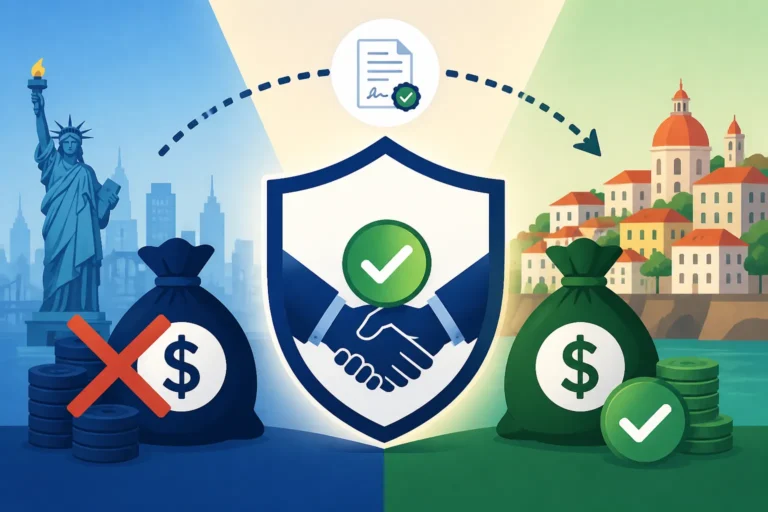
Managing Dual Currency Budgets: Strategies for Couples Earning USD and EUR
Disclosure: This article contains affiliate links. If you buy through them, we may earn a commission at no extra cost to you. Read our full disclosure.
One of the most jarring experiences of moving to Portugal is realizing that your financial stability is suddenly tied to a fluctuating number on a screen that you have absolutely no control over. I remember sitting in a sun-drenched café in Graça during my first year, watching the Euro gain strength against the Dollar and realizing my rent had effectively increased by 150 Dollars overnight. This guide solves the complex puzzle of managing a dual-currency household, ensuring you and your partner stay financially buoyant regardless of what happens on the foreign exchange markets.
The Reality of Currency Volatility for Expats in Portugal
Living in Portugal while earning in United States Dollars (USD) creates a unique financial paradox. On one hand, you are often earning a salary that is significantly higher than the local Portuguese average, giving you immense purchasing power. On the other hand, you are essentially a "speculator" in the currency markets every time you pay your utility bills or buy groceries at Pingo Doce. For couples where one person earns in USD and the other in Euro (EUR), or where both earn USD but live a EUR life, the mental load of tracking exchange rates can be exhausting.
Understanding the Exchange Rate Rollercoaster
The exchange rate between the Euro and the Dollar is not just a statistic; it is a living entity that dictates your quality of life. When the Euro is weak, your Dollars go further, and suddenly that expensive dinner in Cascais feels like a bargain. However, when the Euro strengthens, your "fixed" USD income buys fewer Euros, which can lead to a "lifestyle squeeze." many couples move here during a period of Dollar strength, sign a lease on a luxury apartment, and then struggle two years later when the exchange rate shifts back toward historical norms. It is vital to understand that the Money and Finance in Portugal: The Ultimate 2026 Guide for Expats experience is heavily dictated by these macro-economic shifts.
To manage this, you need to look at historical averages rather than the "spot price" of the day. If you are planning your budget based on a specific exchange rate, you are setting yourself up for failure. Instead, it is wise for couples to build their budget using a "stress test" rate—calculate what your life would look like if the Dollar dropped by 10% or 20% against the Euro. If your budget still works under those conditions, you are in a safe zone. This is especially true when considering the Cost of Living in Portugal 2026: Detailed Budgets for Singles and Families which can vary wildly depending on your neighborhood and habits.
Psychological Stress of Dual-Currency Living
There is a specific kind of "currency anxiety" that hits when you check your bank app and see a dip in value. For couples, this can lead to friction. If one partner is more risk-averse, they might want to convert all USD to EUR immediately to "lock in" a rate, while the other might want to wait for a better day. This tension is why having a clear, agreed-upon strategy is more important than the actual exchange rate itself. You need to remove the emotion from the transaction.
One way to mitigate this is to stop thinking in two currencies. Choose a "base" currency—usually the Euro, since that is what you spend—and treat your USD income as a raw material that needs to be processed. By shifting your mindset to "I have X amount of Euros this month" rather than "I have X Dollars which equals Y Euros today," you reduce the constant mental math that leads to burnout. This approach is fundamental when you are first Opening a Bank Account in Portugal: Best Banks for Foreigners and Expats and trying to reconcile your old financial life with your new one.
Practical Tools for Moving Money Between USD and EUR
Once you’ve accepted the volatility, the next step is to minimize the "middleman" costs. Traditional banks are notorious for "eating" your money through hidden exchange rate markups and flat wire transfer fees. When I first moved here, I used a major US bank to send money to a major Portuguese bank, and I estimate I lost nearly 4% of every transfer. That is thousands of Euros over a year—money that could have gone toward a down payment on a house in the Silver Coast.
Beyond Traditional Banks: Why Wise is Essential
For most expats, Wise has become the gold standard for moving money. Unlike traditional banks that use their own "internal" rates, Wise uses the mid-market rate—the one you actually see on Google. They charge a transparent, upfront fee that is usually a fraction of what a bank would take. In a dual-currency household, having a Wise Multi-Currency Account allows you to hold both USD and EUR in the same place. This is incredibly helpful for couples because you can receive your US salary in the USD pocket and then choose exactly when to convert it to the EUR pocket.
Using Wise also provides you with local bank details for both the US and the EU. This means your US employer can pay you via a standard ACH transfer (free), and you can pay your Portuguese landlord via a SEPA transfer (also usually free or very cheap). It eliminates the need for expensive international wires. When you are looking at Wise vs Revolut vs Bank Transfers: Cheapest Way to Move USD/GBP to EUR, you'll find that for large, regular transfers of salary, the transparency of the mid-market rate is almost always the winner for long-term budgeting.
Setting Up a Bridge Account Strategy
A "bridge" account is a secondary account that sits between your primary US bank and your Portuguese bank. For many, this is the Wise account, but it could also be a digital-first bank like Revolut or a specialized expat account. The strategy is simple: your USD income lands in the bridge account. You then set up a recurring transfer of a fixed Euro amount to your Portuguese bank. This "smooths out" the volatility.
By transferring a fixed EUR amount every month, you make your Portuguese life predictable. Some months, that transfer will cost you more USD; some months, it will cost you less. But your rent, utilities, and grocery budget remain constant in your Portuguese bank account. This prevents the "overspending" that happens when the Dollar is strong and you feel "rich," only to be caught short when the rate turns. This is a crucial part of the Money and Finance in Portugal: The Ultimate 2026 Guide for Expats toolkit for anyone living the 2026 expat life.
| Feature | Traditional Bank | Wise / Digital Apps | Neobanks (e.g., Revolut) |
|---|---|---|---|
| Exchange Rate | Hidden Markup (2-5%) | Mid-Market Rate | Interbank (with limits) |
| Transfer Speed | 3-5 Business Days | Instant to 24 Hours | Instant |
| Monthly Fees | Often €5-€15 | Free | Tiered (Free to €15) |
| Local IBAN | Yes | Yes (Multi-currency) | Yes |
| MB Way Support | Yes | No | Partial / Via App |
Expense Allocation: Who Pays What and in Which Currency?
In a relationship where income is split between two currencies, the traditional "split everything 50/50" model often breaks down. If the Euro strengthens, the partner earning USD effectively takes a pay cut, while the partner earning EUR stays the same. This can lead to an accidental power imbalance in the relationship. To avoid this, you need a strategy that accounts for the "real-world" value of your combined income.
The Fixed-Cost Strategy (EUR Expenses)
Couples are advised to cover their core Portuguese fixed costs—rent, health insurance, and utilities—using the income that is already in Euro if possible. If one of you is working for a Portuguese company or is a freelancer with local clients, use that "stable" EUR income for the things that cannot fluctuate. This provides a baseline of security. Even if the USD crashes, your roof is paid for.
If you both earn USD, then you should designate a "conversion day" once a month. On this day, you convert enough USD to cover all fixed EUR expenses for the next 30 days. Don't try to "time the market" by waiting for a better rate on Tuesday afternoon. Pick a date—say, the 28th of the month—and execute. This discipline is what separates successful expats from those who end up moving back home because of financial stress. If you are on the NHR 2.0 (IFICI) Tax Regime: Eligibility, Flat 20% Tax, and Rules in 2026, your net income might be higher, but the principle of fixed-cost allocation remains the same.
The Variable-Cost Strategy (USD Buffer)
While fixed costs should be handled with discipline, variable costs—travel, dining out, luxury purchases—can be handled more flexibly using your USD accounts. Many US credit cards offer "no foreign transaction fees," which can be a great way to spend USD directly in Portugal. However, be careful: while there is no "fee," the bank is still setting the exchange rate.
Keeping a USD "buffer" is also wise for any expenses that are actually denominated in Dollars. If you have US student loans, a US-based life insurance policy, or you like to shop on Amazon US for specific items you can't find here, keep that money in USD. Converting EUR back to USD is a double-loss because you pay fees both ways. Managing these balances is a key part of Portuguese Taxes for Expats: IRS, Tax Residency, and Filing Deadlines, as you'll need to report these accounts eventually.
Protecting Your Purchasing Power with Smart Investing
Just "saving" money isn't enough when you're dealing with two currencies and the inflation rates of 2026. You need your money to work for you. For expats in Portugal, this means looking at investment platforms that allow for cross-border growth without massive tax headaches.
Investing EUR via Trade Republic
If you are accumulating Euro savings, you shouldn't just let them sit in a standard Portuguese savings account (which often pay abysmal interest). Trade Republic has become a favorite among the European expat community because it often offers competitive interest rates on uninvested cash (around 4% in recent years) and allows for easy, low-cost investing in ETFs.
For a couple, setting up a "rainy day" fund in Trade Republic serves two purposes: it hedges against Euro inflation and ensures that your EUR-denominated wealth is actually growing. If you plan on staying in Portugal long-term, perhaps buying property, you need a growing EUR nest egg. This is far more effective than keeping all your savings in a US brokerage account and hoping the exchange rate is favorable when you finally decide to buy that villa in the Algarve.
Navigating Crypto for Currency Hedging with Binance
For the more tech-savvy expat, cryptocurrency can occasionally serve as a neutral "third currency." While highly volatile, stablecoins pegged to the Dollar (like USDT or USDC) can be used to move value across borders quickly. Binance is one of the most accessible platforms for this in Portugal.
Some couples use Binance to hold a portion of their "transitional" funds. For example, if you want to move a large sum from USD to EUR but don't want to do it all at once, you might hold it in a stablecoin and convert smaller amounts over time. However, be extremely mindful of the Cryptocurrency Tax Laws in Portugal 2026: 28% Rule vs 1-Year Exemption before you start trading. Portugal is no longer the "tax-free crypto paradise" it once was, and the Finanças (tax authority) are becoming much more sophisticated in their tracking.
Tax Implications and Reporting for Dual-Income Couples
This is the part that everyone hates, but it's the part that can cause the most damage if ignored. When you earn in one currency and live in another, the tax man has questions. Portugal taxes its residents on their worldwide income. This means if you live in Lisbon but your boss is in New York, you owe the Portuguese government their cut.
IRS Reporting for Foreign Income (Anexo J)
When you file your annual Portuguese tax return, any income earned outside of Portugal must be reported on a specific form called Anexo J. This is where you list your USD earnings. The Finanças will use an official annual exchange rate to convert your USD income into EUR for tax calculation purposes. This can sometimes lead to a "tax surprise" if the exchange rate used by the government is different from the one you actually received when you converted your money.
It is highly recommended to work with a professional who understands the Filing IRS Anexo J for foreign income: Common mistakes expats make. They can help you navigate the nuances of the US-Portugal Double Taxation Treaty, ensuring you don't pay the same tax twice. This is particularly important for couples who might have different tax residencies or who are both earning significant USD income while living in a high-tax jurisdiction like Portugal.
Dealing with FATCA and FBAR as a US Expat
If you are a US citizen, your reporting obligations don't end with Portugal. The US is one of the only countries that taxes based on citizenship, not just residency. You must continue to file US tax returns, and you must report any foreign bank accounts (like your Portuguese ones) if the total balance exceeds $10,000 at any point during the year. This is known as the FBAR (Foreign Bank Account Report).
Additionally, FATCA (Foreign Account Tax Compliance Act) requires Portuguese banks to report your account balances directly to the US IRS. This means there is no "hiding" your Euro savings. For a comprehensive look at this, see US Expats in Portugal: FATCA, FBAR, and Avoiding Double Taxation. Keeping meticulous records of your currency conversions and bank statements is the only way to survive an audit on either side of the Atlantic.
Long-Term Financial Planning in a Multicurrency World
Budgeting for next month is a start, but what about the next decade? If you and your partner plan to make Portugal your permanent home, your financial strategy needs to evolve from "spending USD" to "building EUR wealth."
Building an Emergency Fund in Both Currencies
A standard 6-month emergency fund is harder to calculate in two currencies. I recommend a "split" emergency fund. Keep 3 months of basic living expenses in a local Portuguese account (in EUR) for immediate needs like car repairs or medical emergencies. Keep another 3 to 6 months of expenses in a high-yield US savings account (in USD).
This split protects you. If the Euro has a massive crisis, you have Dollars. If the US banking system has a hiccup, you have Euro. For expats, diversification isn't just about stocks and bonds; it's about the very currency you hold. You might want to consult Finding an English-Speaking Certified Accountant (Contabilista Certificado) to help you structure these funds in a way that is tax-efficient in both countries.
Planning for Retirement: Where Will You End Up?
The most important question for any dual-currency couple is: Where do we plan to retire? If the answer is Portugal, you need to start shifting your long-term investments toward European assets. Relying solely on a US 401(k) or IRA is risky because you will be 100% dependent on the USD/EUR exchange rate in your 70s and 80s.
If you plan to split your time between the two countries, then a 50/50 currency split in your retirement portfolio is the goal. Use tools like Trade Republic for your European side and traditional US brokerages for your American side. By building wealth in both "buckets," you ensure that you can afford to live comfortably no matter which way the geopolitical winds blow. This long-term view is essential as you navigate the Portuguese Taxes for Expats: IRS, Tax Residency, and Filing Deadlines throughout your working years in the Algarve or Lisbon.
Disclaimer
The information provided in this article is for educational and informational purposes only and does not constitute professional financial, legal, or tax advice. Currency markets and tax laws in Portugal are subject to frequent changes. You should always consult with a certified financial advisor or a qualified accountant who specializes in cross-border tax compliance before making any significant financial decisions. All mentions of specific brands are for contextual purposes and do not imply a personal endorsement of their current terms and conditions.