How to Hike the Levadas of Madeira
Disclosure: This article contains affiliate links. If you buy through them, we may earn a commission at no extra cost to you. Read our full disclosure.
If you have ever arrived in Madeira, opened a map, and found dozens of levada walks with similar names, unclear start points, a new online trail fee, and fog rolling in by noon, this guide is for you. I’ll walk you through choosing the right levada, paying the fee, reaching the trailhead, and finishing your hike safely.
Understanding the Levadas and Choosing Your First Route
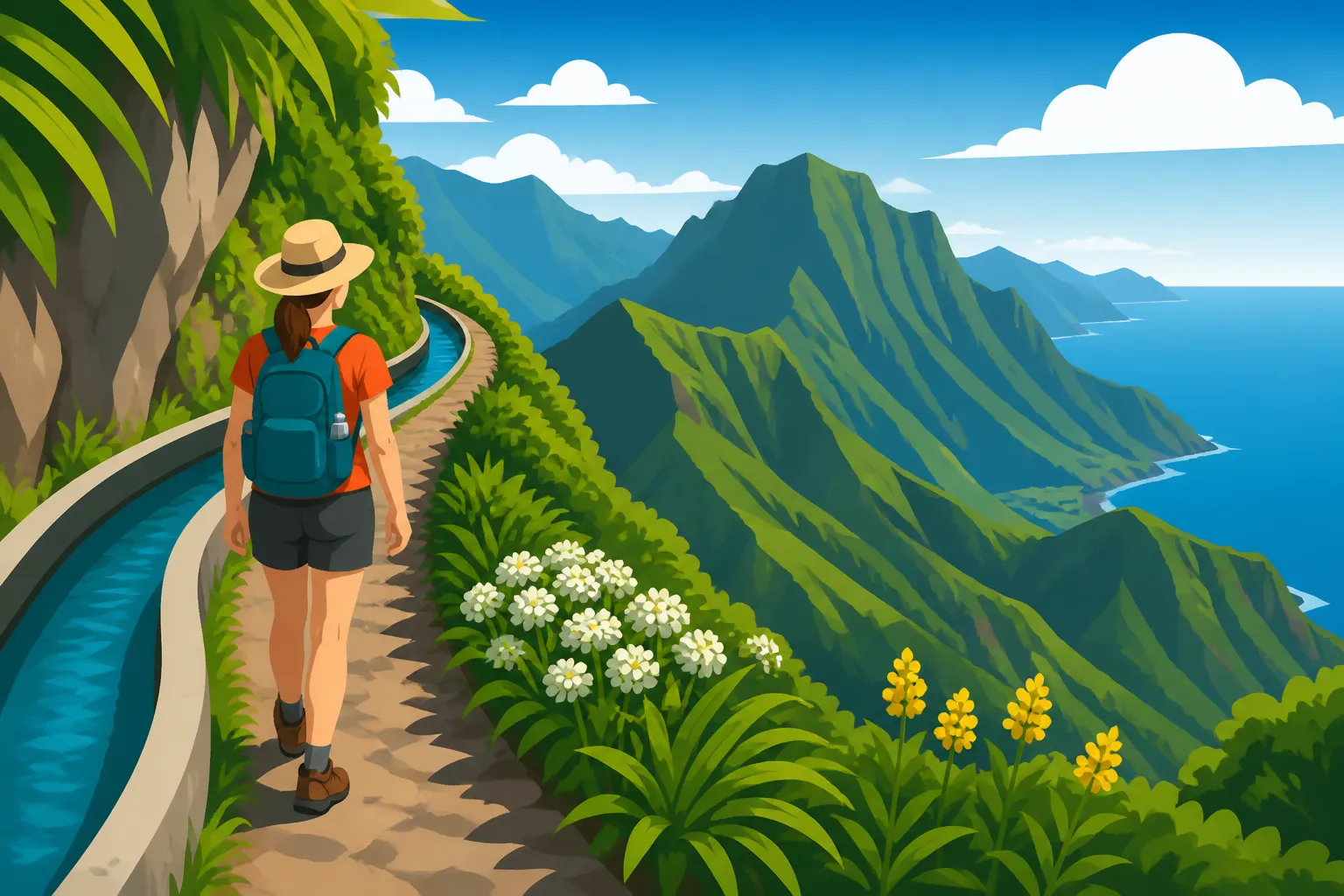
The first time I stood at the edge of a levada, I was a bit underwhelmed. It was a narrow stone channel of water, about knee-height, with a dirt path running alongside it. Twenty minutes later I was walking through ancient laurel forest with moss dripping off the trees and a waterfall roaring somewhere below me. I understood why people come back to Madeira year after year just to walk these channels.
What a Levada Actually Is
Levadas are irrigation channels built over several centuries to carry water from the wet, mountainous north and centre of Madeira to the drier south, where sugar cane, vines, and bananas were grown. Workers cut them into sheer cliff faces, sometimes while hanging from ropes. The maintenance paths beside the channels became the walking trails you use today.
This history matters for hikers. Because the channels follow the contour of the mountain to keep water flowing gently, most levada walks are surprisingly flat. You can walk for an hour and barely gain any height. The catch is that the path is often narrow, and on some routes the downhill side is a long drop with nothing but a thin wire fence or no barrier at all. “Flat” does not mean “easy” if you have vertigo.
The trails that carry a “PR” code (Pequena Rota, or short route) are the officially classified, signposted ones. These are the routes managed, signposted and monitored by the regional authorities. Plenty of unofficial levada walks also exist. Some are lovely. Others are unmaintained, partly collapsed, or closed for good reason. Stick to the classified PR routes until you know the island well.
The Rabaçal Trio: Best Starting Point for First-Timers
If I could recommend one area for your first levada walk, it would be Rabaçal, on the edge of the Paul da Serra plateau, reached from the ER 105 road. Three official trails start from this area, and together they give you a little of everything: forest, waterfalls, lakes, and that classic levada-side walking.
Here is how the three routes compare, based on the Visit Madeira trail pages as of October 2026:
| Trail Code | Trail Name | Distance One Way | Difficulty | Listed Duration | Highlight |
|---|---|---|---|---|---|
| PR 6 | Levada das 25 Fontes | 4.3 km | Moderate | 3 hours | A pool fed by many small cascades tumbling down a mossy rock wall |
| PR 6.1 | Levada do Risco | 1.5 km | Easy | 2 hours | The tall Risco waterfall at the end of a short forest walk |
| PR 6.2 | Levada do Alecrim | 3.5 km | Easy | 2:30 hours | The “Dona Beja” lake that feeds the Lagoa do Vento waterfall |
As of October 2026, each of these three trails costs €4.50 per visitor over 12, paid on the SIMplifica portal. Children 12 and under are exempt. The fee is charged per trail, so if you plan to combine Levada das 25 Fontes and Levada do Risco on the same morning, pay for both routes.
My personal take: PR 6.1, Levada do Risco, is the perfect warm-up. It is short, easy, and the payoff is a genuinely impressive waterfall. PR 6, Levada das 25 Fontes, is the most famous and the most crowded, and at 4.3 km one way it is the one where you will feel your legs on the climb back up. PR 6.2, Levada do Alecrim, is the quiet cousin. It sees fewer walkers, follows the channel through beautiful scenery, and ends at the “Dona Beja” lake, where you can sit and eat lunch in near silence.
Picture a typical scenario. A couple flies into Funchal, rents a car, and has one free day. They drive up to Rabaçal early, walk PR 6.1 to the Risco waterfall, double back, and continue along PR 6 to the 25 Fontes pool before the tour buses arrive. That is a full, satisfying day, and they have barely scratched the surface of the island. For broader island planning, see Madeira for Travelers: Levadas, Funchal, and Peaks.
Other Classic Levada Walks Worth Knowing
Once you have done Rabaçal, a few other routes come up again and again in conversations with locals and long-term residents.
Levada do Caldeirão Verde, in the northeast near Santana, takes you through deep laurel forest and several tunnels to a green cauldron where a waterfall drops into a pool. This one requires a headlamp, and in wet conditions the path can be muddy and slippery. It is longer than the Rabaçal walks, so start early.
Vereda dos Balcões, near Ribeiro Frio, is the gentlest option on the island. It is a short stroll to a viewpoint over the valleys of the northeast, and it is ideal if you are travelling with older relatives or small children, or if the weather is too poor for anything bigger. Bird lovers often see chaffinches eating out of people’s hands at the viewpoint.
Levada do Rei, also in the north, is a calmer forest walk that follows the channel to a pretty spot at the end. It is less dramatic than Caldeirão Verde but more relaxed, with fewer exposed sections.
For these other routes, I would not assume anything about fees or opening status. The regional authorities have been moving official trails onto paid access, and closures happen after storms or rockfalls. Check the Visit Madeira trail pages and the SIMplifica portal for the specific route before you set off. If you want to know how many routes you can realistically fit into one trip, see How Many Days Do You Need in Madeira?.
Paying the Fee, Getting to the Trailhead, and Where to Stay
This is where most of the stress happens. The walking itself is the fun part. The logistics, especially the fee system and the mountain roads, are where I see visitors get flustered.
How to Pay the Trail Fee on SIMplifica Step by Step
The fee is paid online through the SIMplifica portal, the regional government platform. Here is the process I follow, and the one I walk visiting friends through:
- Decide which trails you will walk and on which day. For Rabaçal, that means choosing between PR 6, PR 6.1, and PR 6.2, or a combination.
- Open the SIMplifica portal on your phone while you still have a good signal. Do this in your hotel or in Funchal, not at the trailhead, where coverage can be patchy.
- Find the trail access payment section and select the specific trail by its name and code.
- Enter the number of walkers. Remember that visitors over 12 pay €4.50 per trail as of October 2026, and children 12 and under are exempt.
- Pay by card and save the confirmation. Take a screenshot as well, because you may not have data on the mountain.
- Repeat for each additional trail. If you are walking two routes, you need two payments.
- Keep the proof handy while walking. Wardens and staff may check, and having it on your lock screen saves fumbling in a rucksack.
A quick word on mobile data: the plateau and the deep valleys can have weak or no coverage. Downloading offline maps and having your payment screenshot saved locally is just common sense. If you are still sorting out a phone plan, see How to Get a Local eSIM for Travel in Portugal.
Getting There by Car, Bus, or Guided Tour
Madeira has no train network, and the mountain roads are steep, winding, and sometimes narrow enough that you will be reversing to let a bus past. Each way of reaching the trails has its own trade-offs:
| Option | Best For | Pros | Cons |
|---|---|---|---|
| Rental car | Confident drivers who want flexibility | Start early, beat the crowds, change plans if fog arrives | Steep roads, parking pressure at popular trailheads, driving fatigue |
| Public bus | Budget travellers with time | Cheap, no driving stress | Infrequent services to mountain areas, early starts are hard, linear routes tricky |
| Guided tour with transfer | First-timers, solo hikers, non-drivers | Pick-up from your hotel, a guide who knows conditions, easy linear routes | Less flexibility, group pace, popular times of day |
| Taxi | Linear walks or groups sharing a fare | Drop-off at one end, pick-up at the other | Needs pre-arranged pick-up, costs add up |
Driving is how I do most levada walks, and I genuinely enjoy it, but I won’t pretend it is relaxing for everyone. The ER 105 up to Rabaçal climbs onto the Paul da Serra plateau, which can switch from bright sun to thick cloud in minutes. If you are not used to mountain driving with a manual gearbox, give yourself extra time. For advice on hiring a car, insurance, and what to expect behind the wheel, see Renting a Car in Portugal: Tolls, Insurance, and Driving Tips.
At Rabaçal itself, the road from the main parking area down to the Rabaçal forestry house, where PR 6 and PR 6.1 begin, is closed to private cars. You either walk down the access road or use the shuttle that runs between the car park and the house when it is operating. Check current shuttle availability locally, and remember that walking back up that road at the end of the day is a climb.
If you would rather not drive at all, a guided levada tour is a very sensible choice. GetYourGuide lists a range of levada walks with hotel pick-up from Funchal, including Rabaçal and Caldeirão Verde routes, and that solves both the transport problem and the “will I get lost” worry in one go. Read what is included before booking, especially whether the trail fee is covered or whether you need to pay it yourself on SIMplifica. For non-drivers, see How to Get Around Madeira Without a Car, which goes deeper into buses and taxis.
Where to Base Yourself for Levada Hiking
Most visitors stay in Funchal, and that works well. It has the most restaurants, the most transport, and most guided tours pick up there. The downside is that every hike in the west or northeast means a drive of an hour or more, which can push your start time back.
If your trip is mainly about walking, consider splitting your stay. A few nights on the west side, around Calheta or Porto Moniz, puts you much closer to Rabaçal and the Paul da Serra plateau. Then a few nights in the northeast, around Santana, puts Caldeirão Verde and Levada do Rei on your doorstep. I use Booking.com to compare small guesthouses and rural stays in these areas, filtering for free parking, since that is surprisingly hard to find in some villages.
Getting to Madeira in the first place is usually a flight into Funchal. If you are coming from Lisbon or Porto as part of a longer Portugal trip, Omio is handy for comparing flight options alongside your mainland train and bus legs in one search. For the full picture on reaching the islands, see Domestic Flights and Ferries to Portugal’s Islands.
Walking the Levadas Safely
I have lived in Portugal long enough to know that the Madeiran mountains deserve respect. Every year there are rescues on the levadas, and many of them involve visitors who were fit enough, but caught out by weather, footwear, or a route they did not research.
Weather, Fog, and Timing Your Hike
The single biggest factor is weather, and it can change faster than you would believe. The south coast around Funchal can be sunny and warm while the plateau above Rabaçal is wrapped in cold, wet cloud. I have left the car in T-shirt weather and been wearing every layer I owned an hour later.
Here is my rule: start early. Clouds often build over the mountains as the day goes on, and morning starts give you the clearest views and the quietest trails. An early start at Rabaçal also means you reach the 25 Fontes pool before it fills up with groups.
Check the forecast for the mountains specifically, not just for Funchal. After heavy rain, waterfalls are at their most impressive, but paths become muddy, rocks become slick, and the risk of rockfall rises. If official trail pages show a route as closed, it is closed. Do not climb over barriers. Closures usually follow landslides or storm damage you cannot see from the start.
Seasonally, Madeira is walkable year-round, but winter brings more rain and more frequent closures. If you are visiting in the cooler months, see What’s the Weather Like in Portugal in Winter? for a realistic sense of what to pack.
Tunnels, Drops, and the Right Footwear
Even on the “easy” Rabaçal routes, you will be walking on uneven stone, roots, and wet surfaces. Here is what I consider non-negotiable:
- Hiking shoes or boots with real grip. Fashion trainers are the most common footwear I see on stretchers.
- A headlamp or strong torch for any route with tunnels. Phone torches drain your battery and leave you with one hand free.
- A waterproof jacket, even on a sunny morning.
- A warm layer for the plateau, which is noticeably colder than the coast.
- More water and snacks than you think you need. Facilities are limited or non-existent once you leave the trailhead.
- A charged phone with offline maps and your SIMplifica payment saved.
- A small first aid kit with blister plasters.
On exposed sections, walk on the inside, closest to the mountain wall, and let people pass at wider points. If you have vertigo, Levada do Risco and Vereda dos Balcões are your friends. Levada das 25 Fontes has some steeper stepped sections that get crowded and slippery, so take your time. For more general preparation advice that applies across the country, see Hiking in Portugal: Trails and How to Prepare.
A common scenario: a family walks PR 6 to the 25 Fontes pool, spends a long time there taking photos and eating, and then realises they still have the whole route back, plus the climb up the access road, with the light fading and fog coming in. Plan your turnaround time before you start, and stick to it. A levada walk is not finished when you reach the waterfall. It is finished when you are back at the car.
What to Do If Something Goes Wrong
In a real emergency, such as a fall, a serious injury, someone unable to walk, or someone lost, call 112, the European emergency number. Try to note your trail code and the last landmark you passed. Saying “PR 6.2, Levada do Alecrim, about halfway to the Dona Beja lake” is far more useful to rescuers than “somewhere near Rabaçal”.
For non-urgent health concerns, like a twisted ankle that is swelling, a bad cut, or feeling unwell after a hike, Portugal’s SNS 24 helpline is a good first call. The number is 808 24 24 24, clinical triage runs 24 hours a day, and calls cost the same as a call to a landline (per gov.pt, page updated 29 April 2026). A nurse can tell you whether you need a health centre, an urgent care unit, or just ice and rest. See SNS 24 Helpline (808 24 24 24): Triage, Advice, and Sick Notes for how the service works in practice.
Mountain rescues and hospital visits can get expensive for visitors, which is one reason I never go hiking abroad without proper cover. Check that your policy covers hiking on marked trails and any rescue costs. See Do You Need Travel Insurance to Visit Portugal? for what to look for.
A Realistic Levada Day: Sample Plan, Packing, and Trail Etiquette
Theory is useful, but nothing beats a concrete plan. Here is how I would structure a first levada day at Rabaçal, based on many mornings spent up there.
A Sample Rabaçal Day From Funchal
- Wake early, check the mountain forecast, and confirm the trails are open on the official trail pages.
- Pay the fee on SIMplifica for each trail you plan to walk while you still have Wi-Fi, and screenshot the confirmations.
- Drive west and up onto the ER 105, allowing extra time for the winding roads and possible fog.
- Park at the Rabaçal car park and either take the shuttle, if it is running, or walk down the access road to the forestry house.
- Walk PR 6.1, Levada do Risco, first. It is the easy 1.5 km route, and the waterfall is beautiful in morning light.
- Return to the junction and continue onto PR 6, Levada das 25 Fontes, the moderate 4.3 km route with the listed duration of 3 hours.
- Have lunch near the 25 Fontes pool, but set a firm time to start back.
- Walk back to the forestry house and up to the car park, which is the hardest part of the day for many people.
- If you still have energy and time on another day, come back for PR 6.2, Levada do Alecrim, the easy 3.5 km route with a listed duration of 2:30 hours, ending at the “Dona Beja” lake.
That is a satisfying, achievable day for anyone of average fitness. I would not cram all three trails into one day on a first visit. You will enjoy the scenery more if you are not racing the clock. If you are building a wider itinerary around walks, see How to Plan a First Trip to Madeira.
Choosing Between Independent and Guided Hiking
I hike independently most of the time, but I do not think guided walks are only for beginners. Here is how I would decide:
| Factor | Independent Hike | Guided Hike |
|---|---|---|
| Transport | You drive or arrange taxis and buses | Usually included from Funchal |
| Route knowledge | You rely on signs, maps, and your own research | Guide knows current conditions and closures |
| Linear routes | Awkward without a second car or pick-up | Easy, as the vehicle meets you at the end |
| Pace | Your own | Set by the group |
| Learning | Whatever you read beforehand | Stories about levada history, plants, and birds |
| Flexibility | Change plans instantly if fog arrives | Fixed departure and route |
If you are travelling solo, nervous about mountain driving, or want to tackle a longer or more exposed route, a guided walk booked through GetYourGuide or directly with a local Madeiran guiding company is worth considering. Many long-term residents I know started with a couple of guided walks and then went independent once they knew the lie of the land.
Trail Etiquette and Respecting the Levadas
The levadas are working infrastructure. The water in them is still used for irrigation and, in some places, for supplying communities. A few habits make a real difference:
- Never swim in the levada channels or wash in them.
- Carry out every bit of rubbish, including fruit peel and tissues.
- Keep to the path and do not shortcut down slopes, which accelerates erosion.
- Give way politely at narrow sections and on stepped descents.
- Keep noise down. Many walkers come for the silence of the laurel forest.
- Do not feed wildlife anything other than what locals explicitly allow, and ideally nothing at all.
- Respect closures and private property signs, particularly where levadas pass through farmland.
I also want to validate something. Many visitors feel a strange pressure to “do” every famous levada and end up exhausted, crowded, and disappointed. You do not need to walk the most photographed trail to have a great experience. Some of my best memories on the island are quiet mornings on Levada do Alecrim, sitting by the “Dona Beja” lake with a flask of coffee and nobody else around. Choose routes that match your fitness and comfort with heights, start early, and let the island do the rest.
Disclaimer
This article is for general informational purposes only and does not constitute professional advice. Laws, prices and regulations vary by location and change over time. Consult a qualified professional for guidance on your specific situation.