Finding long-term parking in Lisbon: EMEL residential permits explained
Disclosure: This article contains affiliate links. If you buy through them, we may earn a commission at no extra cost to you. Read our full disclosure.
Circling the block in Arroios for forty-five minutes at midnight, eyes blurring as you hunt for a space that is not a loading zone or a driveway, is a rite of passage every Lisbonite dreads. Many residents spend far more hours than they would like idling in their cars, hoping someone will leave a spot so they can finally go to sleep. This guide provides the definitive solution to that nightmare by explaining exactly how to navigate the EMEL residential permit system to secure long-term parking.
Understanding EMEL and the Residential Parking Permit
If you are moving into a central area, your first introduction to the city's infrastructure will likely be the bright green vests of the EMEL officers. EMEL, or Empresa Municipal de Mobilidade e Estacionamento de Lisboa, is the entity responsible for managing almost all on-street parking within the city limits. For an expat, they can feel like the "enemy" due to their efficiency in handing out fines, but they also provide the most affordable parking solution for residents: the Dístico de Residente.
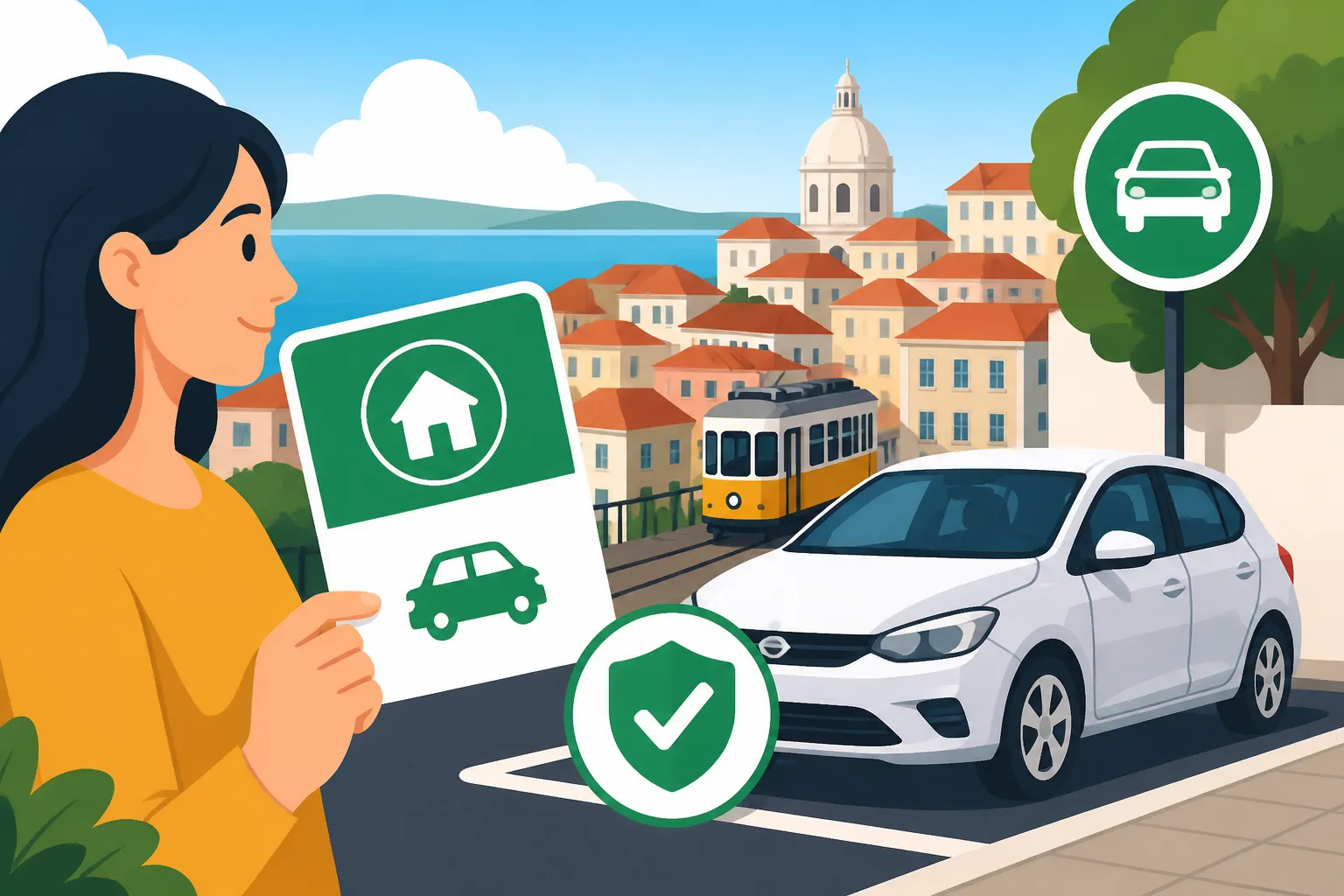
The Dístico de Residente is a virtual or physical permit that allows you to park your vehicle in specific zones near your home without paying the hourly meter rates. Without this permit, living in neighborhoods like Príncipe Real or Estrela with a car is financially unsustainable and logistically impossible. When you are looking for your first home using platforms like Uniplaces, it is vital to check which EMEL zone the property falls into, as some historical zones are significantly more restricted than others.
The permit essentially "whitelists" your license plate in the EMEL database. When an officer scans your plate, they see that you are a local resident and move on. It is important to note that the permit does not guarantee you a spot; it merely gives you the right to occupy one if you can find it. Understanding this distinction is the first step toward managing your expectations of life in a hilly, 18th-century city that was never designed for the Ford Focus.
The Different Types of EMEL Permits
Most people only think about the standard residential permit, but there are actually several versions depending on your life situation. The most common is the Resident Permit, but there is also a "Business" permit (Dístico de Empresa) and a "Green" permit for electric vehicles. If you are driving an electric car, you might be eligible for significantly reduced rates or even free parking in certain zones, which is a massive win in a city where parking can cost three euros an hour.
For those still exploring the city and looking at different neighborhoods, perhaps using a Lisbon Neighborhood Guide: Best Areas for Expats and Digital Nomads, knowing the parking rules of each parish (Freguesia) is essential. Some permits allow you to park in your specific sub-zone and the adjacent sub-zones, while others are strictly limited to your street and the immediate surroundings.
Eligibility Criteria for Foreign Residents
To get an EMEL permit, you cannot just be a visitor; you must prove that your "fiscal" life is centered in Lisbon. This is where many expats hit a wall. To be eligible, your car’s registration document (Documento Único Automóvel) must reflect your Lisbon address, or you must be a named driver on a long-term lease or company car agreement. If you have just arrived and are still figuring out Understanding the Portuguese Rental Market: T0, T1, T2 Layouts Explained, you should know that a temporary Airbnb receipt will not suffice for EMEL.
You must also have your tax residency updated. This means your NIF (Número de Identificação Fiscal) must be linked to the address where you are applying for parking. If you are still using a representative’s address or a foreign address on your tax documents, EMEL will reject your application instantly. They are incredibly strict about the "proof of household" (comprovativo de morada), which usually requires a signed rental contract or an Atestado de Morada from your local Junta de Freguesia.
Why the Permit is Your Best Friend
The cost-to-benefit ratio of the residential permit is unbeatable. While a private garage in the city center can easily cost 150 to 250 euros per month, the first residential permit for a household usually costs as little as 12 euros per year for the administrative fee in many zones. Even if you have to pay a slightly higher rate for a second or third car, it remains the cheapest way to keep a vehicle in the city.
Furthermore, having the permit allows you to avoid the constant anxiety of the "yellow boot" (the wheel lock). EMEL is famous for its speed; if your meter expires at 10:00 AM, they are often there by 10:05 AM. With a permit, you remove that clock from your life entirely. To keep your phone connected so you can manage the EMEL app and other city services without high roaming costs, it is wise to pick up a local eSIM from Airalo as soon as you land.
Step-by-Step Guide to Applying for Your EMEL Permit
The application process has moved largely online in recent years, which is a blessing compared to the old days of standing in line at the Campo Grande office for four hours. However, the digital portal can be finicky and is primarily in Portuguese. You will need to create an account on the "Meu EMEL" portal. This is where you will upload your documents and track the status of your "Dístico."
Before you even log in, you need to ensure your paperwork is impeccable. The most common reason for rejection is a mismatch between the address on your car registration and the address on your ID. If you have recently moved, you must update your address with the IMT (Instituto da Mobilidade e dos Transportes) first. This can be a headache, but it is a mandatory step in the bureaucratic dance of Portugal.
Documentation You Need to Gather
You should prepare a digital folder with clear scans of the following documents. First, your Citizen Card or Residency Card. If you are still waiting for your appointment with AIMA, you may face difficulties, though some people have success using their visa and a NIF and NISS: How to Get Your Portuguese Tax and Social Security Numbers document. Second, you need the car’s registration document (DUA). The "Proprietário" (owner) listed must be you, or you must have a legal document proving you have the right to use the car.
Third, and most importantly, you need proof of residency. EMEL prefers a digital validation through the tax office (Finanças). This is why Registering your rental contract with Finanças: Why your landlord must do it is so vital; if the contract isn't in the government system, EMEL cannot verify you live there. If you are a homeowner, you will need your "Caderneta Predial," which proves you own the property.
The Application Process: Online vs Physical Office
While the online portal is the standard, some complex cases—like company cars or foreign-plated vehicles (which are only allowed for a very short period)—require a visit to an EMEL service point. There are major offices at Campo Grande and near the Mercado da Ribeira (Cais do Sodré). If you go in person, bring physical copies of everything. The staff is generally efficient, but don't expect them to speak perfect English; having a translation app ready is a lifesaver.
Once you submit the application, the "Dístico" is usually approved within 5 to 10 business days. You will receive an email with payment instructions. You can pay this via a Multibanco reference, or more conveniently, Using the MB Way app: Why it’s better than carrying cash in Portugal. Once paid, the permit is active. In the past, you had to stick a physical decal on your windshield, but most zones have now transitioned to a "Dístico Digital," where your plate is simply registered in their cloud.
Costs and Validity Periods
The pricing for residential permits is tiered to discourage households from owning multiple cars in the congested city center. While the first car is very cheap, the price jumps for the second car and becomes quite expensive for the third. This is part of Lisbon's broader strategy to push residents toward public transport and car-sharing.
| Vehicle Number | Annual Administrative Fee (Approx.) | Note |
|---|---|---|
| 1st Vehicle | €12.00 | Very affordable for all residents |
| 2nd Vehicle | €30.00 | Still cheaper than one month of private parking |
| 3rd Vehicle | €60.00+ | Subject to zone availability and higher rates |
Note that these prices can vary slightly depending on whether your street is in a high-demand "Red" zone or a "Green" zone. The permit is typically valid for one year and must be renewed. Set a reminder on your phone; EMEL does not always send a courtesy reminder, and parking with an expired permit is an invitation for a heavy fine or a tow truck.
Navigating Lisbon's Parking Zones and Color Codes
Lisbon is divided into colored zones that dictate how much non-residents pay and how long they can stay. For a resident with a permit, these colors tell you where you can and cannot leave your car. Even with a permit, you cannot just park anywhere. You are assigned a specific "Zona" (usually a number like 05 or 12) which corresponds to your neighborhood.
If you park your car in a different neighborhood's zone, your permit is invalid, and you must pay the meter just like a tourist. This often catches expats off guard when they drive to visit a friend in a different part of town. If you are living a Cascais expat life: Is the premium rent worth the seaside lifestyle?, you will find a similar but different system there, as Cascais has its own municipal parking authority.
Red, Yellow, and Green Zones
The Red zones are the high-traffic commercial areas like Avenida da Liberdade, Chiado, and parts of Avenidas Novas. In these areas, parking is limited to a maximum of two hours for everyone. Crucially, in many Red zones, residential permits are not valid during business hours (usually 9:00 AM to 7:00 PM). This means that even if you live on the street, you might have to move your car or pay the meter during the day.
Yellow and Green zones are much more resident-friendly. Green zones are usually found in more residential neighborhoods like Alvalade or parts of Benfica. Here, the hourly rate is low, the maximum stay is longer (up to 4 hours or more), and residential permits are almost always valid 24/7. When shopping for car accessories like steering locks or sunshades on Amazon Spain, keep in mind that cars parked on the street in Green zones are often left for days at a time, so security is a consideration.
Understanding Resident-Only vs Paid Public Spaces
In some particularly crowded neighborhoods, EMEL has designated "Resident Only" streets or spots, marked with a specific sign (Exclusivo a Residentes). These are the holy grail of Lisbon parking. If you don't have the correct Dístico for that specific zone, you cannot park there at any time, even if you are willing to pay the meter.
Non-residents often ignore these signs, thinking they can get away with it for a "quick coffee," only to return to a 60-euro fine. As a resident, you should learn exactly where these spots are in your zone. They often open up around 6:00 PM when commuters head home, and they are your best bet for finding a spot close to your front door.
Avoiding Fines and the Infamous Yellow Boot
If you do get a fine, do not ignore it. EMEL fines eventually find their way into the tax office (Finanças) system, and they can lead to your bank account being frozen if left unpaid for years. If you find a yellow slip on your windshield, you can pay it at any Multibanco or via the EMEL website. If you find the "Yellow Boot" on your wheel, you have to call the number on the sticker, pay the fine plus a "unlocking fee" (usually around 60-100 euros), and wait for a technician to come set you free.
The ultimate penalty is the "Reboque" (towing). EMEL has a fleet of tow trucks that roam the city, particularly in the mornings, looking for cars parked in loading zones or blocking intersections. If your car vanishes, it has likely been taken to one of the EMEL impound lots (usually in Sete Rios or near the airport). You will have to pay the fine, the towing fee, and a daily storage fee to get it back.
Alternative Long-Term Parking Options in Lisbon
Sometimes, the EMEL permit isn't enough. If you live in Alfama or Bairro Alto, where streets are literally too narrow for cars, or if you simply don't want to deal with the stress of the nightly "parking hunt," you need a plan B. The peace of mind that comes with a dedicated, underground spot is often worth the extra cost.
For those in the process of Finding an English-speaking real estate lawyer for property closing in Portugal, it is highly recommended to prioritize properties that include a "lugar de garagem" (parking space). In the city center, a parking space can add 30,000 to 50,000 euros to the price of an apartment, but it also significantly increases its resale value and your quality of life.
Private Garages and Underground Lots
Many of the large public parking garages (like those run by Telpark or Empark) offer "Abonos" or monthly subscriptions. These can be "24-hour" passes or "Night/Weekend" passes. If you use your car for work during the day and only need a place to put it at night, a night pass can be significantly cheaper than a full 24-hour subscription.
You can also find private individuals renting out their extra garage spots on websites like OLX or Facebook Marketplace. This is often the best deal, but make sure you have a simple written agreement. You don't want to lose access to your spot because the owner decided to sell the apartment without telling you.
Neighborhood-Specific Hacks
In neighborhoods like Graça, residents often use the large open lots near the viewpoints (Miradouros), but these are increasingly restricted. In Arroios, many people park further out toward Olaias where parking is free and then take a short metro ride back. If you are struggling with the residency proof, you might need to visit the local parish office and ask for an Atestado de Morada: How many witnesses do you need at the Junta? to prove your local status.
Another hack is to look for "Parques de Estacionamento Municipal" that are not managed by EMEL but by the local Freguesia. These are rarer but often have very low monthly rates for locals. Always keep your eyes open for small, unassuming "Garagem" signs in the windows of old buildings; these "neighborhood garages" are often family-run and don't advertise online.
Using Apps and Tech to Manage Your Parking
The "e-park" app by EMEL is essential if you don't have a permit yet or if you are parking outside your zone. It allows you to pay for parking via your phone and, more importantly, extend your time without walking back to the car. You load a balance onto the app (minimum 10 euros) and just start the timer when you park.
Technology can also help you find a spot. While Google Maps isn't great at showing real-time street parking, apps like Waze sometimes have "parking" layers that show public lots. If you are still waiting for your physical ID card, you might find that some digital services are restricted. Make sure you know the How to request and activate it by mail process for your Finanças password, as you will need it to log into the EMEL portal. Finally, for those with high-value vehicles, check the ActivoBank account opening requirements for D7 and D8 Visa holders to ensure your insurance payments and auto-debits for parking subscriptions are handled through a reliable local bank.
Disclaimer
This guide is for informational purposes only. Parking regulations in Lisbon, including EMEL fees, zone boundaries, and eligibility requirements, are subject to change by the Lisbon Municipal Chamber (Câmara Municipal de Lisboa). Always verify the current rules on the official EMEL website or at a physical service point before making long-term financial commitments. Relocating a vehicle or applying for residency permits involves legal obligations; consult with a professional advisor if you are unsure of your status.