How to enroll your child in a Portuguese public school (Agrupamento)
Disclosure: This article contains affiliate links. If you buy through them, we may earn a commission at no extra cost to you. Read our full disclosure.
Navigating a new country’s educational framework can feel daunting, especially when trying to overcome language barriers and administrative hurdles. Enrolling your child in the Portuguese public school system (Agrupamento Escolar) involves understanding strict geographic catchments, gathering certified paperwork, and mastering online registration portals. This guide breaks down the entire enrollment process step-by-step so you can secure a spot for your child with minimal stress.
Understanding the Portuguese Public School System and Agrupamentos
To successfully enroll your child in Portugal, you first need to understand how the public school network is structured. Unlike many countries where every individual school operates independently, Portugal organizes its public educational institutions into geographic clusters called Agrupamentos de Escolas. An Agrupamento combines several primary schools, middle schools, and often a senior high school under a single administrative board and central secretariat (Escola Sede).
When you register your child, you are applying to an Agrupamento rather than a single isolated building. The central administrative team then assigns your child to a specific school facility within their cluster based on age, capacity, and available language support programs.
Educational Cycles in Portugal Explained
The Portuguese public school system is divided into clear educational stages known as ciclos. Understanding these divisions helps when determining where your child fits within the local framework, as curriculum expectations and school hours shift significantly between cycles.
- Pre-Escolar (Preschool): Optional education for children aged 3 to 5 years old.
- Ensino Básico (Basic Education): Compulsory schooling spanning ages 6 to 15, split into three distinct cycles:
- 1º Ciclo (1st Cycle): Years 1 through 4 (ages 6 to 10). Children typically have one primary class teacher for foundational subjects like mathematics, Portuguese, and environmental studies.
- 2º Ciclo (2nd Cycle): Years 5 and 6 (ages 10 to 12). Students transition to subject-specific teachers and move across different classrooms.
- 3º Ciclo (3rd Cycle): Years 7 through 9 (ages 12 to 15). Students take broader academic courses, including foreign languages, natural sciences, and humanities.
- Ensino Secundário (Secondary Education): Years 10 through 12 (ages 15 to 18). Students choose specialized academic tracks (such as Science and Technology, Socio-Economic Sciences, or Humanities) or vocational programs aimed at preparing them for university or technical careers.
Parents trying to decide between local public options and non-public options often weigh long-term integration against initial language difficulty. For a broader perspective on education paths, read about Public Schools vs International Schools in Portugal: Costs and Curriculums to determine what best fits your family’s long-term plans.
| Educational Cycle | School Years / Grades | Typical Student Ages | Key Features & Focus Areas |
|---|---|---|---|
| Pre-Escolar | N/A | 3 to 5 years | Socialization, foundational motor skills, and creative play |
| 1º Ciclo | Years 1 – 4 | 6 to 10 years | Single main teacher, foundational literacy, basic math, and English |
| 2º Ciclo | Years 5 – 6 | 10 to 12 years | Introduction to specialized teachers, history, geography, and sciences |
| 3º Ciclo | Years 7 – 9 | 12 to 15 years | Advanced subject study, secondary foreign language, and computer skills |
| Ensino Secundário | Years 10 – 12 | 15 to 18 years | Specialized academic or vocational tracks preparing for university or work |
Priority Criteria for School Placement
Public school placements in Portugal are not distributed on a simple first-come, first-served basis. Instead, the Ministry of Education applies a legal priority system during the main enrollment window.
- Children with Special Educational Needs: Students requiring specialized learning support receive top priority.
- Siblings Already Enrolled: Children who have brothers or sisters currently attending a school in the same Agrupamento are prioritized to keep families together.
- Geographic Proximity (Home Address): Priority goes to children whose primary residential address falls within the catchment boundary of the Agrupamento.
- Workplace Proximity (Parent’s Employment): If your home address is elsewhere, but one parent works full-time within the catchment area, you can request placement based on workplace location.
Because catchment boundaries rely heavily on your registered address, arriving in Portugal with solid lease paperwork is essential. If you are staying in mid-term temporary housing booked through services like Uniplaces while looking for a permanent residence, make sure you secure an official rental contract that allows you to register your local presence before the school application deadline opens.
Essential Documents and Requirements for Enrollment
The most common point of frustration for expat parents is administrative documentation. Portuguese school secretariats require a specific stack of paperwork before processing an application, and missing a single document can result in delays.
The Core Paperwork Checklist for Expats
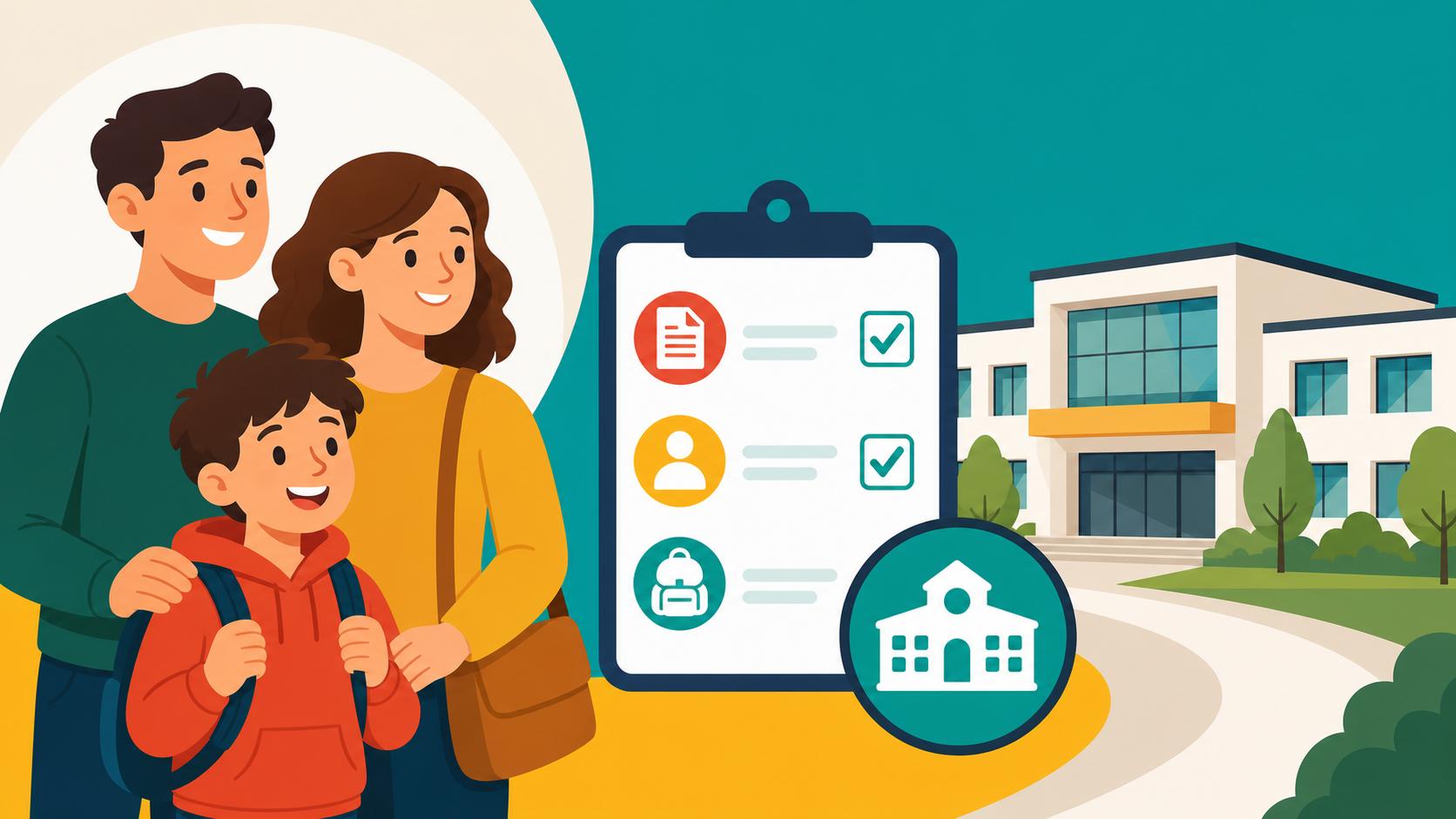
Before approaching the school secretariat or logging into the online application portal, assemble a comprehensive binder containing original copies and printed PDFs of the following documents:
- Identification: Passports or national identity cards for both the child and parents.
- Portuguese Tax Numbers (NIF): Issued tax identification numbers for the student and at least one parent.
- Residence Cards or Visas: Valid Portuguese residence permits (Título de Residência) or proof of an active legal status in Portugal.
- Proof of Address: An official proof of residence document (Atestado de Morada). You can obtain this from your local parish council. Learn how to secure one by reading about Registering Your Address with Junta de Freguesia (Atestado de Morada).
- Social Security Number (NISS): Required to process school social welfare subsidies, though applications can sometimes move forward provisionally if this is still processing.
- Healthcare Identification: The child’s national health system number (Número de Utente) or private health insurance certificate.
Handling School Transcripts and Academic Equivalences
If your child is entering the 1º Ciclo at Year 1 level, prior foreign transcripts are usually not required. However, if your child is entering Year 2 or higher, you must complete an academic equivalency process (Equivalência de Estudos) to prove their completed education level abroad matches the Portuguese curriculum standard.
To process an equivalency, foreign school report cards, transcripts, and completion certificates must be officially translated into Portuguese and certified. Depending on your home country, documents may also require an Apostille stamp under the Hague Convention. Explore more details on certifying foreign paperwork in our detailed guide on Translating and Certifying Documents for Portuguese Immigration.
Once certified, submit these academic records to the central school (Escola Sede) of your chosen Agrupamento. The direction board will evaluate the coursework and issue an equivalency declaration assigning your child to the appropriate school year. You can review the broader context of academic equivalencies in Portugal by reading about the Equivalence of Foreign Diplomas: Getting Your Degree Recognized in Portugal.
Health Records and the Vaccination Book
Portugal takes public health tracking very seriously within its education system. Every child enrolled in a public or private school must present an up-to-date national vaccination booklet (Boletim de Vacinas).
If your child was vaccinated outside Portugal, you must transfer those international records onto an official Portuguese booklet. To do this, take your foreign vaccination records to your local health center (Centro de Saúde). An administrative nurse will cross-reference the immunizations against Portugal’s Plano Nacional de Vacinação (PNV) and issue a registered Portuguese booklet or sign off on an exemption for non-mandatory vaccines. For clear steps on converting international medical documents, consult How to get your child’s Boletim de Vacinas (Vaccination book) translated.
Step-by-Step Guide to the Registration Process
Enrollment can be completed either online through the national portal during the standard annual application window, or in person directly at the school secretariat if you arrive outside the official period.
Navigating the Portal das Matrículas Online
During the official enrollment season, all public school registrations are managed through a centralized government website called the Portal das Matrículas.
- Access the Portal: Log into the official Portal das Matrículas using the Portuguese Digital Mobile Key (Chave Móvel Digital) or your Portal das Finanças login credentials (NIF and password).
- Enter Personal Data: Input personal detail fields for the student and guardians, ensuring that address details match your official tax records exactly.
- Upload Required Attachments: Upload digital copies (PDFs) of passports, proof of address (Atestado de Morada), vaccination clearance, and foreign transcript equivalencies.
- Select School Preferences: Choose up to five preferred schools in order of preference within your target Agrupamento or neighboring catchments.
- Submit and Track: Submit the application and save the receipt declaration (Comprovativo de Matrícula). You can monitor status updates directly on the dashboard as secretariats process allocations.
In-Person Enrollment at the School Secretariat
If you arrive in Portugal midway through the academic year, or if you encounter persistent technical glitches on the government website, you should complete the enrollment in person.
Visit the administrative secretariat at the head office school (Escola Sede) of your local Agrupamento. Ask for the Secretaria or Serviços Administrativos. School secretaries handle manual placements for families who move outside regular enrollment dates. Bring physical copies of all required documents, including printed proof of address and certified transcripts. The secretariat staff will issue paper forms (Ficha de Inscrição) and log your request directly into their system.
When running around a new town visiting municipal buildings, local health centers, and school secretariats, remaining connected on the go makes managing appointments much smoother. Using an instant mobile data package from providers like Airalo allows you to pull up emails, check Google Maps directions, and access translated documents right from your smartphone without searching for public Wi-Fi.
Important Deadlines and Enrollment Timelines
The Ministry of Education publishes strict annual calendars for standard enrollment windows, which generally open in late spring and early summer depending on the grade level:
- Pre-Escolar & 1st Year of 1º Ciclo: Registration typically opens between mid-April and mid-May.
- Years 2 through 7 (Basic Education): Registration usually occurs throughout June and early July.
- Years 8 through 12 (3rd Cycle and Secondary Education): Registration opens in July following the conclusion of national exams and assessment periods.
If you submit your application during these main windows, school placement results are usually published on the portal or posted on physical lists outside the Escola Sede by late July or early August. For mid-term arrivals, placements depend entirely on remaining class capacity within the Agrupamento.
Helping Your Child Transition and Integrate into a Local School
Moving into a foreign language environment requires patience and preparation. Portuguese public schools offer structured support networks to help non-native children integrate smoothly into classroom life.
Portuguese Language Support and PLNM Classes
By law, Portuguese public schools must provide language support for foreign students who do not speak European Portuguese. This program is called Português Língua Não Materna (PLNM).
When a non-Portuguese student registers, the school assesses their language proficiency level (ranging from A1 basic to C1 advanced). Based on this evaluation, the child is assigned targeted language hours. Depending on school resources, students may be pulled out of non-core subjects a few hours a week to attend small-group PLNM sessions, or receive dedicated co-teaching assistance within their standard classroom.
School Meals, After-School Care, and Associated Costs
While tuition in Portuguese public schools is completely free, parents pay small fees for daily meals and extended care services.
- School Lunches: Public schools offer warm, balanced daily lunches consisting of soup, a main course (meat or fish), bread, fruit, and water. Meals are subsidized through the school social welfare system (Ação Social Escolar – ASE). Prices per meal are low, with further discounts applied for lower-income brackets.
- Extended Hours (CAF and AAAF): Standard school days usually run from 9:00 AM to 3:30 PM or 4:00 PM. For working parents who need longer coverage, municipalities and parent-teacher associations organize Componente de Apoio à Família (CAF) for primary students and Atividades de Animação e Apoio à Família (AAAF) for preschool children. These programs provide supervised care before 9:00 AM and after 4:00 PM for a modest monthly fee.
Parents seeking additional advice on managing young family routines in Portugal can consult our guide on Moving to Portugal with Kids: Schools, Childcare, and Family Life to see how local school schedules fit alongside overall family arrangements. If you need coverage before your child reaches school age, read Childcare in Portugal: Creches, Nannies, and Monthly Costs, or consider private support options like Finding English-speaking babysitters and nannies in Lisbon and Cascais.
Preparing School Supplies and Everyday Classroom Life
At the start of the school year, your child’s primary teacher or subject tutors will issue a specific list of required supplies (Lista de Material Escolar). While standard textbooks (manuais escolares) are provided free of charge for compulsory years through government vouchers called Mega, parents must purchase stationary, notebooks, art materials, and physical education uniforms.
Sourcing specific lined exercise books (cadernos pautados) or technical drawing tools locally can involve trips to multiple stationery shops (papelarias). To save time and find competitive prices on specialized items, many expat families order stationery kits, ergonomic backpacks, and lunchware online through Amazon Spain, which provides fast, reliable delivery directly to residential addresses across Portugal.
By gathering your documents early, understanding the priorities of your local Agrupamento Escolar, and embracing local integration programs like PLNM, you can set your child up for a successful educational journey in Portugal.
Disclaimer
This article is for general informational purposes only and does not constitute professional advice. Laws, prices and regulations vary by location and change over time. Consult a qualified professional for guidance on your specific situation.