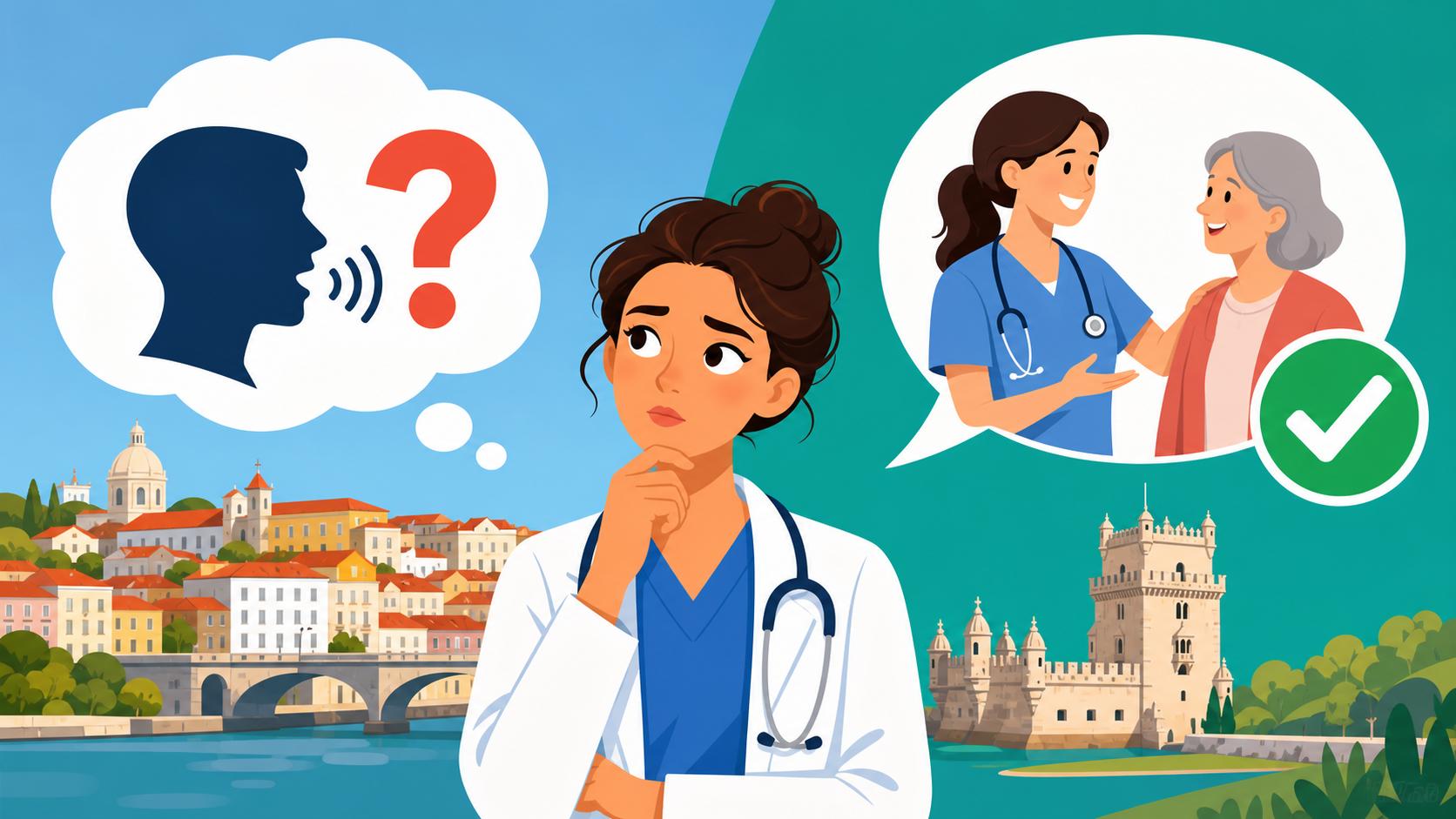
Do I need to be fluent in Portuguese to work as a nurse or doctor?
You trained for years, you hold a nursing or medical licence back home, and Portugal’s hospitals are clearly short-staffed. Then someone at the expat meetup says, “You’ll never practise here without perfect Portuguese.” Is that true? This guide explains what language level the Portuguese system expects from nurses and doctors, how registration works, and which English-friendly roles exist while you learn.
The Short Answer and Why It Matters
You do not need to sound like you were born in Braga. But for any role where you treat patients, you need solid, functional, professional Portuguese. The system is built around patient safety. A nurse who can’t follow a handover at shift change, or a doctor who can’t take a history from an elderly patient in rural Trás-os-Montes, is a risk. Portuguese regulators treat language as part of competence, not as a nice extra.
Many expats go through this, including British nurses and Brazilian-trained GPs. Their journeys were very different. That difference sums up the reality better than any rulebook.
Who Regulates Nurses and Doctors in Portugal
Two professional bodies hold the keys. Doctors must register with the Ordem dos Médicos. Nurses must register with the Ordem dos Enfermeiros. Without active registration, you cannot legally practise clinically, whether in a public SNS hospital or a private group like CUF, Hospital da Luz, or Lusíadas. This applies even in a private clinic that mostly serves English-speaking expats.
Both Ordens can require proof that you communicate well enough in Portuguese to work safely. For applicants whose native language is not Portuguese, that usually means one of two things. Either you sit a language or communication assessment set by the Ordem, or you present a recognised Portuguese language certificate. Requirements and accepted certificates change, so always confirm the current rules directly with the relevant Ordem before you invest time and money.
What Fluent Actually Means in a Clinical Setting
When people say “fluent,” they often picture literary perfection. Clinically, it means something more practical:
- Taking a patient history, including colloquial descriptions of pain and symptoms
- Explaining a diagnosis, a procedure, or medication instructions clearly
- Obtaining informed consent in a way the patient genuinely understands
- Writing clinical notes and reading colleagues’ notes in the electronic record
- Handling phone calls, handovers, and multidisciplinary meetings
- Understanding regional accents, especially from older patients
The level regulators look for is generally upper-intermediate to advanced on the European CEFR scale. Doctors in patient-facing specialities often find they need to function closer to C1 in practice. The official threshold and the level that makes you comfortable on a Tuesday night in Urgências are not always the same thing.
European Versus Brazilian Portuguese
Brazilian-trained professionals start with a huge advantage, but there is an adjustment. European Portuguese swallows its vowels, uses different vocabulary, and has its own medical slang. My Brazilian GP friend told me her first month in a Centro de Saúde in Setúbal felt like learning a cousin’s dialect. She was clinically excellent, but she kept missing what older patients meant. Within a few months she was fine. For English speakers starting from zero, expect a much longer road.
Registration Pathways for Nurses and Doctors
Language is only one piece. Your qualification also has to be recognised, and the route depends heavily on where you trained.
EU-Trained Versus Non-EU-Trained Professionals
If you trained in an EU or EEA country, your nursing or medical qualification may benefit from automatic recognition under European rules. The process is mostly administrative. Even then, the Ordem can check your language skills before you practise.
If you trained outside the EU, for example in the UK after Brexit, the US, India, the Philippines, or South Africa, the process is longer. Doctors usually need formal recognition of their medical degree, which can involve evaluation by a Portuguese medical faculty and knowledge exams. Nurses also go through recognition of their training before applying to the Ordem dos Enfermeiros. For the general mechanics, see Equivalence of Foreign Diplomas: Getting Your Degree Recognized in Portugal and Professional Licensing and Regulated Professions in Portugal.
Step-by-Step: The Typical Route to Clinical Practice
Every case is different, but the general sequence looks like this:
- Gather your documents: diploma, transcripts, detailed curriculum or syllabus, registration certificate from your home regulator, and a certificate of good standing.
- Get documents apostilled and translated into Portuguese by a certified translator. Translating your university diploma (Apostille and Equivalence) for HR covers the practical side.
- Obtain your NIF, the Portuguese tax number, which you will need for almost every administrative step.
- Apply for recognition of your qualification through the competent route, either automatic EU recognition or academic recognition for non-EU degrees.
- Prepare for and pass any required knowledge exams, which are conducted in Portuguese.
- Prove your Portuguese language competence to the Ordem’s standard through their assessment or an accepted certificate.
- Register with the Ordem dos Médicos or Ordem dos Enfermeiros and pay the registration and membership fees.
- Apply for jobs, sort out your residence permit if you are non-EU, and register with Segurança Social.
Notice that Portuguese appears at steps five and six. Knowledge exams for recognition are generally in Portuguese, so your language studies need to start long before you think you need them.
Doctors and Specialist Training
For doctors, recognition of the basic medical degree is not the end. If you want to train as a specialist in Portugal, entry into specialist training goes through a national selection process, and it runs in Portuguese. If you already hold a specialist title from abroad, there is a separate process for recognising specialist qualifications through the Ordem dos Médicos, which can involve assessment by the relevant speciality college.
A hypothetical scenario: Dr. Amara, a cardiologist trained in Nigeria, moves to Lisbon. She speaks English and French but no Portuguese. Realistically, she spends her first year doing intensive language study while compiling her recognition file. She may not see a Portuguese patient until her second or third year. It is slow, but colleagues who have done it say the specialist demand at the end makes it worthwhile.
Nurses and the Shortage Context
Portugal has long struggled to keep nurses, as many Portuguese-trained nurses leave for the UK, Switzerland, and elsewhere. That creates real openings, especially in the interior, in elderly care, and in private hospital groups. See The Portugal Job Market 2027: Skill Shortages and Most In-Demand Roles for the broader picture.
Shortages do not lower the language bar, though. Employers may be more willing to support you with language courses or flexible start dates, but the Ordem’s requirements still apply.
Comparing Roles by How Much Portuguese You Need
This is where expats find real hope. Not every healthcare-related job demands clinical-level Portuguese from day one.
Language Requirements Across Healthcare Roles
| Role | Portuguese Level Typically Needed | Professional Registration Required | Notes |
|---|---|---|---|
| SNS hospital doctor | Advanced, professional | Ordem dos Médicos | Daily work entirely in Portuguese |
| SNS hospital or health centre nurse | Advanced, professional | Ordem dos Enfermeiros | Handovers, notes, and patients all in Portuguese |
| Private hospital doctor or nurse | Advanced, professional | Yes, same Ordem | Some English-speaking patients, but still mostly Portuguese |
| Doctor or nurse at a clinic serving expats | Professional | Yes, same Ordem | English helps, but registration rules still apply |
| Telehealth for foreign patients | Varies, often low for Portugal itself | Depends on where patients and licence sit | Licensing follows patient location rules |
| Clinical research coordinator | Intermediate to advanced | Usually not | Pharma and CROs often work partly in English |
| Pharmaceutical or medical device roles | Basic to intermediate | Usually not | Many multinational teams operate in English |
| Medical tourism coordinator | Basic to intermediate | No | Patient-facing in English, admin in Portuguese |
| Healthcare assistant in elderly care | Intermediate | No, but employer checks apply | Residents are mostly elderly Portuguese speakers |
Private Hospitals and Expat-Heavy Regions
In the Algarve, Cascais, and parts of Lisbon, private hospitals see a lot of English-speaking patients. Hospital Particular do Algarve is a well-known example, and Healthcare in the Algarve: HPA (Hospital Particular) review for expats shows how central English is to its patient experience.
Here is the catch. Even at a hospital with lots of British and Dutch retirees, your colleagues, the electronic records, internal protocols, and most of your patients still operate in Portuguese. Being bilingual is a selling point there, but it is an addition to Portuguese, not a replacement.
English-Friendly Bridge Roles While You Learn
Many professionals take a bridge role while they study the language and work through recognition. Common options include:
- Clinical research at contract research organisations or hospital research units
- Medical affairs, pharmacovigilance, or medical writing for pharmaceutical companies
- Medical tourism coordination, especially for dental and cosmetic procedures
- Health tech startups in Lisbon and Porto that need clinical input
- Telehealth for patients in your home country, provided your home licence and its rules allow it
For telehealth from a Portuguese platform’s perspective, see Telehealth and Online Doctors: Using TravelDoctores and Doctorsa. Broader English-friendly options are covered in English-Speaking Jobs in Portugal: Tech, Tourism, and Customer Service.
A friend of mine, a Canadian ICU nurse, spent eighteen months as a clinical trial coordinator in Porto. She used English for sponsor calls and steadily more Portuguese with site staff. By the time her registration came through, she had absorbed hospital vocabulary naturally. She called it the best language course she never paid for.
How to Reach Clinical-Level Portuguese
Build a Realistic Learning Plan
If you are starting from zero, think in years, not months. A rough path that has worked for people I know:
- Start with structured basics before you move, focusing on European Portuguese specifically.
- Once in Portugal, enrol in an intensive course, ideally at a university language centre in Lisbon, Porto, or Coimbra.
- Add medical vocabulary early: body parts, symptoms, medication, and consent language.
- Practise listening to real patients through Portuguese health podcasts, TV medical dramas, and SNS information videos.
- Sit a recognised certificate exam at the level your Ordem accepts.
For an at-home foundation, PortuguesePod101 is useful because it has a dedicated European Portuguese track rather than defaulting to Brazilian. Many busy professionals use PortuguesePod101 during commutes and night-shift breaks to build listening skills before they ever sit in a classroom. For in-person options, see Language Schools for Adults: Intensive Portuguese Courses for Professionals.
Certificates and Proof
The CAPLE system, run in association with the University of Lisbon, offers internationally recognised Portuguese certificates at different CEFR levels. Higher-level certificates are the ones relevant to clinical registration. Portuguese Language Certificates (CIPLE and CAPLE) explains how they work. Remember that the A2 CIPLE exam is the level linked to permanent residence; it is far below what clinical practice requires.
Practise the Language of the Ward
General Portuguese and clinical Portuguese are different animals. Patients don’t say “I have epigastric pain.” They say “dói-me aqui na boca do estômago.” Older patients from the north may use expressions you won’t find in a textbook.
Practical tips:
- Shadow or volunteer in a Portuguese healthcare setting where permitted, even in non-clinical roles
- Keep a notebook of patient phrases and regional expressions
- Role-play history-taking with a tutor using real case scenarios
- Read Portuguese clinical guidelines and patient leaflets
- Join Portuguese professional groups and conferences
Pair formal study with daily speaking practice. Combine PortuguesePod101 lessons on listening comprehension with a tutor for medical role-play, and you cover both the everyday and clinical sides. How to Improve Your Portuguese for the Workplace has more strategies.
Visas and Timing
If you are non-EU, consider how your residence status fits your timeline. A job offer from a Portuguese healthcare employer may open the door to a skilled-worker route; Highly Qualified Professional Visa (D3): Eligibility and Corporate Sponsorship explains that pathway. Some professionals arrive on another visa, study intensively, complete recognition, and then switch into clinical work. Plan your finances for a period of lower income, because recognition and language study rarely move as fast as you hope.
Final Thoughts From Someone Who Has Seen It Done
So, do you need to be fluent? For clinical practice, yes, in the practical, patient-safety sense. You need strong professional Portuguese, proven to the satisfaction of the Ordem dos Médicos or Ordem dos Enfermeiros. There is no English-only shortcut, even in expat-heavy private hospitals.
But it is absolutely achievable. British nurses, Indian doctors, and American physiotherapists have made it, usually by starting language study early, taking an English-friendly bridge role, and treating recognition as a multi-year project. Start your Portuguese today, even if your move is far off. PortuguesePod101 or a weekly tutor can get you moving, and your future patients will thank you for every hour you put in.
Disclaimer
This article is for general informational purposes only and does not constitute professional advice. Laws, prices and regulations vary by location and change over time. Consult a qualified professional for guidance on your specific situation.