Can a freelancer in Portugal opt out of Social Security if they have private insurance?
Disclosure: This article contains affiliate links. If you buy through them, we may earn a commission at no extra cost to you. Read our full disclosure.
One of the biggest shocks for new freelancers in Portugal is realizing that your "take-home" pay is significantly lower than your gross invoices once the state takes its cut. I remember sitting in a breezy Lisbon cafe during my first year, staring at a spreadsheet and wondering why my private health insurance didn't count for anything in the eyes of the taxman. This guide explains exactly why you cannot swap the state system for a private one and how to manage the mandatory contributions of the Portuguese Social Security system.
The Mandatory Reality of Segurança Social for Freelancers
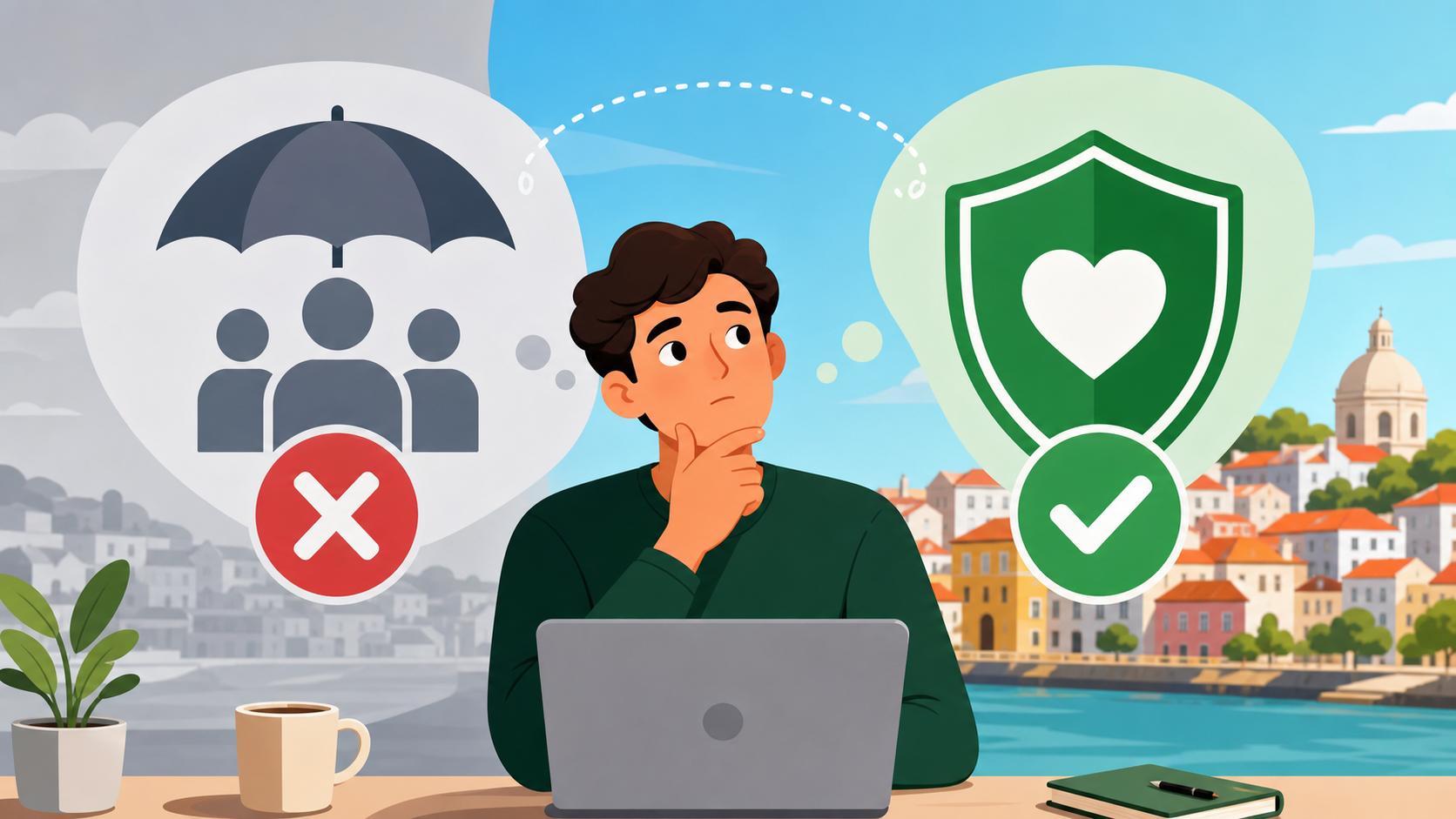
If you are moving to Portugal to work as a digital nomad or an independent contractor, you will likely be operating under the "Recibos Verdes" (Green Receipts) system. The question of whether you can opt out of the public Social Security system (Segurança Social) if you already have a high-end private medical plan is one of the most common queries in expat circles. Unfortunately, the answer is a firm no. In Portugal, Social Security is not a health insurance plan; it is a holistic social protection system that is legally mandatory for all residents earning an income, regardless of any private policies they may hold.
The Portuguese government views Social Security as a collective safety net that covers much more than just a visit to the doctor. It funds the state pension system, unemployment benefits, maternity and paternity leave, and long-term disability support. Because it is a "solidarity-based" system, the law requires every worker to contribute to the pot. Many expats try to argue this point at the local office, only to be met with a polite but firm "não." Even if you never intend to draw a Portuguese pension or use a public hospital, your contributions are the entry price for living and working in this beautiful country.
To get started with this process properly, you will first need to focus on Getting your NISS online: Step-by-step guide for new foreign workers. This number is your gateway to the system, and without it, you cannot legally issue invoices or begin your professional activity. While the bureaucracy can feel like a mountain, understanding that this is a non-negotiable tax will save you a lot of headache during your first year.
Real Exemptions: When You Actually Don't Have to Pay
While you can't "opt out" just because you have a private insurance policy, there are several legitimate scenarios where you are exempt from making monthly payments. The most famous one is the "honeymoon period" for new freelancers. When you first open your activity (Início de Atividade) with the Tax Authority (Finanças), you are automatically exempt from Social Security contributions for the first 12 months. This is a massive relief for those just starting out, as it allows you to build your client base without the heavy burden of monthly state fees.
Another common exemption applies to those who are "doubling up." If you already have a full-time employment contract with a company in Portugal and you are paying Social Security through that salary, you generally do not have to pay additional Social Security on your freelance earnings, provided your freelance income doesn't exceed a certain threshold (usually 12 times the Social Support Index). This is a great way for expats to transition from a corporate job into full-time freelancing.
If you find yourself in a position where you are paying both systems or simply need a better way to manage your cash flow during these transition periods, using a versatile tool like Wise can be incredibly helpful for keeping your business and personal expenses separate while dealing with different currencies. During your first year, you should also be looking into Registering with the Centro de Saúde: Getting Your SNS Número de Utente to ensure you are fully integrated into the public health side of the system, even while you enjoy your 12-month Social Security exemption.
How the Quarterly Declaration Works
Once your initial 12-month exemption ends, you enter the "Quarterly Declaration" (Declaração Trimestral) cycle. This is where many freelancers get tripped up. Unlike a standard salary where taxes are deducted automatically, a freelancer must report their income every three months via the Segurança Social Direta portal. These declarations happen in January, April, July, and October.
The calculation is based on the income you earned in the previous three months. The state typically takes 70% of your total gross earnings as the "calculation base" and then applies a 21.4% tax rate to that amount. It sounds complicated, but the portal usually does the math for you. For example, if you invoiced €10,000 in a quarter, your "relevant income" is €7,000, and your monthly Social Security payment for the next quarter would be roughly €499.
Managing these large, lump-sum payments requires discipline. I personally recommend setting aside at least 25-30% of every invoice into a separate savings bucket. For those looking to grow that "tax pot" while it sits waiting for the quarterly deadline, platforms like Trade Republic offer attractive interest rates on uninvested cash, which can take the sting out of the eventual payment. It is also a good idea to cross-reference your reporting with your Filing the Annual IRS Tax Return (Modelo 3): Deadlines and Process to ensure your reported income matches across both the Tax Authority and Social Security.
| Feature | Public Social Security (SNS/Segurança Social) | Private Health Insurance |
|---|---|---|
| Requirement | Mandatory for all workers | Optional (but recommended) |
| Cost | 21.4% of relevant income | Fixed monthly premium |
| Pension | Contributes to state retirement | No retirement benefit |
| Sick Leave | Includes "Baixa" (paid sick leave) | No income replacement |
| Hospital Access | Public hospitals only | Private clinics and hospitals |
| Maternity | Paid parental leave included | Only if specific rider is added |
Social Security Benefits vs. Private Insurance Perks
It is easy to view Social Security as just another tax, but it does offer "benefits" that private insurance typically excludes. The most significant for freelancers is the Subsídio de Doença (paid sick leave). If you fall ill and cannot work for an extended period, the state will pay you a percentage of your reference income, provided you have a doctor’s note (Baixa) from the public system. Private health insurance in Portugal almost never covers "loss of income"—it only covers the medical bills.
Furthermore, if you are planning on Having a baby in Portugal: Costs, citizenship rules, and registering the birth, the Social Security system is what pays for your maternity or paternity leave. Private insurance might cover the cost of a private hospital room at a facility like CUF or Hospital da Luz, but it won't put money in your bank account while you are taking time off to bond with your newborn.
However, the public system has its flaws, such as long waiting lists for non-urgent surgeries. This is why most expats choose a hybrid approach: they pay the mandatory Social Security to stay legal and secure their future rights, while also maintaining a private policy for faster access to specialists. If you are a high-earner or a crypto enthusiast living in Portugal, you might be using Binance to manage your digital assets, but remember that even crypto-derived income must be declared if it is part of your professional activity, which in turn affects your Social Security contributions.
Managing the Financial Burden
The combined weight of IRS (Income Tax) and Social Security can feel overwhelming, often exceeding 40% of your total income once you reach certain brackets. To survive as a freelancer here, you need to be proactive about your finances. This means not just paying what is owed, but also finding ways to reduce your taxable base. While you can't opt out of Social Security, you can ensure you are not overpaying by accurately reporting your expenses on the e-Fatura guide: Why cashiers ask for your NIF at the supermarket.
It is also worth noting that if your income is very low (less than roughly €660 per month), you may be eligible for a reduced Social Security contribution. Conversely, if you are earning a very high income, there is a "ceiling" on the calculation base, which prevents your monthly payments from becoming astronomical. Navigating these nuances is much easier if you have a professional on your side. I always tell new arrivals that Finding a reliable English-speaking Contabilista for your complex IRS return is the best investment you can make in your first 90 days.
If you ever feel that the system has treated you unfairly—perhaps a payment wasn't recorded correctly or an exemption was ignored—you have rights. Every public office in Portugal is required to have a "Livro de Reclamações" (Complaint Book). While it should be a last resort, knowing Understanding the 'Livro Amarelo' (Yellow Book) for Medical Complaints and its equivalents in the tax and social security offices can give you leverage when bureaucracy becomes a brick wall.
Common Pitfalls for Foreign Freelancers
One of the most frequent mistakes I see is expats assuming that because they pay social security in their home country (like the UK or the US), they are exempt in Portugal. While there are bilateral "Totalization Agreements" that prevent you from paying into two systems for the same income, these usually only apply to "posted workers" sent by a foreign company for a limited time. If you are a resident freelancer in Portugal, the Portuguese system takes precedence.
Another pitfall is the failure to close the "Activity" properly when leaving the country. If you stop working but don't officially close your activity with Finanças and Segurança Social, the system will assume you are still earning and will eventually send you a bill for "estimated" contributions, plus interest and fines. Before you catch your flight out, make sure you follow the steps for Leaving Portugal: Closing Bank Accounts and Settling Final Tax Bills to ensure your exit is as smooth as your arrival.
Lastly, don't ignore the notifications in your Segurança Social Direta inbox. They are rarely good news, but ignoring them only makes the penalties worse. If you are struggling with the language, use a browser translation tool or ask a local friend for help. Portugal is a wonderful place to live, but it demands a high level of administrative diligence. Once you accept that Social Security is a mandatory part of the journey—just like the slow afternoon coffees and the beautiful cobblestone streets—the financial planning becomes much easier to handle.
Disclaimer on Legal and Financial Advice
This guide is for informational purposes only and is based on personal experience and current regulations. Tax laws and Social Security rules in Portugal are subject to frequent changes. Always consult with a certified Portuguese accountant (Contabilista Certificado) or a legal professional before making decisions regarding your tax residency or social security contributions. Use the official "Livro de Reclamações" or the "Portal da Queixa" if you encounter systemic issues with government entities.