Becoming a Tax Resident in Portugal: The 183-Day Rule Explained
Disclosure: This article contains affiliate links. If you buy through them, we may earn a commission at no extra cost to you. Read our full disclosure.
One of the most stressful realizations for any newcomer is that your "extended holiday" in the sun has suddenly morphed into a permanent tax obligation. I remember sitting in a cafe in Chiado, staring at my calendar and realizing I’d crossed that invisible line without even noticing. This guide breaks down exactly how the 183-day rule works, how it triggers residency, and what you need to do to stay on the right side of the law.
Understanding the 183-Day Rule in Portugal
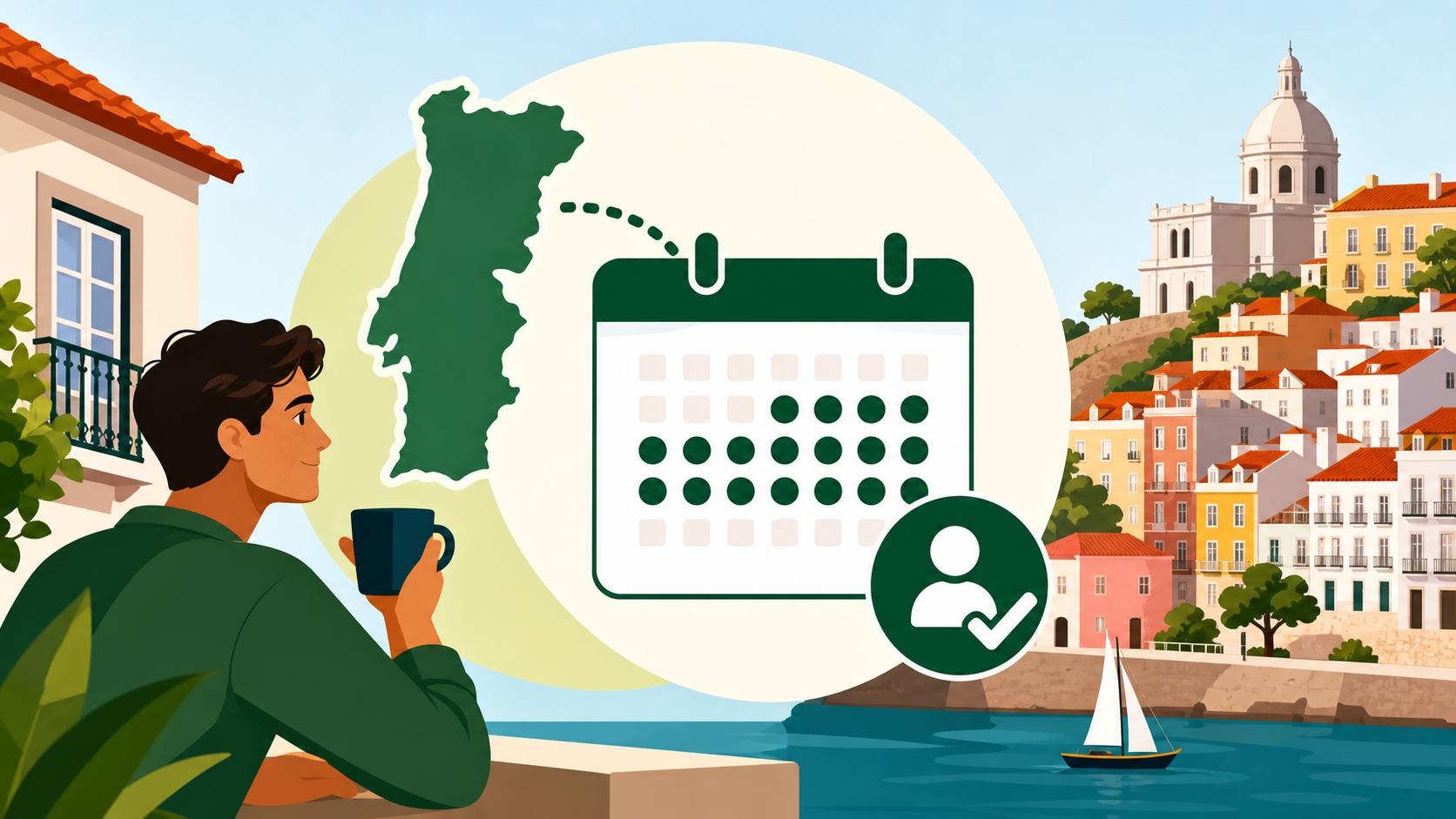
The "183-day rule" is the primary threshold used by the Autoridade Tributária e Aduaneira (the Portuguese tax authority, often called Finanças) to determine if you are a tax resident. In the simplest terms, if you spend more than half a year on Portuguese soil within a single calendar year, you are legally considered a resident for tax purposes. This isn't just a suggestion; it is a statutory trigger that changes how your income is treated and where your primary financial loyalty lies.
The Literal Definition of the 183-Day Count
When counting your days, you must be meticulous. In Portugal, a "day" is defined as any period that includes an overnight stay. However, the tax authorities can also be quite granular; even partial days can sometimes be aggregated if they form a pattern of presence. Most expats find it helpful to keep a simple spreadsheet or use a travel tracking app to log every entry and exit. People can get caught out because they forgot to account for a "quick" weekend trip back home that actually spanned three calendar days.
It is important to realize that 183 days is just the tipping point. The moment you hit day 184, you are retroactively considered a resident from the first day you entered the country during that tax year. This means your Portuguese Taxes for Expats: IRS, Tax Residency, and Filing Deadlines clock starts ticking immediately. You cannot simply wait until the end of the year to figure it out; you need to be proactive about your status the moment you realize you are likely to stay.
Does the Year Have to Be Consecutive
A common misconception among digital nomads and "slow travelers" is that the 183 days must be consecutive. This is absolutely not the case. The Portuguese tax year runs from January 1st to December 31st. Any days you spend in the country, whether it’s a two-month stint in the Algarve followed by a month in Porto later in the year, are added together. If the total sum exceeds 183 days within that January-to-December window, you have met the residency criteria.
This cumulative counting can be particularly tricky for those who move to Portugal mid-year. If you arrive in August, you won't hit 183 days by December 31st, but you might still be considered a resident under different criteria, such as having a "habitual residence." However, for the purely day-count-based trigger, the cumulative total is the only number that matters. If you are balancing life between two countries, you must be extremely careful with your travel dates to avoid accidental residency.
The Concept of the Habitual Residence
Even if you spend fewer than 183 days in Portugal, you can still be deemed a tax resident if you have a place of abode that suggests you intend to keep it as your habitual residence. Finanças looks for "permanence." If you have a long-term lease or you have purchased a home and it is available for your use on December 31st, the authorities may argue that your "center of vital interests" has shifted to Portugal.
Many expats have thought they were "safe" because they only spent 150 days in the country, only to be surprised by a tax bill because they had signed a 12-month rental contract. The intention to stay is often judged by the infrastructure you build around yourself. This is why Renting an Apartment in Portugal: Contracts, Fees, and Tenant Rights is a major step that often signals to the government that you are no longer just a tourist.
The Criteria Beyond Just the Days
While the 183-day rule is the most famous metric, it is not the only one. Portugal uses a multi-faceted approach to determine where you "belong" financially. This is meant to prevent people from spending 180 days in Portugal and 185 days elsewhere just to avoid local taxes while still enjoying the benefits of living in the country. If you live here, the government generally expects you to contribute to the system.
Owning or Renting a Home
As mentioned, having a home at your disposal is a massive red flag for residency. It doesn't matter if it's a luxury villa in Quinta do Lago or a tiny T0 in Braga. If the property is considered your "permanent home," you are a resident. Finanças defines this as a place where you maintain the "habitual intention" of living. This is often the primary reason why people applying for the D7 Passive Income Visa Portugal: 2026 Requirements and Step-by-Step Process are automatically funneled into the tax residency system; the visa itself requires proof of long-term accommodation.
If you are trying to remain a non-resident, you must be careful about how your housing is structured. Staying in short-term Airbnbs or hotels is usually viewed as temporary. However, the moment you register a rental contract with Finanças (which landlords are legally required to do), your name enters the system associated with a Portuguese address. This registration is a strong piece of evidence that the government will use to claim you have moved your life here permanently.
Economic Ties and Center of Vital Interests
The "center of vital interests" is a bit of a legal gray area, but it essentially refers to where your life is most concentrated. This includes where your spouse and children live, where you do your banking, and where your professional life is based. If your children are enrolled in a local school and your spouse is working in Lisbon, you will find it nearly impossible to argue that you are not a tax resident, even if you personally travel for work and spend fewer than 183 days in the country.
Your financial habits also play a role. While using international tools like Wise to manage your daily spending is common and efficient, the government looks at where your primary income is earned and where your assets are held. If you are consistently moving large sums into a local bank account to fund your lifestyle, it suggests a permanent economic tie. For a broader look at how these ties affect your bottom line, see our guide on Money and Finance in Portugal: The Ultimate 2026 Guide for Expats.
Why Your NIF Address Matters More Than You Think
Your NIF (Número de Identificação Fiscal) is your tax identity in Portugal. When you first get a NIF as a non-resident, your fiscal address is usually set to your home country. One of the biggest mistakes expats make is forgetting to update this address—or updating it too early. The moment you change your NIF address to a Portuguese one, you are effectively telling Finanças that you are now a resident.
Many people find themselves in a "tax limbo" because they’ve moved into an apartment but haven't updated their NIF address. While this might seem like a way to delay residency, it can lead to massive fines and complications when you eventually try to file your Filing the Annual IRS Tax Return (Modelo 3): Deadlines and Process. Conversely, if you update it the day you arrive, you might be triggering residency status for the entire calendar year, even if you only intended to be a resident for the second half. This is why Changing your NIF address from a foreign country to your Portuguese address is a step that requires precise timing.
Tax Obligations as a Portuguese Resident
Once you cross that 183-day threshold, your relationship with your money changes. You are no longer just paying the occasional VAT at the supermarket; you are now part of the global Portuguese tax net. This shift can be a shock, especially for those coming from countries with territorial tax systems or lower income tax brackets.
Worldwide Income Taxation vs Territorial Taxation
The most significant change is that Portugal taxes residents on their worldwide income. This means if you have a rental property in London, dividends from a US stock portfolio, or a remote job for a German company, all of that income must be declared in Portugal. You may still owe taxes in those other countries, but Portugal will calculate your total tax bill based on your global earnings and then apply credits for taxes paid elsewhere under double taxation treaties.
Managing these transfers and different currencies can be a headache. I personally use Wise for my monthly transfers because it offers the mid-market rate, which is essential when you're trying to figure out exactly how much your foreign income is worth in Euros for tax purposes. If you are investing the surplus of your foreign income, platforms like Trade Republic are popular among expats for managing stocks and ETFs while living in Europe, as they provide clear reporting that can help when it comes time to file.
Filing the Annual IRS Tax Return Modelo 3
Every tax resident in Portugal must file an annual income tax return, known as the Modelo 3. This is done between April and June for the previous calendar year. Even if all your income was taxed at the source in another country, you still have a reporting obligation. Failing to file can lead to significant penalties, and it can jeopardize your future residence permit renewals.
The Portuguese tax system is surprisingly digital, but the portal (Portal das Finanças) is entirely in Portuguese and can be incredibly daunting. Most expats quickly learn that Finding an English-Speaking Certified Accountant (Contabilista Certificado) is not a luxury—it’s a necessity. An accountant will ensure that you are correctly declaring your foreign income and taking advantage of any Deducting Expenses on IRS: e-Fatura, Supermarkets, Rent, and Healthcare that can lower your final bill.
Social Security Contributions for Residents
Residency often triggers social security obligations, especially if you are working. If you are employed by a Portuguese company, this is handled automatically. However, if you are a freelancer or a digital nomad, you may need to register as a "Trabalhador Independente" and pay monthly contributions. This is often a surprise for those on the Portugal D8 Digital Nomad Visa: How to Work Remotely and Live Legally who didn't realize that residency and the right to work come with the responsibility to contribute to the social safety net.
These contributions provide you with access to the public healthcare system (SNS) and count toward your future pension. While it can feel like a heavy monthly burden, it is the price of admission for long-term life in Portugal. Balancing these costs is a major part of your financial planning during your first year.
Comparative Overview: Resident vs. Non-Resident Tax Status
| Feature | Non-Resident Status | Resident Status (183+ Days) |
|---|---|---|
| Tax Basis | Only income earned in Portugal | Worldwide income (global earnings) |
| Standard Tax Rate | Usually a flat 25% on PT income | Progressive rates up to 48% |
| NIF Address | Foreign address | Portuguese address |
| IRS Filing | Only if PT income was earned | Mandatory annual filing (Modelo 3) |
| e-Fatura Benefits | Not applicable | Deductions for health, rent, etc. |
| Social Security | Generally none | Required if working locally/freelancing |
Strategic Financial Tools for New Residents
Transitioning to Portuguese residency requires a new set of tools. You can't just rely on your hometown bank account anymore; the fees and exchange rate markups will eat you alive over time. You need a setup that understands your multi-country life.
Managing Foreign Income with Digital Solutions
When you become a resident, you’ll likely still have financial "tails" in your home country. Whether it’s a pension, rental income, or a remote salary, you need a way to bring that money into Portugal without losing 3-5% on every transaction. Digital banks and transfer services have revolutionized this. I've found that having a dedicated EUR account that can receive international wires is vital.
Wise is the gold standard here because of its transparency, but it's also worth looking into local digital-first options like ActivoBank. They allow you to maintain the low-cost structure of a digital bank while still having a physical branch you can walk into when the "Portuguese bureaucracy" inevitably hits.
Investing and Wealth Management for Expats
As a resident, your investment strategy needs to be tax-efficient within the Portuguese framework. Many expats find that their old investment accounts back home are no longer the best fit because of how Portugal taxes capital gains. Using a European broker like Trade Republic can be helpful because they are designed for the EU market and often provide tax statements that align more closely with European requirements.
You’ll need to decide whether to keep your assets abroad or move them to Portugal. Generally, Portugal taxes capital gains at a flat rate of 28%, though there are ways to reduce this if you hold assets for many years. Discussing these options with a professional is key to ensuring you aren't overpaying simply because you didn't know the local rules.
Dealing with Cryptocurrency and New Assets
Portugal was once a "crypto heaven," but the rules changed in 2023. Now, if you are a tax resident and you hold crypto for less than a year, you are subject to a 28% tax on gains. If you hold for more than a year, it is currently tax-free, though this is always subject to change. For those who are heavy into digital assets, using an exchange like Binance is common, but you must ensure you are tracking your "buy" dates meticulously.
The reporting requirements for crypto are becoming more stringent every year. You must declare these holdings in your annual return if you've made sales. Understanding the Cryptocurrency Tax Laws in Portugal 2026: 28% Rule vs 1-Year Exemption is vital before you cash out any significant gains while living in Lisbon or Porto.
Avoiding Common Pitfalls and Double Taxation
The fear of being taxed twice on the same dollar is real, but thankfully, Portugal has an extensive network of treaties to prevent this. However, these treaties don't apply themselves automatically; you have to do the paperwork.
The Importance of Double Taxation Agreements (DTA)
Portugal has signed Double Taxation Agreements with dozens of countries, including the US, UK, Canada, and most of Europe. These agreements dictate which country has the "primary" right to tax specific types of income. For example, Double Taxation Agreements (DTA): How Portugal Taxes Foreign Rental Income usually specifies that the country where the property is located gets to tax the income first, and Portugal then provides a credit for that tax.
To benefit from these, you often need to provide a "Certificate of Tax Residence" from Portugal to your home country's tax authority. This proves you are paying taxes in Portugal and allows you to stop (or reduce) the tax withholding in your home country. Without this piece of paper, you might find yourself paying 20% in one country and 28% in the other, then waiting years for a refund.
Coordinating Your Move with NHR 2.0 (IFICI)
The old Non-Habitual Resident (NHR) program was the holy grail for expats, but it has been replaced by the IFICI (often called NHR 2.0). This new regime is more restrictive and focuses on "high value" professions. If you qualify, you could benefit from a flat 20% tax rate on professional income for ten years.
Timing is everything here. You generally need to apply for this status shortly after becoming a tax resident. If you miss the window because you were too busy enjoying the beaches of Ericeira, you could lose out on tens of thousands of Euros in savings. Always check the current NHR 2.0 (IFICI) Tax Regime: Eligibility, Flat 20% Tax, and Rules in 2026 criteria before you officially change your address at Finanças.
Proving You Are No Longer a Resident of Your Home Country
Becoming a resident of Portugal is only half the battle; the other half is "divorcing" your home country's tax system. Some countries, like the US, tax based on citizenship regardless of where you live. Others, like the UK or Australia, tax based on residency but have very strict tests to prove you’ve actually left.
You should keep a "trail of breadcrumbs" to prove your life has moved: a Portuguese lease, utility bills in your name, a local gym membership, and your Portuguese tax returns. If your home country's tax office audits you, these documents are your shield. They prove that you have met the 183-day rule and are legitimately a resident of Portugal.
Practical Steps for Your First 183 Days
If you are currently in the middle of your first year in Portugal, there are three things you should do right now to prepare for your eventual residency status.
Changing Your Fiscal Address at Finanças
Once you have a long-term rental contract or have bought a house, you need to update your address on the Portal das Finanças. If you are a non-EU citizen, you might still need a fiscal representative to do this for you initially, although the rules have been simplified recently. This change is the "official" start of your residency in the eyes of the tax man.
Don't wait until tax season to do this. The portal can be slow, and getting your login credentials (the "senha") can take weeks as they are sent via physical mail to your registered address. Being proactive ensures you have access to the system when you need to validate your invoices for e-Fatura.
Getting Your Documentation in Order
Start a folder (digital or physical) for every major financial document. This includes your employment contract, proof of any foreign taxes paid, bank statements from Wise or other digital banks, and any records of property sales.
In Portugal, the "burden of proof" is often on the taxpayer. If Finanças questions a deduction or a foreign income stream, having the original document ready to go will save you months of back-and-forth bureaucracy. I’ve found that being organized is the best way to reduce the "expat anxiety" that comes with living in a foreign system.
Seeking Professional Help
I cannot stress this enough: do not DIY your first Portuguese tax return if you have foreign income. The cost of a good accountant is usually a fraction of the money they will save you in avoided fines or missed deductions. Look for someone who specializes in "tax residency for foreigners."
Ask them specifically about how your specific home-country assets will be treated. Every country's treaty with Portugal is slightly different. A specialist will know the nuances of the US-Portugal treaty versus the UK-Portugal treaty, which can make a massive difference in your final tax liability.
Disclaimer
This guide is for informational purposes only and does not constitute professional tax, legal, or financial advice. Tax laws in Portugal are subject to frequent changes, and individual circumstances can significantly impact your tax liability. Always consult with a certified Portuguese accountant (Contabilista Certificado) or a qualified tax lawyer before making any decisions regarding your residency or tax status.