The 2-hour lunch break: Navigating traditional Portuguese office schedules
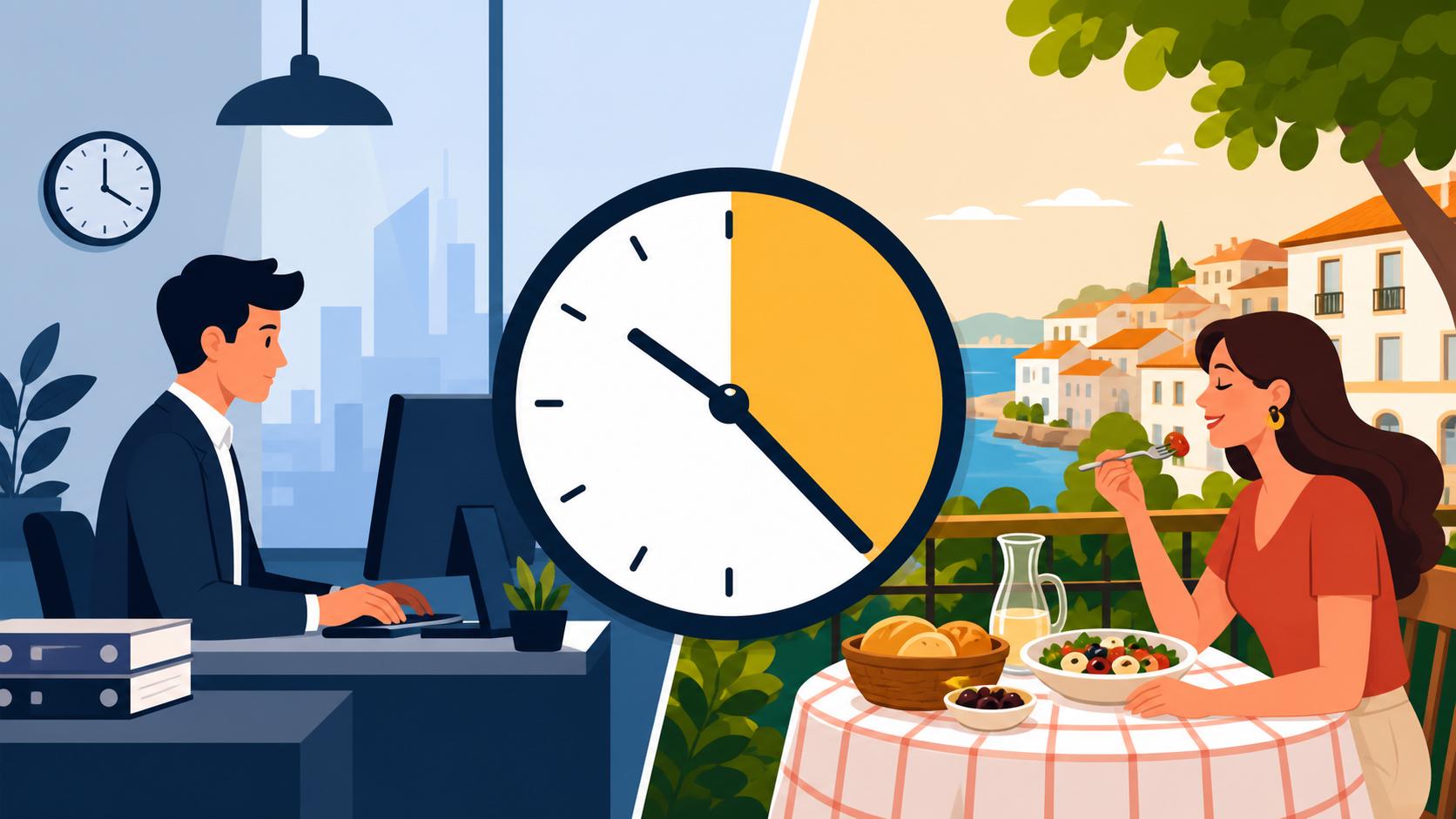
Coming from the fast-paced "grab a sandwich at your desk" culture of London or New York, the sudden silence that falls over a Portuguese office at 1:00 PM can feel like a personal affront to your productivity. I remember my first week in Lisbon, sitting alone in a fluorescent-lit room while my entire department vanished for ninety minutes, leaving me wondering if I’d missed an evacuation siren. This guide breaks down the sacred 2-hour lunch, how it dictates your evening finish time, and the professional etiquette required to survive the midday void without losing your mind.
The Cultural Philosophy of the Long Lunch
In Portugal, lunch—or o almoço—is not merely a pause in the workday to refuel; it is a foundational pillar of social and professional life. While many northern European cultures view a long lunch as a sign of inefficiency, the Portuguese see it as a necessary investment in human capital. If you are struggling to understand why your manager won't approve a 1:30 PM Zoom call, you have to look at the history of the "prato do dia" (plate of the day). This is a sit-down affair, often involving soup, a main course, coffee, and sometimes a glass of wine, all designed to foster the relationships that make Portuguese Work Culture: Hours, Communication, and Office Etiquette function smoothly.
Why It Is a Social Ritual Rather Than a Break
When your colleagues invite you to lunch, they aren't just asking if you're hungry. They are inviting you into the "inner circle." In many ways, the real decisions in a Portuguese company aren't made in the boardroom; they are made over a plate of bacalhau or frango assado. This is where gossip is exchanged, hierarchy is subtly navigated, and "favors" are negotiated. I spent months trying to be the "productive expat" by eating at my desk, only to realize I was being left out of the loop on major project shifts.
To really thrive in this environment, you need more than just a good CV. You need the language skills to keep up with the table talk. Using a tool like PortuguesePod101 can help you master the specific "office banter" and food-related vocabulary that dominates these sessions. Being able to comment on the quality of the olive oil or the freshness of the fish in Portuguese builds more rapport than a dozen polished PowerPoint presentations ever could.
The Trade-off: Why Everything Ends So Late
The most difficult adjustment for many foreigners is realizing that the 2-hour lunch isn't "free time." It is time shifted from the middle of the day to the end of it. If you take a ninety-minute or two-hour break, your 5:00 PM finish becomes a 7:00 PM finish. This is why you will often see offices bustling with activity long after the sun has set. This delay is a core component of Portugal work culture: Is it acceptable to leave the office right at 6 PM? and the answer is frequently a resounding no.
In traditional sectors, leaving "on time" (by international standards) can be seen as a lack of commitment. Because the day starts a bit later and the lunch is so expansive, the "productive" hours often don't truly begin until 3:30 PM. This creates a rhythmic "second wind" in the late afternoon that can be exhausting for those used to an early start.
Typical Daily Timeline: From Breakfast to the Late Commute
Navigating a Portuguese office requires understanding a timeline that feels shifted by about two hours compared to the Anglo-Saxon world. Most offices "open" at 9:00 AM, but the actual work rarely starts until 9:30 AM after the first coffee run. Understanding these micro-shifts is essential for Working in Portugal as an Expat: Job Market, Culture, and Hiring in 2027.
The Morning Start and the Mandatory Coffee Break
Do not expect anyone to answer an email at 9:01 AM. Usually, the first hour is dedicated to the café. Colleagues will gather at the nearest pasteleria for a bica (espresso) and a quick pastry. This is a mini-version of the lunch ritual. If you are trying to reach someone urgently, this is the time to use the phone. As noted in our guide on Dealing with slow email responses: Why calling is better in Portuguese business, a quick call during the morning coffee gap is often more effective than a formal email.
Navigating the 1 PM to 3 PM Midday Void
Between 1:00 PM and 3:00 PM, the country effectively shuts down. This is the "Golden Hour" of the Portuguese kitchen. Most restaurants stop serving the prato do dia by 2:30 PM, so the rush is concentrated and intense. If you have administrative tasks to do, such as visiting the bank or a government office, be aware that these institutions often have their own internal lunch rotations that can make service incredibly slow during this window.
| Time Slot | Activity | Expat Survival Strategy |
|---|---|---|
| 09:00 – 10:00 | Arrival & Coffee | Do not schedule meetings; use for deep work. |
| 10:00 – 13:00 | Core Work Hours | Peak productivity and internal collaboration. |
| 13:00 – 15:00 | The Long Lunch | Join the team or use for personal errands. |
| 15:00 – 17:00 | The Re-engagement | Low energy; focus on emails and administrative tasks. |
| 17:00 – 19:30 | The Second Wind | High-intensity work and major decision-making. |
| 19:30+ | The Exit | Socializing or finally heading home for dinner. |
The Sixth Hour Rush and Evening Etiquette
As 5:00 PM approaches, you might expect people to start packing up. Instead, this is often when the most intense work begins. Managers who have been in meetings or at long lunches finally return to their desks and start delegating. This "evening rush" is a specific quirk of Corporate Culture in Portugal: Hierarchy, Dress Code, and Meetings. If you are working for a traditional boss, this is the time when they will likely walk over to your desk to discuss a "quick" matter that takes an hour.
Practical Survival Tips for Modern Expats and Remote Workers
If you are working remotely for a company in the US or UK while living in Portugal, the local schedule can actually work to your advantage. However, if you are employed by a local firm, you need a strategy to balance your personal life with the late-night culture.
Managing Meetings with International Colleagues
The biggest clash occurs when a UK team (on the same time zone) wants a 1:00 PM "lunch and learn" or a US team wants a 6:00 PM (Portugal time) "kick-off." Transparency is key. You must explicitly state your "availability blocks." However, in a local Portuguese firm, you may find that Boss-employee dynamics in Portugal: Navigating hierarchy and titles (Doutor/Engenheiro) mean that if a superior wants a meeting at 6:30 PM, you are expected to be there, regardless of your personal plans.
Utilizing the Lunch Break for Bureaucracy
While the office is empty, you can actually get a lot done if you play your cards right. Many supermarkets and shopping malls remain fully staffed during the lunch hours. If you are not joining the team for almoço, this is the best time to handle your grocery shopping or visit the pharmacy. However, avoid the "Finanças" (Tax Office) or the "Loja do Cidadão" during this time unless you have an appointment, as staffing is usually at a skeleton level, leading to massive wait times.
Setting Boundaries Without Offending the Team
You can decline the 2-hour lunch, but you must do it carefully. If you say, "I'm too busy to eat," it can be interpreted as a criticism of your colleagues' work ethic. Instead, try saying, "I have a personal commitment today, but I'd love to join next Tuesday." To make these interactions smoother, having a basic grasp of the language is non-negotiable. I recommend using PortuguesePod101 to learn polite "refusal" phrases that don't burn professional bridges.
How the Schedule Impacts Different Industries in Portugal
Not every office in Portugal adheres to the 1980s-style two-hour wine lunch. The landscape is shifting, especially in the larger cities like Lisbon and Porto.
Tech and Startups vs. Traditional Civil Service
In the tech hubs of the Parque das Nações or the startup incubators in Porto, the culture is much closer to the "Silicon Valley" model. You might see people eating salads at their desks or taking a quick 30-minute break to play padel. However, even in these modern environments, the 7:00 PM finish remains remarkably common. The salary structures, which often include the Minimum Wage (€920) vs Average Salary: What to Expect in Portugal, are built around the assumption of these long days.
Retail and Banking Hours
Retail is where the schedule becomes truly confusing for newcomers. In smaller towns, shops will close strictly from 1:00 PM to 3:00 PM. If you show up at 1:05 PM, the shutters will be down, and no amount of knocking will help. Banks also have very specific hours, often closing to the public by 3:00 PM or 3:30 PM, which makes it nearly impossible to visit them if you are also working a standard 9-to-6 job. This is where the 14-month salary system—explained in The 14-Month Salary System: Christmas and Holiday Bonuses Explained—comes into play, as many people use their lunch breaks to manage the complex finances associated with Portuguese employment.
Adapting Your Life to the Portuguese Rhythm
Ultimately, you have two choices: fight the rhythm or join it. For the first year, I fought it. I tried to stay on a "9 to 5" schedule, and I ended up lonely and stressed. Once I started embracing the long lunch, I found that my stress levels dropped significantly.
Embracing the Almoço for Mental Health
There is something profoundly healthy about stepping away from a screen for 90 minutes. In Portugal, you are expected to enjoy your food. This mental "reset" allows for higher productivity in the late afternoon. If you’re worried about the language barrier making these lunches awkward, remember that most Portuguese people are incredibly patient with expats. A few months of consistent study with PortuguesePod101 will give you enough of a baseline to understand the jokes and contribute to the conversation.
Preparing for the "August Shutdown"
The long lunch is a daily microcosm of the "August Shutdown." Just as the office disappears at 1:00 PM, the entire country disappears in August. If you have a deadline in the first week of September, you need to have everything signed off by July 15th. Understanding the daily schedule prepares you for the seasonal schedule of the country. This is the reality of living in a place that prioritizes life over the "grind."
The Importance of the "Imperial" After Work
Even after the late finish at 7:00 PM or 7:30 PM, the day isn't over. Often, the team will head out for a quick "Imperial" (a small draft beer). This is the final stage of the Portuguese office schedule. It is a 20-minute decompress before the commute home. If you want to be seen as part of the team, skipping the lunch but showing up for the after-work beer is a viable compromise.
Disclaimer
This guide is based on cultural norms and personal experiences within the Portuguese workforce. Professional environments can vary significantly between multinational corporations, local startups, and traditional family businesses. Always observe your specific workplace culture and consult your human resources department regarding official working hours and contract obligations.