How to Prepare for the A2 Portuguese Citizenship Test
You have finally built up enough legal residence to think about a Portuguese passport. Then you open the nationality law and see that you must prove “sufficient knowledge” of the language, the culture, the history and how the state works. This guide explains what that means today, how to study for an A2-level test in European Portuguese, and how to walk into exam day ready.
What the Portuguese Citizenship Language and Knowledge Requirement Looks Like Now
When I started my own citizenship prep, I made a classic mistake. I bought a grammar book, crammed verb tables for two weeks, and assumed that was the whole job. It wasn’t. The language is the biggest piece, but the law asks for more than that, and you need to understand the full requirement before you build a study plan around it.
The Legal Requirement Under the Nationality Law
Portugal’s nationality law, Lei n.º 37/81, was amended by Lei Orgânica n.º 1/2026. That amendment was published in the Diário da República on 18 May 2026 and came into force on 19 May 2026. As of October 2026, Article 6, paragraph 1, sets out what an applicant for naturalisation has to show. You must prove, by a test or a certificate, that you have:
- Sufficient knowledge of the Portuguese language.
- Sufficient knowledge of Portuguese culture, history and national symbols.
- Sufficient knowledge of the fundamental rights and duties that come with Portuguese nationality.
- Sufficient knowledge of the political organisation of the Portuguese state.
On top of the knowledge requirements, you must make a solemn declaration that you adhere to the fundamental principles of the democratic rule of law. You must also show that you have the means to support yourself.
So the citizenship hurdle is no longer only a language exam. It is a language exam plus a civic-knowledge requirement. The detail of how all this is tested sits in the Regulamento da Nacionalidade, and the government had to amend that regulation within 90 days of the law. In practice, the instructions about which tests and certificates count live in that regulation and in the guidance published by the IRN (Instituto dos Registos e do Notariado). Before you book anything, check the IRN’s current list of accepted tests and certificates. That list is the one that matters on the day your application is reviewed.
Where the A2 CIPLE Exam Fits Into Your Preparation
For years, A2-level European Portuguese has been the benchmark that expats in Portugal aimed for. The best-known certificate at that level is the CIPLE (Certificado Inicial de Português Língua Estrangeira). It is run through CAPLE, the Portuguese language assessment centre linked to the University of Lisbon. A2 on the Common European Framework of Reference means “elementary user.” In real life, that means you can:
- Handle everyday transactions.
- Describe your background and surroundings in simple terms.
- Follow short, clear messages about familiar topics.
Even with the new law, A2-level Portuguese is the practical foundation for everything else. The civic-knowledge part will almost certainly be delivered in Portuguese, so you cannot understand questions about the Assembleia da República if you cannot read a basic sentence. Do not treat the CIPLE as the entire requirement, though. Confirm on the IRN list whether a CIPLE certificate is accepted for the language part, and how the culture, history and civic elements are assessed. Then prepare for both.
For a deeper look at the certificate itself, see Portuguese Language Certificates (CIPLE and CAPLE) and Portuguese Language Test (CIPLE A2) for Permanent Residency and Citizenship.
Who Is Presumed to Meet the Language Part
There is one important exception. Nationals of Portuguese-speaking countries, the CPLP (Brazil, Angola, Mozambique, Cape Verde, Guinea-Bissau, São Tomé and Príncipe, Timor-Leste and Equatorial Guinea), are presumed to meet the language part of the requirement under Article 6, paragraph 10. The only exception is where their lack of Portuguese is manifest.
That presumption covers the language part only. It does not waive the knowledge of culture, history, national symbols, rights and duties, and political organisation. A Brazilian friend of mine in Porto was relieved to skip the grammar drills. She still sat down with a history book and the Constitution, because she knew she couldn’t skip those parts of the requirement.
When You Can Actually Apply
There is no point peaking in your Portuguese studies years before you are eligible, so timing matters. Here is how residence is counted under the law as it stands as of October 2026.
| Applicant group | Minimum legal residence for naturalisation | Maximum window in which separate periods can be added together |
|---|---|---|
| Nationals of non-EU, non-CPLP countries | 10 years | 12 years |
| EU citizens | 7 years | 9 years |
| CPLP nationals | 7 years | 9 years |
| Stateless persons | Check the IRN for your case | 6 years |
Only time spent legally resident in Portugal under a residence title, visa or permit counts. Time spent waiting for a decision on a residence permit application is not added to the count. Separate periods of legal residence, whether continuous or interrupted, are added together, as long as they all fall within the maximum window shown in the table for your group.
There is also a transitional rule. Applications filed on or before 18 May 2026 are decided under the previous rules, which required 5 years of legal residence. If you filed by that date, your case follows the earlier framework. If you are applying now, the 10-year and 7-year periods apply.
If you want to work out exactly where you stand, How to Count Residency Time Toward Portuguese Citizenship walks through the calculation. The bigger picture is in Portuguese Citizenship and Naturalization: The 10-Year Path Explained.
Building a Realistic Study Plan for A2 European Portuguese
The good news about a long residence period is that you have time. The bad news is that time makes it easy to procrastinate. I know people who have lived in Lisbon for years and still order coffee in English. Here is how to turn the years ahead into a steady, low-stress plan.
Assess Your Starting Point Honestly
Before you buy a single course, find out where you actually are. Many language schools in Lisbon, Porto, Coimbra and Faro offer a free or low-cost placement test. You can also try a mock CIPLE paper; CAPLE publishes sample materials. Sit it under realistic conditions, with no dictionary and no phone, and see what happens.
Picture two learners. The first has lived in Cascais and absorbed plenty of vocabulary from neighbours and the market, but has never studied grammar formally. They will probably do well on listening and speaking but struggle with written tasks: verb endings, gender agreement, spelling words like “já” and “está” with the right accents. The second has done a year of app streaks and can conjugate “ser” and “estar” perfectly, but freezes when a real person from Setúbal speaks at normal speed and swallows half the vowels. These two need completely different study plans. A placement test tells you which one you are.
Write down your results by skill:
- Reading
- Writing
- Listening
- Speaking
Your weakest skill gets the most time in your plan.
Choose the Right Mix of Courses, Tutors and Self-Study
Most people who pass comfortably use a combination of resources rather than relying on just one. These are the main options and how they compare for A2 preparation.
| Resource type | Best for | Watch out for |
|---|---|---|
| Government-supported classes such as Português Língua de Acolhimento | Structured, low-cost learning with other immigrants and a focus on daily life | Limited schedules, waiting lists, class pace that may not suit you |
| University language courses in Lisbon, Porto or Coimbra | Rigorous grammar, academic structure, exam-oriented teaching | Fixed semester calendars and higher cost than community options |
| Private language schools | Flexible start dates, intensive formats, CIPLE-focused courses | Quality varies, so ask about European Portuguese teachers specifically |
| One-to-one online tutors | Targeted speaking practice and fixing personal weak spots | Make sure the tutor teaches European, not Brazilian, Portuguese |
| Apps and podcasts | Daily vocabulary and listening on the go | Rarely enough on their own for written and spoken exam tasks |
| Conversation exchanges and meetups | Real-world confidence and natural listening | Unstructured, so mistakes can go uncorrected |
For a breakdown of the free and paid options, see Learning European Portuguese: Top Apps, Tutors, and Free Government Classes. If you are weighing a university course against a private school, Intensive Portuguese language courses for adults: University vs Private Schools compares them in detail.
My own pattern worked like this. I took a weekly group class for structure and an online tutor once a week for speaking. I listened to Portuguese radio, RTP Antena 1 and TSF, while cooking. That trio covered grammar, conversation and listening without burning me out.
European Portuguese Versus Brazilian Portuguese
Make sure every resource you use is in European Portuguese. Most global apps, YouTube channels and textbooks default to Brazilian Portuguese because the Brazilian market is so much larger. The two share a written language with some spelling and vocabulary differences, but the pronunciation is dramatically different. Portuguese from Portugal reduces unstressed vowels so heavily that “telefone” can sound like “tlfone,” and “desculpe” often comes out as “dshculp.”
Some grammar habits also differ. In Portugal you will hear “estou a fazer” for “I am doing,” where Brazilians typically say “estou fazendo.” Portugal also uses “tu” for informal “you” much more than most of Brazil does, and object pronoun placement differs too (“diz-me” rather than “me diz”). If you learn Brazilian patterns and then sit a European Portuguese exam, the listening section will feel like a different language. The written section may also lose you marks for patterns that sound odd to a Portuguese examiner.
For more on the differences, see European vs Brazilian Portuguese: What Visitors Should Know.
Mastering Each Part of the A2 Language Exam
The CIPLE is organised around three main components: reading comprehension with written production and interaction, listening comprehension, and oral production and interaction. Whatever form the IRN-accepted language test takes, these skills are what an A2 examiner looks for. Let’s work through each one with practical techniques.
Reading Comprehension and Writing Tasks
A2 reading texts are short and practical: notices, advertisements, simple emails, short news items, menus, opening hours and instructions. You will need to pick out specific information, such as when something opens, what something costs or who is invited. You will also need to grasp the general purpose of a text.
To practise, read the real world around you. Next time you are at Pingo Doce or Continente, read the promotional leaflets. When your câmara municipal posts a notice about bin collection or street works, read it slowly and look up the words you don’t know. Junta de Freguesia notices, CP train announcements and pharmacy opening-hours signs all count as authentic A2 material. Keep a small notebook, or a notes app, of the new words grouped by theme: shopping, transport, health, housing, work, leisure.
The writing tasks at A2 usually ask for short, functional texts. Typical examples are a note to a neighbour, a reply to an invitation, a short message describing your weekend, or a simple form. Examiners want three things:
- You complete the task, covering every point the prompt asks for.
- Your message is understandable.
- You control basic structures such as the present tense, the pretérito perfeito for completed past actions, simple connectors like “e,” “mas,” “porque” and “depois,” and polite forms of address.
Here is a practice routine that works:
- Choose a common A2 writing prompt, for example “Write to a friend telling them about your new apartment.”
- Underline every element the prompt asks you to include.
- Write your answer by hand, because many exam formats are on paper and handwriting is slower than typing.
- Check gender agreement on every noun and adjective, and check every verb ending.
- Give it to your tutor or teacher for correction, and rewrite it with the corrections.
- Keep a list of your recurring mistakes and read it before each new practice piece.
Don’t try to sound sophisticated. A clear, correct, slightly boring answer scores better than an ambitious one full of errors.
Listening Comprehension
This is the section that frightens most expats, and for good reason. European Portuguese is fast and full of reduced vowels. The good news is that A2 recordings are deliberately clear and use everyday situations: station announcements, phone messages, short dialogues in shops, weather forecasts, simple interviews.
Train your ear in layers. Start with slow, learner-focused audio in European Portuguese, then move on to authentic material. Short RTP news clips are excellent because the presenters speak clearly. Portuguese television programmes with Portuguese subtitles help you connect sound with spelling. Telenovelas made in Portugal, not Brazil, are surprisingly useful for everyday phrases.
When you practise with exam-style recordings, use this sequence:
- Read the questions before you listen so you know what information to listen for.
- Listen once for the general meaning and don’t panic about missed words.
- Listen a second time and focus on the specific details: numbers, times, places, names.
- Check your answers, then listen again with a transcript if one is available.
- Note the sounds that tripped you up and replay those exact moments.
Pay special attention to numbers, days, months and times. Listening tasks love to test whether you caught “quinze” versus “cinquenta,” or “terça” versus “quarta.” Practise dictations of phone numbers, prices and dates until you can write them down without hesitating.
Speaking and Oral Interaction
The oral component is usually done face to face with examiners, sometimes alongside another candidate. You will typically be asked to introduce yourself and talk about familiar topics: your family, your job, your daily routine, where you live, what you like doing in your free time. You may also need to do a role play, such as asking for information or arranging something with the other person.
Prepare a solid personal “core” you can deliver comfortably, covering:
- Your name.
- Where you are from.
- How long you have lived in Portugal.
- What city you live in and what you like about it.
- Your work or what you did before.
- Your family.
- Your hobbies.
Rehearse it aloud until it is fluent, but don’t memorise it word for word. Examiners can tell when someone is reciting, and they will ask follow-up questions to push you off the script. Practise answering questions such as “Porque é que escolheu Portugal?”, “O que fez no fim de semana passado?” and “O que gostaria de fazer no futuro?”
Learn a few survival phrases for when you get stuck, so you never fall silent:
- “Pode repetir, por favor?”
- “Desculpe, não percebi.”
- “Como se diz… em português?”
- “Quer dizer que…”
Using these naturally shows the interaction skills that A2 examiners want to see. In my own oral exam, I blanked on the word for “dishwasher.” I said “a máquina que lava os pratos,” and the examiner smiled and moved on. Talking your way around a gap is a skill, not a failure.
Finally, speak with real people. Order at the pastelaria in Portuguese even when the staff switch to English. Chat with your neighbour about the weather. Ask the person at the CTT counter a question. Each small interaction lowers your anxiety for exam day.
For a step-by-step look at registering and sitting the exam, see How to Take the CIPLE Portuguese Exam and CIPLE Exam dates 2026: How to register for the A2 Portuguese test online.
Preparing for Culture, History, Rights and Exam Day Logistics
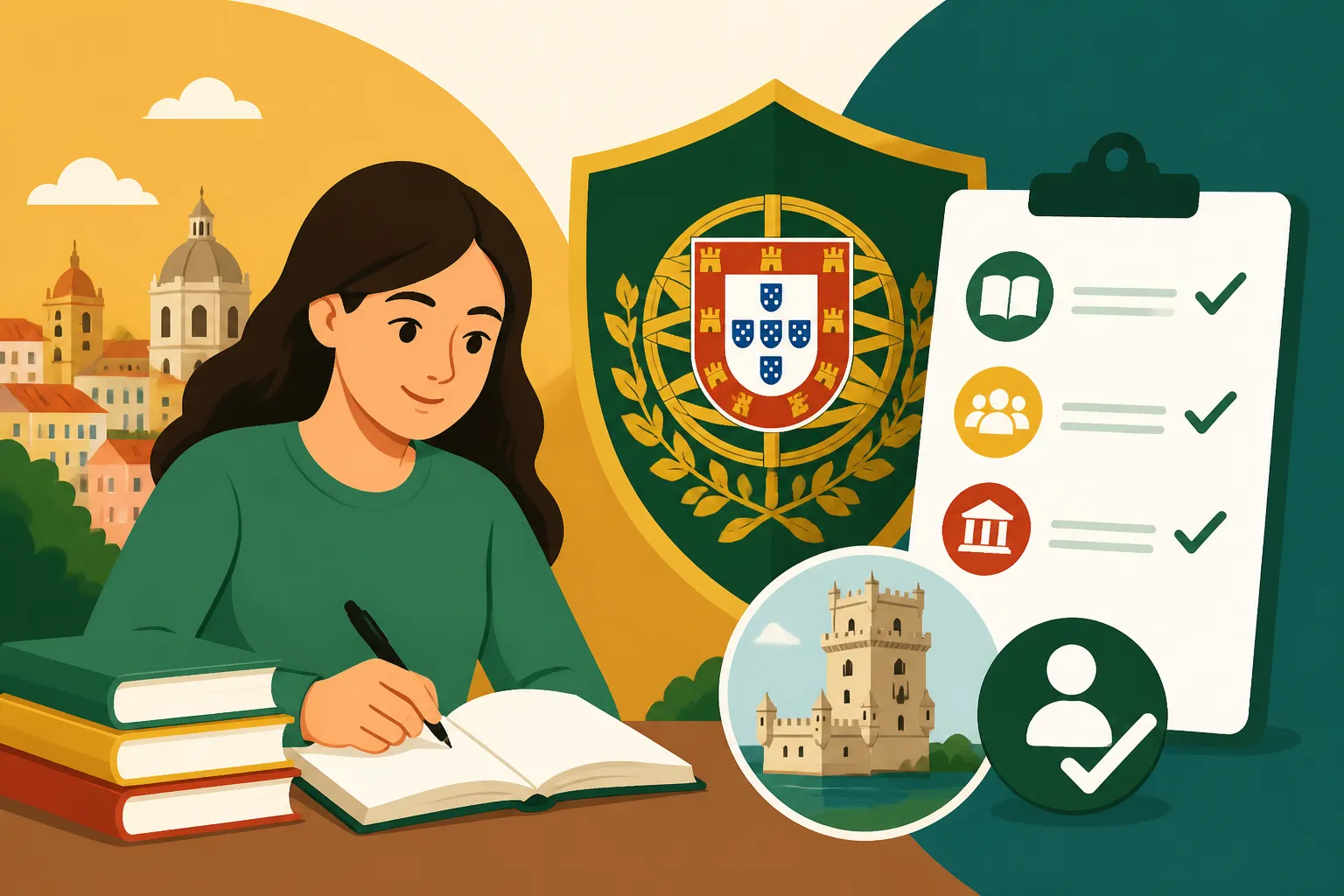
This is the part many people underestimate. The law now explicitly requires sufficient knowledge of Portuguese culture, history and national symbols, of the fundamental rights and duties of nationality, and of the political organisation of the state. You will need to show this knowledge in whatever format the IRN accepts, so study it with the same seriousness as your verbs.
Portuguese History, Culture and National Symbols
You don’t need to become a historian, but you should be comfortable with the broad story of the country and its symbols. Here is a solid study list:
- The founding of Portugal. Know the role of Afonso Henriques, the first king, and why Guimarães is called the “cradle of the nation.”
- The Age of Discoveries. Know who Vasco da Gama, Pedro Álvares Cabral and Infante D. Henrique (Henry the Navigator) were, and what the maritime expansion meant for the country.
- The dictatorship and the Carnation Revolution. Know what happened on 25 April, why it is a national holiday, and how it led to democracy.
- The national symbols. Learn the flag, with its green and red fields and the armillary sphere and shield, and the national anthem, “A Portuguesa.” Know what the main elements of each represent.
- Language and culture. Know about Luís de Camões and “Os Lusíadas,” Fernando Pessoa, fado as intangible cultural heritage, and the significance of 10 June, the Day of Portugal, Camões and the Portuguese Communities.
Learning this in Portuguese kills two birds with one stone. Read short history texts aimed at Portuguese schoolchildren, because they are written in simple language. Visit places like the Mosteiro dos Jerónimos in Belém, the Castelo de Guimarães or the Museu do Aljube in Lisbon, which focuses on resistance to the dictatorship, and read the information panels in Portuguese first. For more background, see History, Architecture, and Heritage in Portugal.
Rights, Duties and the Political Organisation of the State
The civic side asks you to understand how Portugal is governed and what being a citizen involves. Focus on these areas:
- The Constitution of the Portuguese Republic. Know that it is the supreme law, and understand the broad categories of fundamental rights it protects, such as equality, freedom of expression, religion and association, and the right to vote.
- The organs of sovereignty. These are the President of the Republic, the Assembleia da República (parliament), the Government led by the Prime Minister, and the courts. Know what each one broadly does.
- Elections. Understand the difference between presidential, legislative, local (autárquicas) and European elections, and who gets to vote in each.
- Local government. Know the layers you deal with as a resident: municípios with their câmaras municipais, and freguesias with their juntas de freguesia.
- The autonomous regions. Know that the Azores and Madeira have their own regional governments and legislative assemblies.
- Duties of citizens. These include respecting the Constitution and the law, paying taxes, and taking part in civic life.
The solemn declaration of adherence to the principles of the democratic rule of law will make much more sense once you understand these basics. It isn’t just a box to tick.
A practical tip: make flashcards in Portuguese with the institution on one side and a simple description on the other. For example, “Assembleia da República” on the front, and “o parlamento, faz as leis, os deputados são eleitos” on the back. Study them in short bursts on the metro or while waiting at the Loja do Cidadão.
Booking the Exam and What to Expect on the Day
Once your level is solid, the logistics are straightforward, but plan ahead. Exam sessions fill up, especially in Lisbon and Porto.
- Check the IRN’s current list of accepted tests and certificates for the language and civic-knowledge parts of your application.
- Find an authorised exam centre. For the CIPLE, this means checking the CAPLE network for an approved centre near you. Many language schools and universities around the country act as centres.
- Check the session calendar, registration deadlines and current fees on the official centre or CAPLE pages, and register early.
- Prepare the identification you will be asked for, usually your passport or residence card, and confirm the exact requirement with your centre.
- Do at least two full mock exams under timed conditions in the final weeks.
- Visit the exam location beforehand if you can, so you know the route and won’t arrive flustered.
- On the day, bring the identification and any confirmation your centre asks for, plus pens and water. Arrive early.
- After the exam, check with your centre for how and when results and certificates are issued. Keep the certificate safe, because you will submit it with your citizenship application.
If things don’t go to plan, don’t panic. What happens to your citizenship timeline if you fail the CIPLE A2 exam? covers your options.
Getting the Rest of Your Application Ready While You Study
Your study period is the perfect time to get the rest of your paperwork in order, so that the language and knowledge certificate isn’t the only thing standing between you and filing.
Civil documents. You will typically need a birth certificate from your home country, and possibly marriage or name-change documents. These usually need an apostille or consular legalisation and a certified Portuguese translation. Online certified translation services such as RushTranslate can handle the translation of documents like birth and marriage certificates. Check with the IRN whether a particular translation format, or certification inside Portugal, is required for your document type. Apostilles and Certified Translations for Portuguese Visas explains how apostilles and certified translations work in Portugal.
Tax number and address. Make sure your NIF records show your current Portuguese address. An outdated foreign address on your Finanças profile can cause headaches when official letters go missing. If you set up your NIF remotely through a service like Bordr when you first arrived, log into the Portal das Finanças and confirm the address was updated after you moved.
Continuous legal residence. Because only time under a valid residence title counts, keep your permit renewals on schedule. When a renewal asks for proof of health coverage, some residents use international expat insurers such as Cigna Global alongside or instead of SNS access, depending on their situation. Whichever route you choose, keep the policy documents and renewal confirmations organised. See How to Renew Your Portuguese Residence Permit for the renewal process.
Means of support. Gather recent payslips, pension statements, tax returns or bank statements showing you can support yourself, because the law lists this as a requirement.
Criminal record certificates. Expect to provide criminal records from Portugal and from the countries where you have lived. Some of these need apostilles and translations, so start early.
When everything is together, How to Apply for Portuguese Citizenship After Ten Years takes you through filing the application itself.
A Final Word of Encouragement
I won’t pretend this is effortless. There will be evenings when the verb “pôr” makes you want to throw your textbook into the Tejo. There will be days when a waiter in Porto answers your carefully prepared Portuguese in English. Remember why you are doing this. Every hour you invest pays off twice: once in the exam room, and every day after that in a country where you can finally understand the jokes, the news and your neighbours. The people I know who passed comfortably weren’t the most gifted linguists. They were simply the most consistent ones. Start this week, keep it small and keep it going.
Disclaimer
This article is for general informational purposes only and does not constitute professional advice. Laws, prices and regulations vary by location and change over time. Consult a qualified professional for guidance on your specific situation.