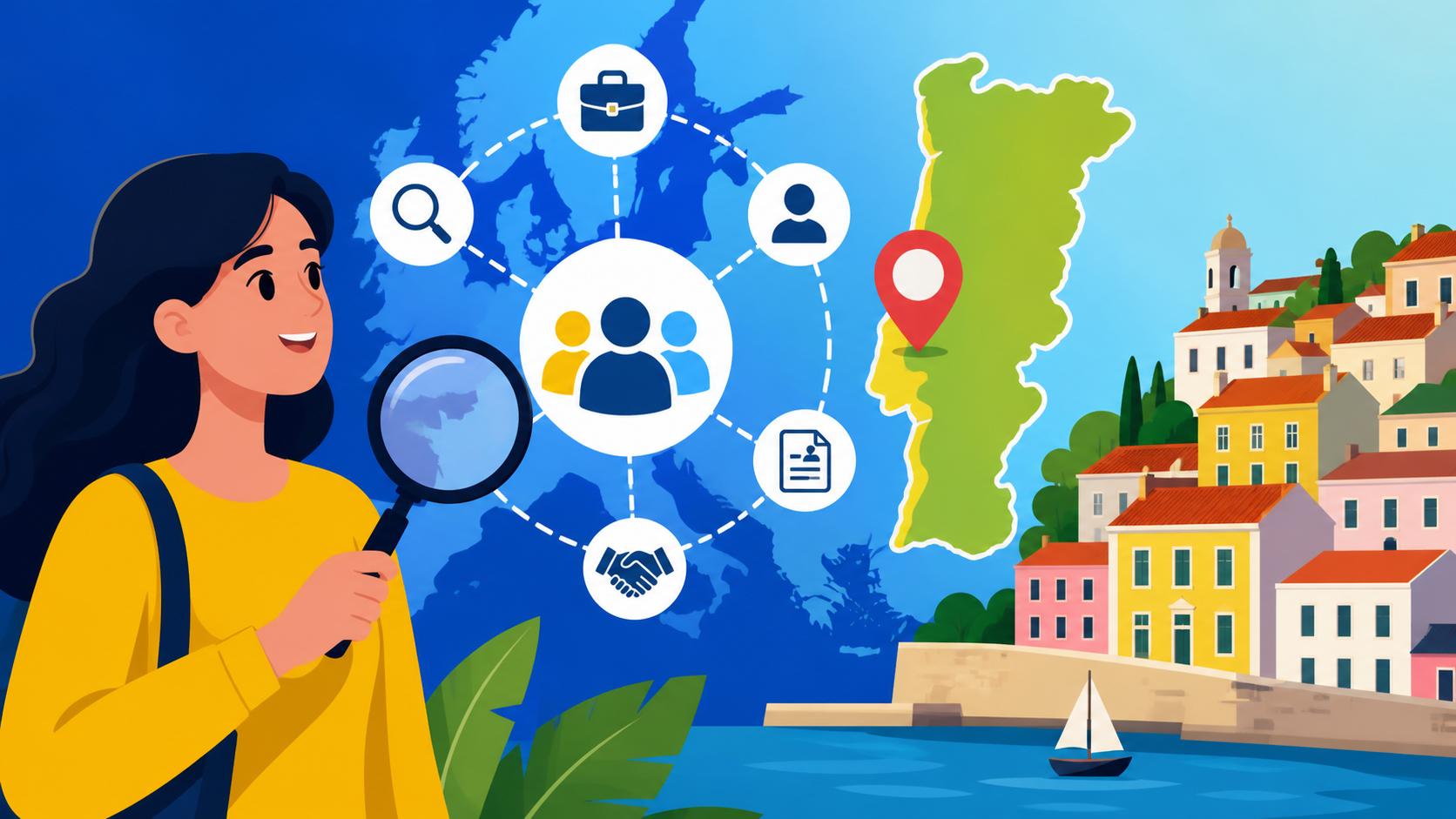
What is the “EURES” network and how can EU citizens use it to find jobs in Portugal?
Finding a job in a new country often feels like shouting into a void where your experience doesn't translate and the rules are hidden. I remember my first month in Lisbon, clutching a stack of resumes and realizing I didn't even know which portals the locals actually used. This guide demystifies the EURES network to help EU citizens secure legal, funded employment in Portugal.
Understanding EURES in the Portuguese Context
When you first start looking for work in Portugal, you will likely stumble upon a dozen different websites, most of them in Portuguese and many of them filled with low-quality listings. This is where EURES, or the European Employment Services, becomes your best friend. Established by the European Commission, EURES is designed specifically to facilitate the free movement of workers within the EU, EEA, and Switzerland. It isn't just a job board; it is a massive human network of advisors who are trained to help you bridge the gap between your home country and the Portuguese job market.
In Portugal, the EURES network works hand-in-hand with the IEFP (Instituto do Emprego e Formação Profissional). If you have been researching how things work here, you likely already know that the IEFP and Job Seekers: Registering for Unemployment and Support is a cornerstone of the local labor landscape. While the IEFP handles the domestic side, EURES handles the international integration. This means when a Portuguese company is struggling to find a specific specialist—say, a renewable energy engineer or a senior software developer—they often list that vacancy on EURES to attract talent from across Europe.
What I wish I had known earlier is that EURES advisors in Portugal are real people you can actually talk to. They aren't just faceless algorithms. You can reach out to a EURES advisor based in Lisbon, Porto, or even the Algarve to ask about the specific requirements for your industry. They can provide insights into which regions are currently hiring and whether your professional qualifications need a formal recognition process. This is particularly helpful because the Portuguese bureaucracy can be a maze, and having a "man on the inside" who understands both European standards and local quirks is an invaluable asset.
How EU Citizens Can Leverage EURES for a Portugal Move
If you are an EU citizen, you have the right to live and work in Portugal without a visa, but that doesn't mean the transition is seamless. EURES offers a specific program called the Target Mobility Scheme (TMS) which is arguably the best-kept secret in the European labor market. This scheme provides financial support for various stages of your job hunt. For example, if a company in Braga invites you for an in-person interview, you might be eligible for a travel allowance to cover your flights and accommodation.
Once you secure a job, the support doesn't stop there. The TMS can provide a relocation allowance to help with your initial moving costs. When I first moved, the "security deposit and first month's rent" hurdle was the biggest stressor. Having a few hundred euros from a mobility grant could have changed my entire experience. There are also allowances for language training. While many tech jobs in Lisbon are English-speaking, you will find that integrating into the office culture is much easier if you have basic language skills. Using a platform like PortuguesePod101 to get your foot in the door before you even arrive can make those first few "coffee breaks" at work much less awkward.
To get started, you need to create a profile on the EURES portal and upload your CV using the Europass format. However, don't just "set it and forget it." You should actively search for vacancies tagged with "Portugal" and pay close attention to The Portugal Job Market 2027: Skill Shortages and Most In-Demand Roles to see if your skills align with what the country actually needs. The portal allows you to see the "Living and Working" conditions for Portugal, which gives you a high-level overview of things like social security, healthcare, and education. It is a great starting point, but remember that the reality on the ground often involves more paperwork than the brochure suggests.
The Role of EURES Advisors
The human element of EURES is what sets it apart from LinkedIn or Indeed. In Portugal, EURES advisors are stationed at major IEFP offices. Their job is to act as matchmakers. They help Portuguese employers understand that hiring a German, Italian, or Pole isn't a "paperwork nightmare." For you, the job seeker, they can review your CV to ensure it matches Portuguese expectations. For instance, writing a CV for Portuguese Employers: Formats, Photos, and Cover Letters requires a specific tone—often more formal and detailed than what you might find in the UK or Scandinavia.
Advisors can also help you understand the nuances of Portuguese Work Culture: Hours, Communication, and Office Etiquette. One thing that shocks many newcomers is the hierarchy. Portugal still values titles and formal addresses. An advisor can coach you on how to handle an interview with a "Diretor" or "Engenheiro" without making a social faux pas. If you are nervous about these cultural nuances, spending some time on PortuguesePod101 to learn the correct formal greetings will go a long way in making a good first impression during those initial EURES-facilitated introductions.
| Service Type | What EURES Provides | Benefit for the Expat |
|---|---|---|
| Job Matching | Database of thousands of validated vacancies | Ensures you are applying to legitimate companies |
| Financial Aid | Target Mobility Scheme (TMS) grants | Covers interview travel and relocation costs |
| CV Support | Europass integration and advisor review | Makes your profile "readable" to Portuguese HR |
| Legal Advice | Information on social security and rights | Helps you understand Employment Rights in Portugal: Contracts, Leave, and Labor Laws |
| Language Grants | Funding for approved language courses | Offsets the cost of intensive Portuguese lessons |
Practical Realities and Pitfalls of Finding Work via EURES
Let's talk about the elephant in the room: salaries. While EURES listings are generally for high-value roles, Portugal's wages are lower than the EU average. You need to be very clear on minimum wage (€920) vs average salary: what to expect in Portugal before you sign a contract. Many expats get excited about a "European-scale" job title only to realize the take-home pay barely covers a T1 apartment in the center of Lisbon.
Another unique aspect you'll find in EURES contracts in Portugal is the "14-month salary" system. This isn't a bonus in the traditional sense; it is your annual salary divided into 14 payments instead of 12. You receive an extra month's pay in the summer (for holidays) and another in December (for Christmas). It sounds great, but it can make your monthly budget feel tighter than you expected. Make sure you understand how the 14-month pay structure works and how holiday bonuses are taxed so you aren't surprised when your first paycheck arrives.
Furthermore, many jobs listed on EURES for Portugal are located in the "Interior" (the countryside) or in smaller cities like Coimbra or Aveiro. While the cost of living there is much lower, the "expalt lifestyle" is very different from what you find in Lisbon. You won't find an English-speaking community on every corner. In these regions, being able to communicate is non-negotiable. If you're serious about taking a job outside the major hubs, you should be using PortuguesePod101 every single day to build your vocabulary. The EURES advisors will tell you the same: the job is yours because of your skills, but you will keep it because of your ability to integrate.
Preparing for the Interview and Beyond
Once EURES helps you find a lead, the real work begins. Portuguese interviews are often multi-staged. You might have a preliminary screening with a recruiter, followed by a technical test, and finally an interview with the department head. You should prepare by reading up on Job Interviews in Portugal: Common Questions and Professional Attire. Don't be surprised if the interview feels a bit "personal." Portuguese employers value "soft skills" and personality fit just as much as your degree. They want to know if you are someone they can have a long lunch with, as lunch is a sacred part of the Corporate Culture in Portugal: Hierarchy, Dress Code, and Meetings.
If you are successful, the EURES network can also help with the "aftercare." This includes registering for your NIF (tax number) and NISS (social security number). As an EU citizen, your residency process is simpler than for those on a D7 or D8 visa, but it still requires a trip to the local Camara Municipal to get your CRUE (Certificate of Registration for EU Citizen). EURES advisors can often provide the exact checklist for your specific municipality, saving you hours of searching through outdated government websites.
Finally, remember that learning Portuguese for career growth: certificates and business language is a lifelong journey. Even if you land a job in an international tech firm where the "official language" is English, the politics of the office, the jokes in the kitchen, and the negotiations with local vendors will all happen in Portuguese. Using tools like PortuguesePod101 allows you to bridge that gap. Being the "foreigner who actually tries to speak the language" will earn you more respect and job security than any certification ever could.
Disclaimer
This guide is provided for informational purposes only and does not constitute legal or professional career advice. While the EURES network is a government-backed initiative, the availability of grants, specific job requirements, and labor laws in Portugal are subject to change. Always verify current regulations with the IEFP or an official EURES advisor before making financial or relocation decisions.