The A2 Portuguese Language Test for Citizenship
If you have spent years in Portugal juggling renewals, AIMA queues and Finanças letters, the language requirement for citizenship can feel like one last hurdle with no clear map. This guide explains what the Portuguese language and civic knowledge requirement actually involves under the current nationality law, where the A2 exam fits, how to prepare, and how to keep your application clean.
What the Citizenship Language Requirement Actually Asks For Now
When I first started thinking about naturalisation, I assumed the language part was a box you ticked with one exam certificate and then forgot about. Many of us came to Portugal on a residence visa, slowly built a life, and only later began to see citizenship as a real possibility. The rules have since been rewritten, and the language requirement now sits inside a broader test of what the law calls integration.
So before you book anything or buy a single textbook, you need to understand exactly what the law asks you to prove. Get this part right and every later step becomes easier. Get it wrong and you could spend months preparing for an exam that covers only half of what you need.
The Legal Wording Behind the Test
The legal basis is Lei n.º 37/81, the Portuguese Nationality Law, as amended by Lei Orgânica n.º 1/2026. That amending law was published in the Diário da República on 18 May 2026 and came into force on 19 May 2026. Article 6, paragraph 1, sets out what an adult applying for naturalisation must show, and the language requirement is one part of that list.
The law now requires proof, by a test or certificate, of sufficient knowledge of the Portuguese language and of Portuguese culture, history and national symbols. That second half is what catches people off guard. Language and cultural knowledge are written into the same requirement, so being able to order a bica and chat to your neighbour about the weather is no longer the whole picture.
The law does not set the details of the test itself. Those come from the Regulamento da Nacionalidade, the regulation that puts the Nationality Law into practice, and the new law gave the government 90 days to amend it. This is why I keep telling friends not to rely on what worked for someone who applied years ago. The IRN (Instituto dos Registos e do Notariado) publishes the tests and certificates it accepts, and that list is the one that matters for your application.
Language Plus Culture, History, and Civic Knowledge
On top of the language and culture requirement, the same article requires sufficient knowledge of the fundamental rights and duties that come with Portuguese nationality, and of the political organisation of the Portuguese state. In plain terms, you are expected to understand how the Assembleia da República, the President, the Government and the courts relate to each other, and what being a citizen means in terms of rights and obligations.
The application also requires a solemn declaration of adherence to the fundamental principles of the democratic rule of law, and proof that you have the means to support yourself. Those two are not tested in a classroom, but they belong to the same package. Think of the language and civic knowledge requirement as the part you study for, and the declaration and means of support as the parts you document.
From a preparation point of view, this changes how you should plan. A pure language course will build your Portuguese, but it may not cover the founding of the nationality, the meaning of the flag and the national anthem, the 25 de Abril revolution, or how the Constitution organises power. I would build your study plan around both tracks from the start rather than bolting history on at the end.
Who Is Presumed to Meet the Language Part
Nationals of Portuguese-speaking countries, the CPLP states, are presumed to meet the language part of the requirement unless their lack of Portuguese is manifest. This is set out in Article 6, paragraph 10. If you are Brazilian, Angolan, Cape Verdean, Mozambican or from another CPLP country and you speak Portuguese as your everyday language, you generally will not need to prove it with a language certificate.
The word “manifest” matters. The presumption is not unconditional. Someone who holds a CPLP passport through a parent but grew up abroad speaking no Portuguese could still face questions if it is obvious they cannot use the language. If that describes you, talk to a professional before relying on the presumption.
Also keep in mind that the presumption covers the language part. The law also asks for knowledge of Portuguese culture, history, national symbols, rights and duties, and political organisation. How the regulation treats CPLP applicants on those points is something to confirm on the IRN’s current guidance, rather than assume.
Where the Language Test Fits in the 10-Year Citizenship Timeline
There is no point getting your language certificate in hand if your residence timeline is not where it needs to be. Many people rush to sit an exam early out of anxiety, only to realise their residence count was nowhere near ready. Let us place the language requirement inside the full naturalisation picture. For the bigger overview, see Portuguese Citizenship and Naturalization: The 10-Year Path Explained.
Residence Periods and How They Are Counted
As of October 2026, naturalisation requires at least 10 years of legal residence in Portugal. For EU citizens and nationals of CPLP countries, the requirement is 7 years. That is the headline number most people need to plan around, and it is why the language test is now usually a medium-term project rather than something you cram in your third year.
Only time spent legally resident in Portugal under a residence title, visa or permit counts towards that total. Time spent waiting for a decision on a residence permit application is not added to the count. If you arrived on a visa, then waited for AIMA to process your first residence card, check carefully which dates your documents actually cover.
This is one of the most emotionally painful parts of the process for people who lived through long backlogs. You were physically here, paying taxes, renting a flat, building a life, and yet the calendar for citizenship only runs from the dates covered by a valid title. Keep every visa page, residence card and renewal decision, because those dates are your evidence. For a detailed walkthrough of the calculation, see How to Count Residency Time Toward Portuguese Citizenship.
The Maximum Window Rule
Separate periods of legal residence, whether continuous or interrupted, are added together. That is good news for anyone who left Portugal for a period and came back. However, all of those periods must fall within a maximum window, and the size of that window depends on your nationality.
For EU citizens and CPLP nationals, the window is 9 years. For nationals of other countries, it is 12 years. For stateless persons, it is 6 years. So an American, British or Indian applicant needs their 10 years of legal residence to fit inside a 12-year span, while a French or Brazilian applicant needs their 7 years to fit inside a 9-year span.
Here is a practical example. Imagine a Canadian, call her Leah, who held residence for four years, spent two years back in Toronto caring for a parent, then returned and held residence again. Her separate periods can be added together, but they must all sit within a 12-year window. If her gap had been much longer, the earliest years could fall outside the window and stop counting. If you have any gap in your history, map it out on paper before you start language study.
| Applicant Group | Minimum Legal Residence | Maximum Window for Adding Periods | Language Part |
|---|---|---|---|
| Nationals of non-EU, non-CPLP countries | 10 years | 12 years | Proof by test or certificate |
| EU citizens | 7 years | 9 years | Proof by test or certificate |
| CPLP nationals | 7 years | 9 years | Presumed met unless lack of Portuguese is manifest |
| Stateless persons | Check with the IRN for your situation | 6 years | Proof by test or certificate |
Applications Filed Under the Previous Rules
There is a transitional rule. Applications filed on or before 18 May 2026 are decided under the previous rules, which required 5 years of legal residence. If you submitted before that date, your file is assessed under the regime in force when you filed.
For everyone filing on or after 19 May 2026, the current law applies, including the 10-year or 7-year requirement and the expanded knowledge requirement. If you are unsure which regime covers a file that was submitted by a lawyer or solicitor on your behalf, ask for the submission receipt and check the date.
The practical takeaway is that most people reading this today are planning under the current rules. If that is you, the language and civic knowledge requirement is something you can prepare for steadily over several years. That is actually a gift: you have time to learn the language properly rather than memorising answers. When you are ready to put the application together, see How to Apply for Portuguese Citizenship After Ten Years.
The CIPLE Exam and Other Proof of Portuguese
For years, the CIPLE was the exam most foreigners talked about in connection with citizenship. It still matters a great deal, but under the current law it has to be understood in context. The CIPLE is a language exam. The law asks for language plus culture, history, national symbols, rights and duties, and political organisation. Here is how to think about the options.
What CIPLE at A2 Level Tests
CIPLE stands for Certificado Inicial de Português Língua Estrangeira. It is the A2 level exam on the Common European Framework of Reference scale, and it is run through CAPLE, the assessment centre linked to the University of Lisbon. Exams are offered at authorised centres across Portugal and abroad, including universities, language schools and some Camões institutes. For more on the certificate family, see Portuguese Language Certificates (CIPLE and CAPLE).
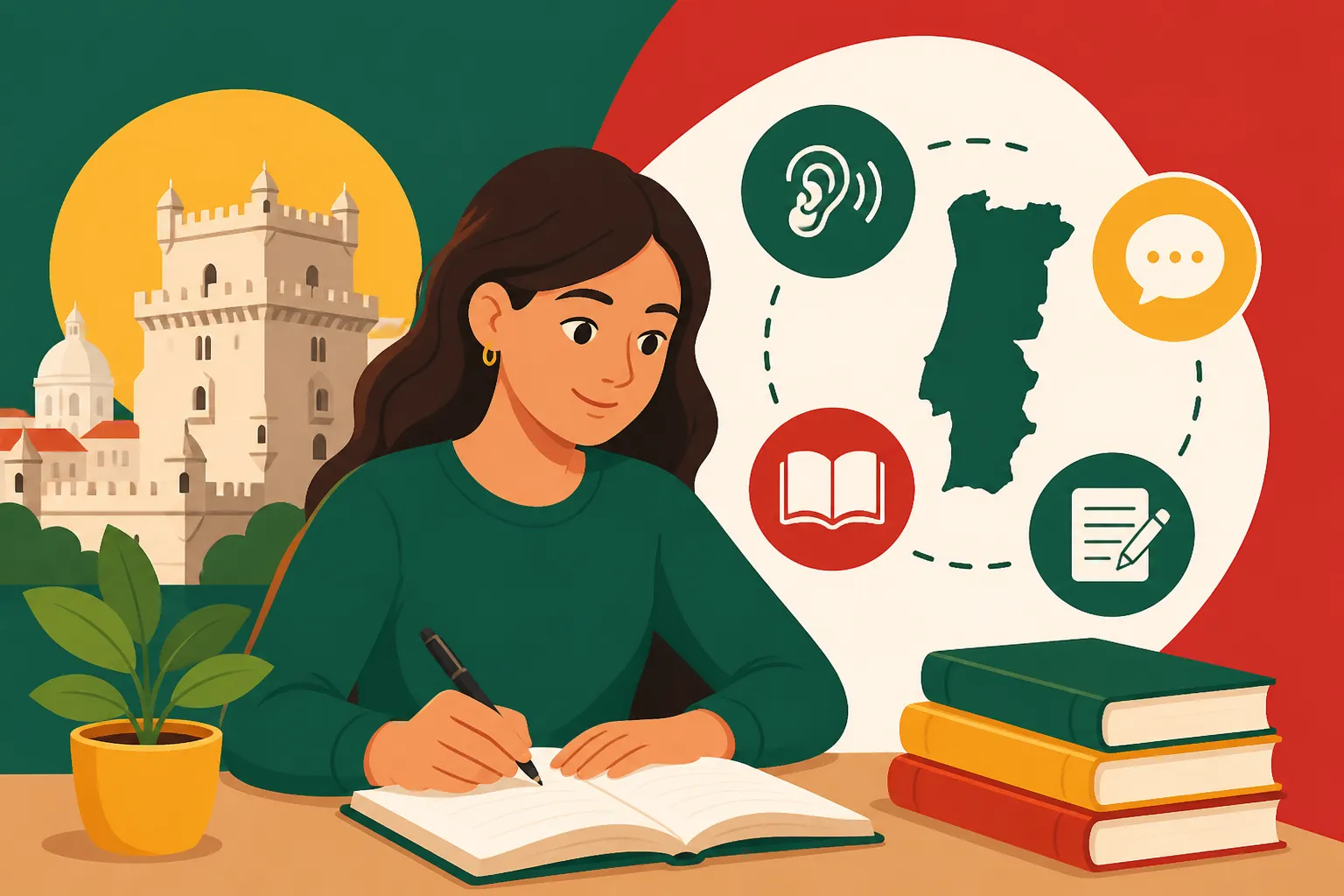
The exam assesses the four core skills: reading, writing, listening and speaking. Reading tasks typically involve short everyday texts such as notices, messages and simple articles. Writing involves short practical pieces, like an email to a friend or a note to a neighbour. Listening uses everyday audio like announcements and short conversations. Speaking is done face to face with examiners, usually in pairs.
A2 is a basic, functional level. You need to handle routine situations: introducing yourself, describing your home and family, talking about your daily routine, shopping, asking for directions and describing past events simply. You do not need to discuss politics in elegant subjunctive sentences. You do need to cope with European Portuguese at natural speed, which is the bit that trips up many learners who studied mainly with Brazilian materials. For the practical side of registering and sitting the exam, see How to Take the CIPLE Portuguese Exam.
Other Certificates and Course Routes
Historically, the IRN has accepted several types of proof beyond the CIPLE, such as certificates from Portuguese public schools showing successful study of Portuguese at an appropriate level, and completion of Português Língua de Acolhimento courses run through IEFP centres and partner schools. These routes have suited different people: the school certificate for those who studied in Portugal, and the PLA course for residents who preferred a classroom approach to an exam.
Under the current law, the question is not only whether a document proves A2 language skills, but whether it satisfies the full requirement covering culture, history, national symbols, rights and duties, and political organisation. The amended Regulamento da Nacionalidade decides which tests and certificates qualify and whether a separate civic knowledge test is needed.
| Route | What It Typically Demonstrates | Best Suited To | What to Confirm Before Relying on It |
|---|---|---|---|
| CIPLE exam through CAPLE | Portuguese at A2 level across reading, writing, listening and speaking | Self-directed learners who test well | Whether the IRN accepts it alone or alongside a separate civic test |
| Português Língua de Acolhimento course | Language learning in a classroom with an integration focus | Residents who want structure and a teacher | Whether the course certificate appears on the IRN’s current list |
| Certificate from Portuguese education | Formal study of Portuguese in the school system | People who studied in Portugal | Which level and type of certificate the IRN accepts |
| Civic and cultural knowledge assessment | Knowledge of culture, history, national symbols, rights, duties and state organisation | Every applicant who must prove the full requirement | The format and content set by the amended Regulamento da Nacionalidade |
Why You Must Check the IRN List Before Booking Anything
I cannot stress this enough. Before you pay for an exam session or enrol in a course specifically for citizenship purposes, check the IRN’s current list of accepted tests and certificates. The IRN is the body that receives and decides nationality applications, and its list reflects how the regulation is being applied.
This is not a bureaucratic formality. Picture someone who spent a winter evening each week in a private language school, sat an internal exam, and received a beautifully printed certificate, only to discover it was not on the accepted list. That person now has to sit a recognised exam anyway, losing months. Ten minutes on the IRN’s guidance can prevent that.
If you find the guidance hard to interpret, or your situation is unusual, consider getting professional help. For when a lawyer is worth it, see Hiring an Immigration Lawyer in Portugal: When Is It Actually Necessary?. For most straightforward cases, a careful read of the official list and a phone call or visit to an IRN service point is enough.
Preparing for the Language and Civic Knowledge Components
Now for the part where I can speak most from experience. Learning European Portuguese as an adult, while also working, raising kids or managing a renovation, is hard. The sounds are swallowed, the vowels disappear, and people in Lisbon speak at a speed that feels unfair. But A2 is genuinely reachable for almost anyone who studies consistently, and the civic knowledge side is very learnable once you organise it.
Building Real A2 European Portuguese
Start by committing to European Portuguese specifically. Brazilian materials are excellent and plentiful, but the pronunciation, some vocabulary and certain grammar habits differ. Using “você” constantly, or saying “ônibus” instead of “autocarro”, will not fail you on its own, but listening comprehension is where the gap shows. Train your ear on Portuguese radio such as RTP Antena 1, TV news, and everyday conversations at your local café and market.
Mix structured study with real life. Structure means a course book, a tutor or a class that moves you through grammar in a logical order: present tense, pretérito perfeito, imperfeito, reflexive verbs, prepositions, and the basic future and conditional forms. Real life means using what you learn: paying at the pastelaria in Portuguese, asking the pharmacist a question, chatting with the woman at the Junta de Freguesia. For app, tutor and free class options, see Learning European Portuguese: Top Apps, Tutors, and Free Government Classes.
If you prefer intensive study, many universities in Lisbon, Porto and Coimbra run Portuguese courses for foreigners, and private schools offer more flexible timetables. Intensive courses suit people who can carve out a few weeks or months and want fast progress. Weekly classes suit people building slowly alongside work. For a comparison, see Intensive Portuguese language courses for adults: University vs Private Schools.
Studying Portuguese History, Symbols, and Institutions
The civic knowledge side is where you can make quick, satisfying progress. Begin with a simple timeline: the founding of the kingdom and Afonso Henriques, the Age of Discoveries, the 1755 Lisbon earthquake, the end of the monarchy and the First Republic, the Estado Novo dictatorship, the Carnation Revolution of 25 April 1974, decolonisation, and Portugal joining what is now the European Union. You do not need an academic’s depth, but you should be able to explain why these moments matter.
National symbols are worth learning carefully. Understand the flag and the meaning of its colours and the armillary sphere, the national anthem “A Portuguesa”, and the significance of national days such as 10 de Junho, the Day of Portugal, Camões and the Portuguese Communities. Visiting places like the Mosteiro dos Jerónimos in Belém or the Castelo de Guimarães makes this stick far better than flashcards alone.
For political organisation and rights and duties, focus on the Constitution of the Portuguese Republic: the President as head of state, the Assembleia da República as parliament, the Government led by the Prime Minister, the courts, and local government through municipalities and freguesias. Then look at fundamental rights such as freedom of expression and religion, and duties such as respecting the law and contributing through taxes. Reading simple Portuguese-language explainers serves double duty, because you build vocabulary and civic knowledge at once.
A Realistic Study Plan for Busy Adults
Here is a plan I would give a friend who works full time and has a few years of residence still ahead. Adjust the pace to your starting point.
- Assess your level honestly using a placement test from a language school or a free online CEFR self-assessment, and note which skill is weakest.
- Choose one structured resource, such as a European Portuguese course book, a weekly class or a regular tutor, and stick to it rather than jumping between apps.
- Schedule short daily practice, even fifteen to twenty minutes, focusing on listening to European Portuguese audio.
- Add one weekly speaking session with a tutor, conversation partner or language exchange, because speaking is the skill most people neglect.
- Start a civic knowledge notebook in Portuguese, adding one historical event, symbol or institution each week with a short summary in your own words.
- Once your course feels comfortable, practise with past or sample exam papers from the official provider of whichever test you plan to take.
- Check the IRN’s current list of accepted tests and certificates, then confirm the format of any civic knowledge assessment.
- Book your exam or assessment at an authorised centre, leaving enough buffer to resit if needed before your planned application.
- Keep your certificate and results in a safe place with your residence documents, ready for the application.
The key is consistency over intensity. Often, people who studied for twenty minutes a day for a year outperform people who crammed for a month. Your brain needs time to absorb those swallowed vowels.
Exam Day and the Paperwork Afterwards
Passing the test is a milestone, but it is not the finish line. The certificate has to fit into a complete, consistent application file. This is where expats who were brilliant students sometimes stumble, because the paperwork side has its own traps.
What Exam Day Feels Like
Arrive early. Exam centres usually check identity documents carefully, so bring the same passport or residence card you used when registering. Names must match exactly. If your registration shows a name with or without accents, middle names, or a different order from your passport, sort it out with the centre in advance rather than on the morning.
The written components tend to run in one block, with listening played through speakers in the room. This is where nerves can hit hard, especially if the acoustics are poor. My advice is to read the questions before the audio starts, focus on keywords, and accept that you will not catch every word. A2 tasks are designed so that understanding the gist and key details is enough.
The oral component is usually the most stressful for adults, but it is often the most forgiving. Examiners are trained to put candidates at ease. If you freeze, it is perfectly fine to say “Desculpe, pode repetir, por favor?” Speaking in short, simple, correct sentences beats attempting complex ones and getting lost. Talk about real things in your life: your neighbourhood, your work, your weekend.
Turning Your Certificate Into a Clean Application
Once you have your language and civic knowledge proof, it joins the rest of your nationality file. That typically includes a birth certificate, criminal record certificates from your country of origin and from countries where you lived, evidence of your legal residence periods, proof of means of support, and the solemn declaration of adherence to the principles of the democratic rule of law. The exact list comes from the IRN.
Foreign documents usually need an apostille or legalisation, and documents not in Portuguese need a translation accepted by the Portuguese authorities. Requirements vary by document, so check what the IRN expects. Some applicants use an online certified translation service such as RushTranslate for foreign birth or criminal record certificates, but always confirm the translation format will be accepted in Portugal before ordering, because Portuguese rules on certification can differ from those elsewhere. For a deeper look, see Apostilles and Certified Translations for Portuguese Visas.
Also tidy up your tax and identity records. Many long-term residents first got their NIF remotely, sometimes through a service like Bordr, with a fiscal representative and a foreign address on file. By the time you apply for nationality, your Finanças record should show your Portuguese address and reflect your current status. Inconsistencies between your address on your residence card, your tax record and your application are a classic source of delays.
Keeping Your Residence Record Unbroken
The language test is something you control. The residence count is something you must protect. Because only time under a valid residence title counts, every renewal matters. Missing a renewal window, letting a card lapse without a documented renewal in progress, or spending long periods abroad can affect your count. For renewal steps, see How to Renew Your Portuguese Residence Permit.
Renewals often require proof of ongoing means of support, accommodation and, depending on your permit type, health coverage. Some residents who are not yet fully settled in the SNS keep an international plan such as Cigna Global during their early years, which can also help them feel secure while travelling. Whatever you choose, make sure your coverage meets the specific requirement of your permit type when you renew, and check the provider’s own pages for current plan details.
Many residents also consider permanent residence along the way, which has its own language requirement and benefits. If that is on your radar, see From Residency to Permanent Residence in Portugal. Some people find it reassuring to secure permanent residence while still building years towards citizenship.
Common Scenarios and Frustrations Answered
No guide is complete without addressing the real-life situations that keep people up at night. These are the questions I hear most often from friends, neighbours and readers who are partway through the journey.
What If You Fail the Exam
First, breathe. Failing a language exam is common, especially on a first attempt, and it does not affect your residence count or your eligibility in any permanent way. Exams are offered in multiple sessions, so you can usually resit. Check the provider’s current calendar and registration rules rather than relying on memory.
Treat a fail as diagnostic information. Results normally show which components were weakest. If listening let you down, spend a few weeks on Portuguese radio and podcasts. If writing was the issue, practise short emails and messages with a tutor who corrects your grammar. If you froze in the oral, book mock interviews. For more on what a fail means for your plans, see What happens to your citizenship timeline if you fail the CIPLE A2 exam?.
The best protection is planning. Because the residence requirement now spans 10 years for most applicants, or 7 for EU and CPLP nationals, you can sit your language assessment well before your residence count is complete. That leaves room for a resit without delaying your application, provided your certificate is still accepted when you file. Check whether the IRN applies any validity rules to the proof you submit.
Couples and Families on Different Timelines
It is common for partners to arrive at different times or under different permits. One may have come first on a work visa, with the other following through family reunification months later. Each person’s residence count is individual, so each must calculate their own dates and maximum window.
Languages develop differently, too. Perhaps one partner works in a Portuguese-speaking office and picks up the language naturally, while the other works remotely in English and barely uses Portuguese. Be honest and supportive with each other. The partner who is further behind may benefit from a structured course, while the stronger speaker can help with daily practice at home.
Mixed-nationality couples need extra care. If one partner is an EU or CPLP national, their residence requirement is 7 years with a 9-year window, while a non-EU, non-CPLP partner needs 10 years within 12 years. A CPLP partner may also be presumed to meet the language part, while the other must prove it. Write down each person’s requirements separately so you do not accidentally plan around the wrong numbers.
Long-Term Residents Who Feel Stuck
Some of the most frustrated people I meet have lived here a long time but struggle with formal study. Maybe they arrived in later life, have never sat an exam in a second language, or simply find the classroom intimidating. If that is you, please know that A2 is a basic level and many people in exactly your situation have passed with steady, patient practice.
Start with what you already know. You probably handle dozens of Portuguese interactions a week without noticing: greetings, café orders, supermarket chats, bus announcements. Build from there. A tutor who adapts lessons to your real life, focusing on your neighbourhood, your hobbies and your routines, can make learning feel natural rather than academic.
For the civic knowledge side, lean on lived experience. You may have watched election coverage, stood in a crowd on 25 de Abril, or seen the Santos Populares in your street. Connect those memories to the history and institutions you are learning about, and the material becomes personal rather than abstract. That, more than anything, is what the requirement is trying to measure: whether you understand the country you have chosen to call home.
Disclaimer
This article is for general informational purposes only and does not constitute professional advice. Laws, prices and regulations vary by location and change over time. Consult a qualified professional for guidance on your specific situation.