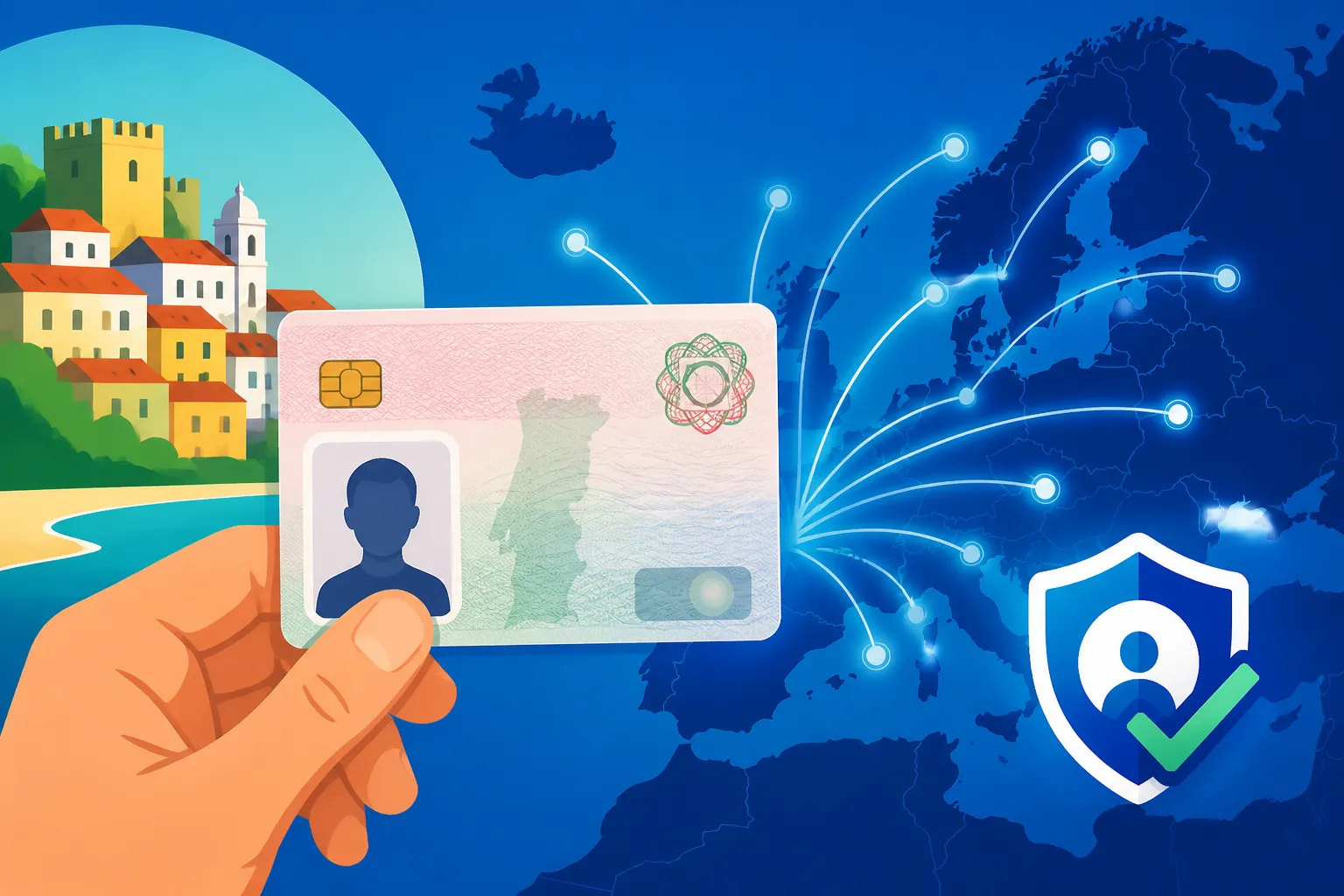
Using your Portuguese residence card as a valid ID across the European Union
You land in Seville or Milan for a long weekend, hand your shiny Portuguese residence card to the hotel receptionist or the airline gate agent, and get told politely, “Passport, please.” That moment frustrates a lot of foreign residents. This guide explains where your Título de Residência works as ID across the EU, where it does not, and how to travel without surprises.
What Your Portuguese Residence Card Actually Is
When I finally collected my card after months of waiting on AIMA, I treated it like a golden ticket. In Portugal it is close to one. Outside Portugal it has a much narrower job.
A Residence Permit, Not a National ID or Passport
Your Título de Residência proves that Portugal has authorised you to live in the country. It is a residence document. It is not a national identity card like the Portuguese Cartão de Cidadão, and it is not a travel document like a passport.
That distinction drives almost everything else in this guide. EU citizens can often cross borders and board flights with only their national ID card, because EU law recognises those cards as identity and travel documents. Your residence card has no such status. It confirms your right to live in Portugal and, inside the Schengen Area, your right to make short visits to other member states. It always works alongside your passport, never in place of it.
If you are an EU citizen with a CRUE registration certificate, the same logic applies in a different form. The certificate proves you registered your residence in Portugal. Your national ID card or passport remains your identity document when you travel.
Where the Card Works as ID Inside Portugal
At home, the card does a lot of heavy lifting. I have used mine at bank branches, the Loja do Cidadão, the Junta de Freguesia, notaries, pharmacies collecting prescriptions, and CTT counters when picking up registered post. Landlords, employers and mobile operators generally accept it as your primary identification.
Portuguese law expects people to be able to identify themselves to the authorities, so carrying the card day to day is sensible. If the PSP or GNR stop you at a checkpoint on the A2 heading to the Algarve, the residence card is what they expect to see from a foreign resident.
A practical tip: some institutions also want to see your passport the first time you open an account or sign a contract, because the passport number is printed on other records. Keep a clear scan of both documents on your phone for these moments.
What Changes the Moment You Cross a Border
Once you leave Portugal, your card stops being a standalone ID. Spanish, French or Italian officials, hotels and businesses look at it as a foreign residence permit. It explains why you are allowed to be in their country without a visa, but your identity is established by your passport.
For the full picture of short trips across the zone, see Traveling in the Schengen Area with a Portuguese Residence Permit.
Real-World Scenarios Across the EU
This is where theory meets the airport queue. Here are the situations expat friends and I have run into most often.
Flights Within Europe
Imagine you are flying from Porto to Paris on a budget airline. You have checked in on the app and you reach the gate with only your residence card because your passport is in the safe at home. In most cases, you will not board.
Airlines set their own identity rules, and the large carriers serving Lisbon, Porto and Faro generally accept national ID cards only from EU and EEA citizens. Non-EU nationals are asked for a valid passport, even on routes inside Schengen where there is no passport control on arrival. The residence card helps prove you do not need a visa, but the airline still wants the passport.
Leaving through Lisbon’s Humberto Delgado airport toward a non-Schengen destination adds a border check, where you show both documents. For the automated gates, see Using the E-gates at Lisbon airport with a temporary residence permit card.
Road and Rail Trips to Spain and Beyond
Driving from Elvas into Badajoz, or taking the train toward Vigo, feels borderless. There is usually no fixed checkpoint, so it is tempting to leave the passport behind. Do not.
Spanish Guardia Civil and French Gendarmerie run random checks near border zones, especially on motorways and international buses. If stopped, you need to show your passport and residence card together. Without the passport you can be held while your identity is verified, which can ruin a weekend.
If your card has not been issued yet, the situation is more delicate. See Traveling to Spain from Portugal by car while your visa is still processing and Can I leave Portugal to visit France while waiting for my first AIMA card? before you plan anything.
Hotels, Car Rentals and Everyday Transactions
Across much of the EU, hotels must record guest identity details for the police. Spain is especially strict. Receptionists in Madrid, Rome or Brussels usually ask non-EU guests for a passport, because that is the document their registration systems are built around.
Car rental desks in Málaga or Nice almost always want your passport plus your driving licence. Some also ask for the residence card to confirm your address. Pharmacies, banks and post offices abroad generally ask for a passport too when ID is required.
Here is a quick summary of what tends to work in practice:
| Situation | Residence Card Alone | Passport Plus Residence Card |
|---|---|---|
| Opening a bank account in Portugal | Usually accepted | Sometimes requested together |
| Police check inside Portugal | Accepted | Accepted |
| Boarding a flight within Schengen | Generally refused for non-EU nationals | Accepted |
| Random border check in Spain or France | Not enough | Accepted |
| Hotel check-in elsewhere in the EU | Often refused | Accepted |
| Renting a car in another EU country | Usually refused | Accepted with licence |
| Entering a non-Schengen EU country | Does not grant visa-free entry by itself | Depends on that country’s own rules |
That last row matters. Not every EU country is in Schengen. Ireland runs its own immigration system, and your Portuguese card does not automatically give you the same rights there. Before booking anywhere, confirm whether the destination is a full Schengen member and what it requires from your nationality.
Staying Legal: The Rules That Catch Residents Out
The card gives you real freedom, but it comes with limits that are easy to overlook in the excitement of being able to wander Europe.
The 90 in 180 Days Rule Still Applies
A Portuguese residence permit lets you spend up to 90 days in any 180-day period in other Schengen countries. Those days are counted across all of them combined, not per country. A long summer in Italy followed by a Christmas trip to Germany can add up faster than you think.
Living in Portugal does not count toward that limit, but time spent elsewhere does. If you are a digital nomad who likes month-long stays in Berlin or Barcelona, keep a simple log of entry and exit dates.
Also remember the short-stay right is for visits. It does not let you move, work, or study in another member state. Doing any of those requires that country’s own permission.
Expired, Lost or Damaged Cards
Portugal extended the domestic validity of expired residence documents for several years while AIMA worked through renewals, but those automatic extensions ended on 15 October 2025. Even while they ran, they were Portuguese measures that other countries’ border guards and airline staff were not bound to accept.
If your card has expired and you are waiting on renewal, think very carefully before any trip involving a connection or border check elsewhere. The scenario is covered in Can I fly through Frankfurt if my Portuguese residence permit is currently expired?, and renewal steps are in How to Renew Your Portuguese Residence Permit Online via the AIMA Portal.
If your card is stolen on a trip, report it to the local police and keep the report. The document will be in Spanish, French or Italian, and AIMA may need a certified Portuguese or English version. RushTranslate is one option residents use for certified translations of foreign police reports. The broader rules are in Translating and Certifying Documents for Portuguese Immigration, and the steps back home are in What to do immediately if you lose your Portuguese Residence Card.
When Your Details Do Not Match
A mismatch between your passport and your residence card can cause real trouble at a border. This happens when someone gets a new passport with a different number, or changes their name after marriage.
Officials compare the two documents, and inconsistencies lead to questions, delays, and sometimes refusal. If your name changed, update your card before travelling where possible; see Name changes after marriage: Updating your Portuguese residence card. If you renewed your passport, carry the old one along with the new one until AIMA records reflect the change.
Moving house inside Portugal also means updating several records. Your address sits on your Finanças profile, your SNS registration and your AIMA file. Services like Bordr help with the tax-number side of the paperwork, but the residence card update is still something you handle with AIMA.
A Practical Travel Checklist for Residence Card Holders
After several years of hopping between Lisbon, Madrid and a few too many Ryanair gates, this is the routine I follow.
Before You Leave Portugal
- Check that your passport is valid for the whole trip, with spare validity on top.
- Check the expiry date on your residence card and confirm it covers your return date.
- Confirm your destination is a full Schengen member and that your nationality does not need a separate visa there.
- Count your days spent in other Schengen countries over the past 180 days.
- Make sure the name and passport details on your card match your current passport.
- Save photos of both documents in a secure cloud folder and email them to yourself.
What to Carry and How to Store It
- Keep your passport and residence card together in an inside pocket or a zipped bag, never in a back pocket.
- Leave a photocopy of both at your accommodation, separate from the originals.
- Bring your Portuguese driving licence or exchanged licence if you plan to rent a car.
- Carry proof of your Portuguese address, such as a utility bill on your phone, in case a border officer asks about your residence.
- Keep the AIMA renewal receipt with you if your card is in the renewal process, while accepting that foreign authorities may not recognise it.
Health and Insurance While Travelling
Your residence card does not prove you have medical coverage abroad. If you rely on the Portuguese public system, ask Segurança Social whether you can be issued a European Health Insurance Card, since eligibility depends on your situation. Many non-EU residents keep international private cover instead. Cigna Global is a common choice among expats who travel across Europe regularly, but check the policy wording to confirm it covers trips outside Portugal and what you must do to claim.
Before any trip, look up the emergency number for your destination, keep your insurance policy number saved on your phone, and know whether your insurer needs to be contacted before treatment.
With your passport in one hand and your residence card in the other, the whole Schengen Area opens up. The card on its own will carry you through daily life in Portugal. Across the border, think of it as the supporting document, and you will rarely be caught out at a hotel desk or boarding gate.
Disclaimer
This article is for general informational purposes only and does not constitute professional advice. Laws, prices and regulations vary by location and change over time. Consult a qualified professional for guidance on your specific situation.